















The economic relationship between China and Iran represents one of the most significant challenges to international sanctions enforcement and regional security in the modern era. As the United States and its allies work to constrain Iran’s nuclear program and regional destabilization efforts, China has emerged as Tehran’s most critical economic partner, providing an essential revenue stream that directly finances Iran’s military apparatus and nuclear ambitions. This comprehensive analysis examines the complex web of Chinese companies, financial institutions, and government entities that facilitate Iran’s sanctions evasion while exploring the dramatic growth in bilateral oil trade that has made China indispensable to Iran’s survival.
The Escalating Scale of China-Iran Oil Commerce
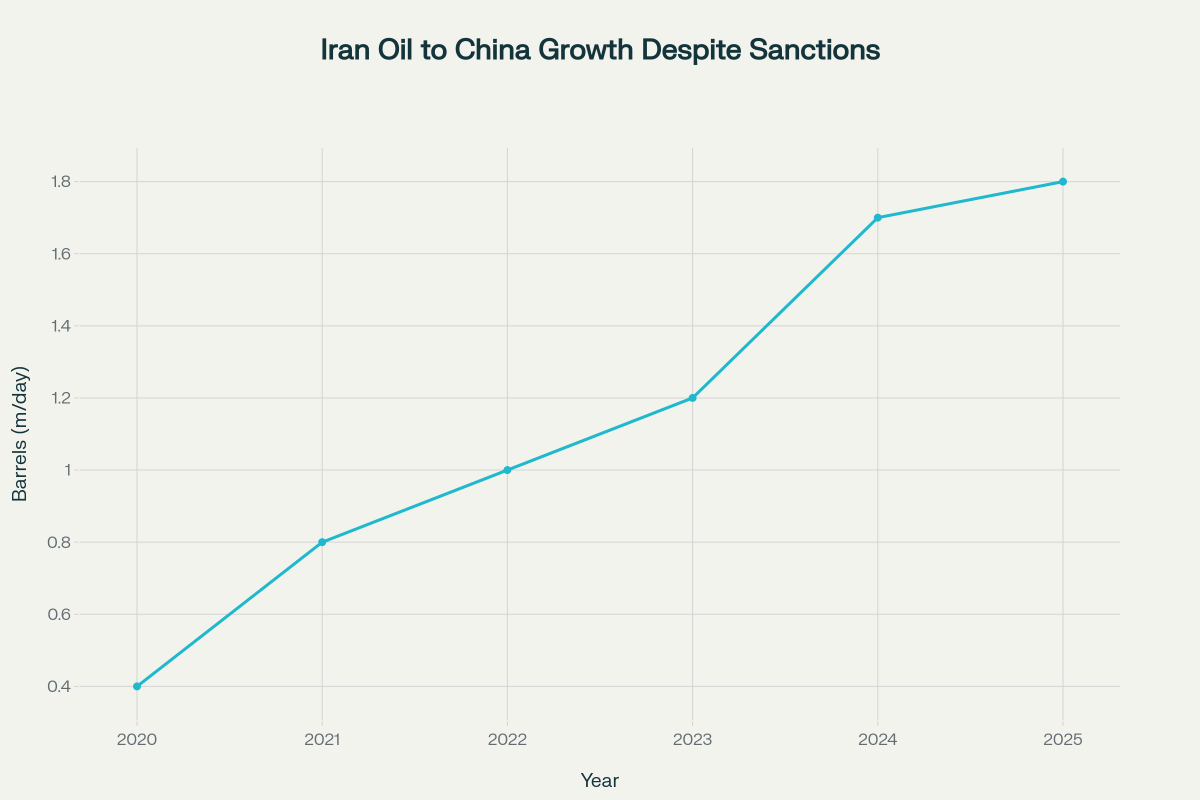
Iran’s Oil Exports to China Have Quadrupled Since 2020 Despite US Sanctions
The magnitude of China’s oil imports from Iran has reached unprecedented levels, fundamentally altering the geopolitical landscape of energy markets and sanctions enforcement. Recent data reveals that Chinese imports of Iranian crude oil have experienced explosive growth, increasing from a modest 400,000 barrels per day in 2020 to approximately 1.8 million barrels per day by 2025[1][2]. This dramatic expansion represents a more than four-fold increase in just five years, occurring despite the reimposition of comprehensive U.S. sanctions on Iran’s energy sector.
The financial implications of this trade relationship are staggering. Iran’s oil revenues from Chinese purchases have grown from $8 billion in 2020 to an estimated $65 billion in 2025, providing Tehran with a crucial source of hard currency that enables continued investment in military capabilities and nuclear infrastructure[3]. China now accounts for approximately 95% of Iran’s total oil exports, making Beijing not merely a customer but the sole lifeline for Iran’s energy-dependent economy[4][5].
This dependency relationship has granted China significant leverage in pricing negotiations, though Iran has gradually reduced the discounts it offers to Chinese buyers as Beijing’s reliance on Iranian crude has deepened. The transformation of this commercial relationship reflects broader shifts in global energy markets and demonstrates how sanctions can inadvertently create new power dynamics between nations.
Iran’s Military Budget: The Oil Revenue Connection
Perhaps the most concerning aspect of the China-Iran oil trade lies in its direct connection to Tehran’s military expenditure and weapons programs. Iran’s 2025 national budget reveals a fundamental restructuring of military financing, with oil revenues now comprising over half of the country’s defense spending[6][7].
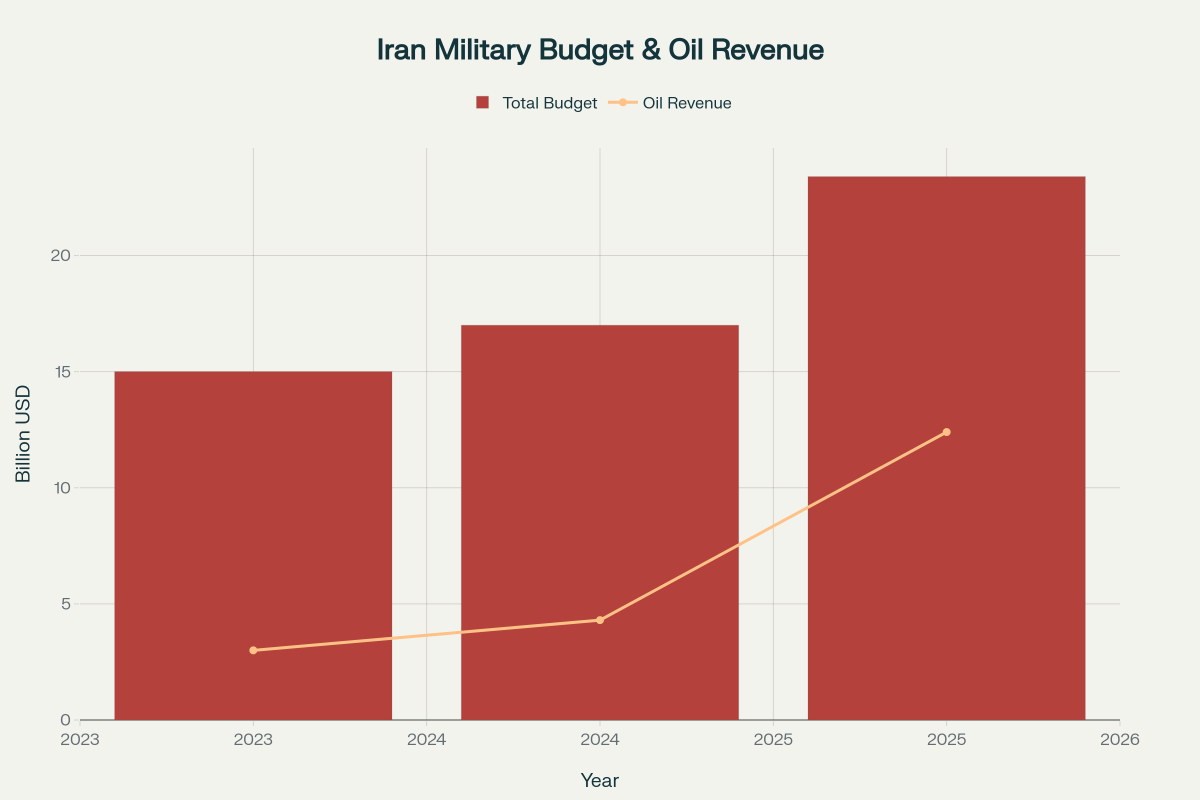
Iran’s Military Budget Shows Dramatic Increase in Oil Revenue Dependency
The data shows a dramatic escalation in oil revenue allocation to Iran’s military forces. In 2023, oil sales contributed $3 billion to a total military budget of $15 billion, representing 20% of defense funding. By 2025, this figure has skyrocketed to $12.4 billion out of a $23.4 billion total military budget, constituting 53% of all defense spending[8]. This represents not merely an increase in absolute terms but a fundamental shift in how Iran finances its military capabilities.
The Islamic Revolutionary Guard Corps (IRGC), designated as a terrorist organization by the United States, has expanded its control over Iran’s oil sector dramatically. Intelligence assessments indicate that the IRGC now controls approximately 50% of Iran’s oil exports, up from 20% just three years ago[9][10]. This expansion grants the IRGC direct access to billions in revenue that can be used to fund proxy forces throughout the Middle East, develop ballistic missile programs, and advance nuclear research.
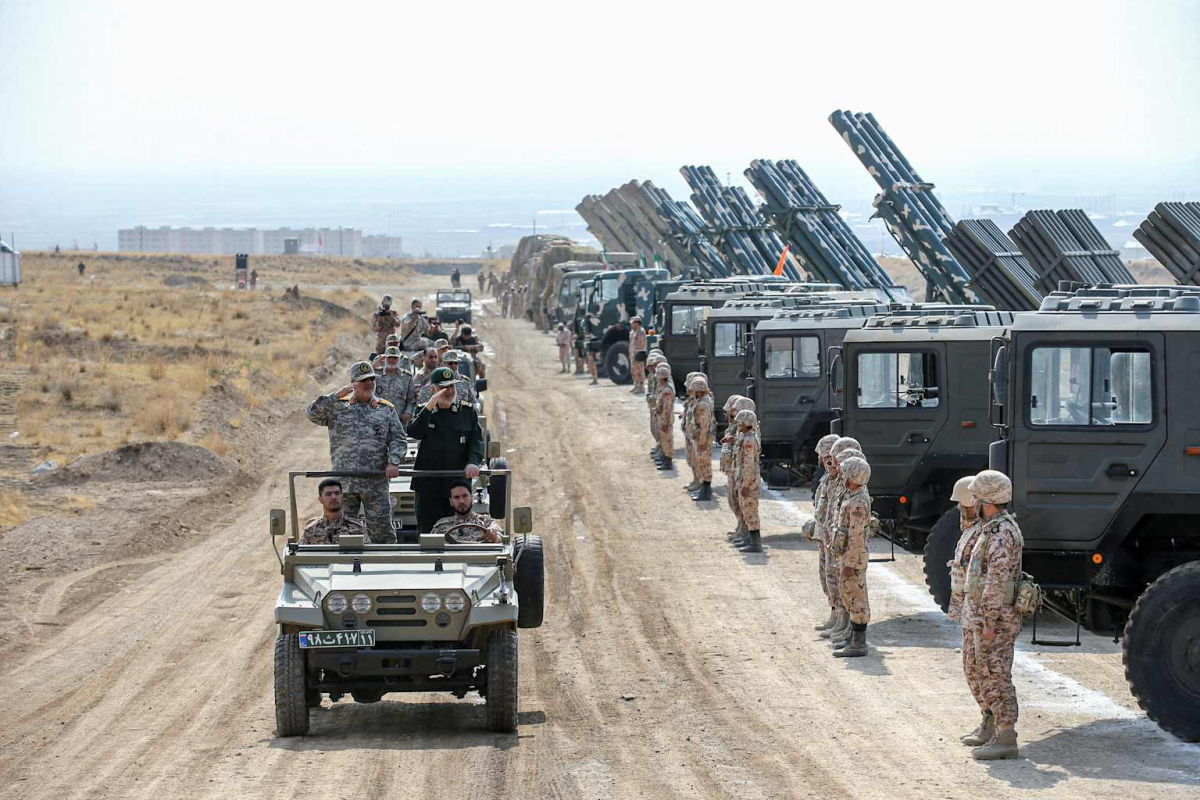
Iranian Revolutionary Guard Corps military parade showcasing rocket launchers and troops, highlighting the IRGC’s military strength linked to oil revenue funding.
The budgetary documents reveal that Iran allocates oil directly to military forces rather than providing cash payments. This system, described as paying the military in crude oil, allows for less transparent financing of classified defense projects and provides the IRGC with an independent revenue stream that operates outside traditional government oversight[7]. The oil is then sold on international markets, primarily to China, generating funds that flow directly to military operations.
The Chinese Teapot Refinery Network: Sanctions Evasion Infrastructure
The backbone of China’s Iranian oil import system consists of independent refineries known as “teapots,” which have emerged as the primary purchasers of sanctioned Iranian crude. These small to medium-sized refineries, concentrated primarily in Shandong Province, operate with greater independence from Chinese state oversight than major state-owned refiners, making them ideal vehicles for handling sanctioned oil[11][12].
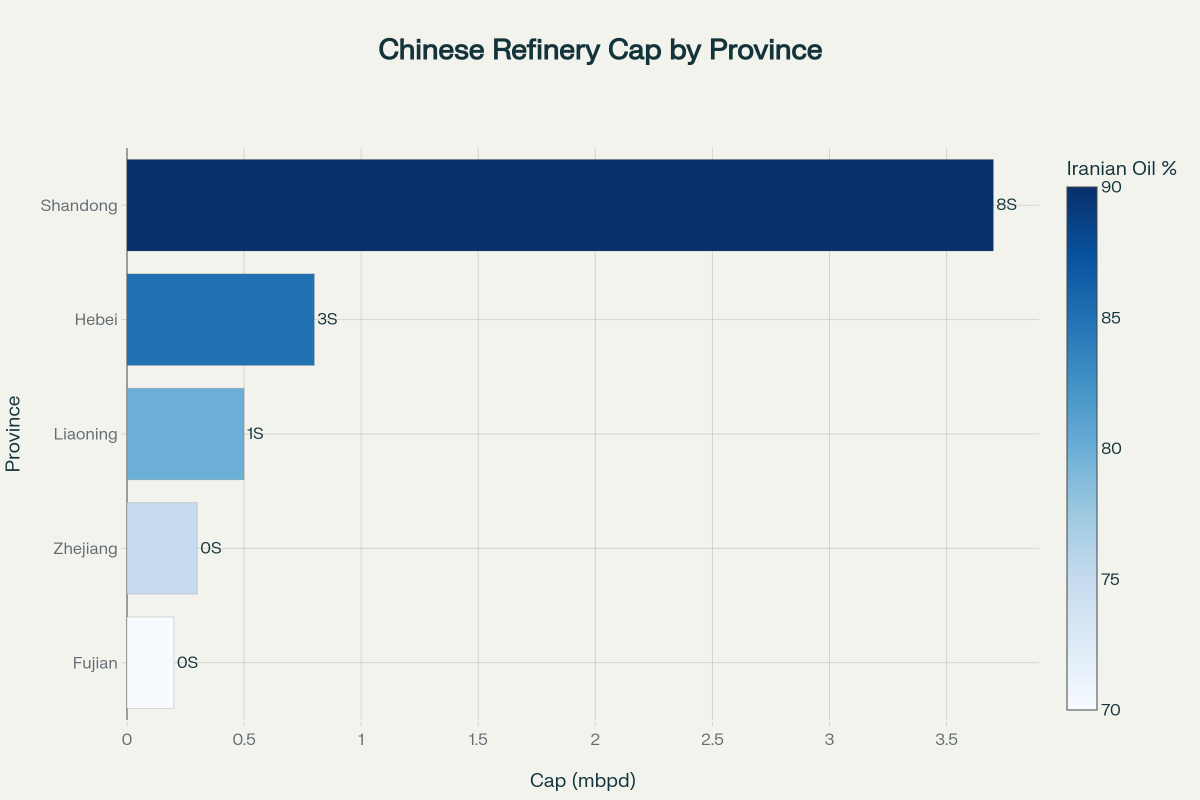
Shandong Province Dominates Chinese Teapot Refinery Operations and US Sanctions Targeting
Shandong Province dominates this network, housing 45 teapot refineries with a combined capacity of 3.7 million barrels per day, representing approximately 20% of China’s total refining capacity[13][14]. These facilities process roughly 90% Iranian crude, making them almost entirely dependent on sanctioned oil for their operations. The concentration of these refineries in a single province creates a geographic hub for Iran’s oil trade with China, facilitating coordination and reducing the complexity of sanctions evasion.
The economic model underlying teapot operations depends heavily on the significant discounts available on Iranian crude. These refineries have historically purchased Iranian oil at discounts of $10-15 per barrel below market rates, enabling profitable operations despite the risks associated with sanctions violations[15][16]. However, as China’s dependency on Iranian oil has increased, these discounts have narrowed considerably.
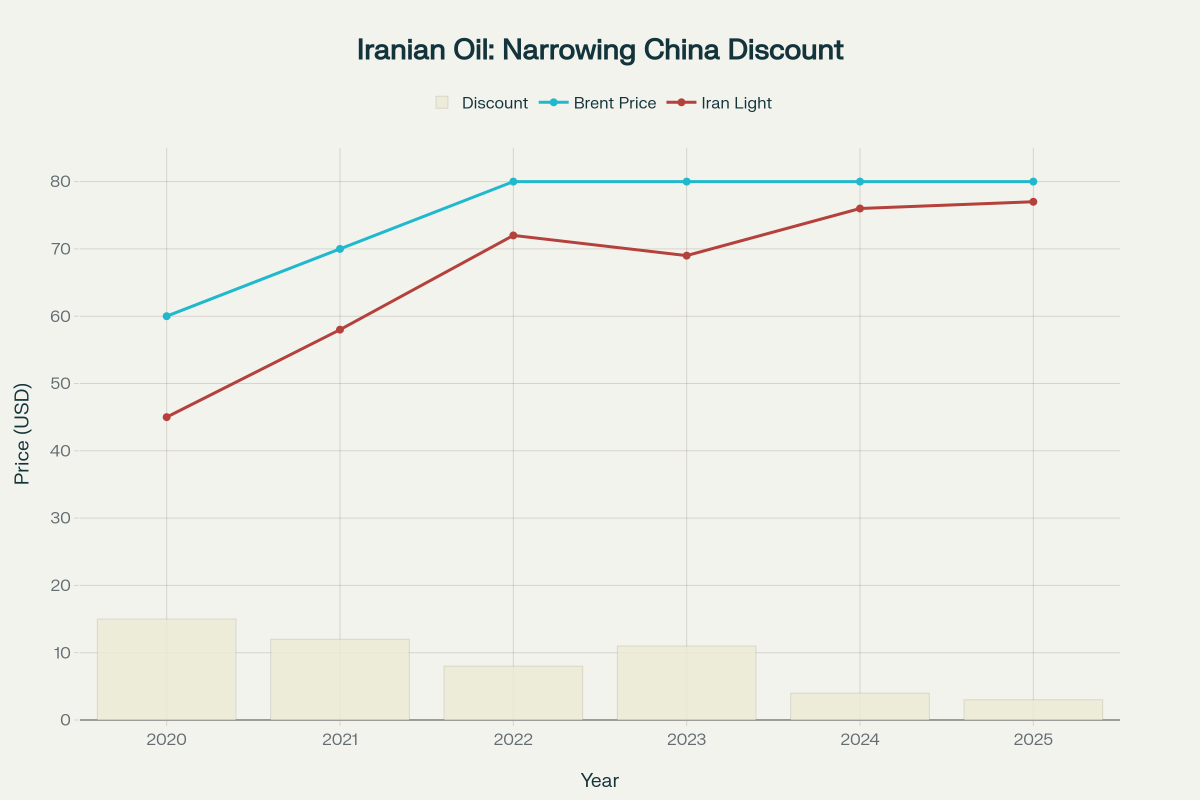
Iranian Oil Discounts to China Have Dramatically Narrowed from $15 to $3 Per Barrel
The pricing data reveals a dramatic shift in Iran’s bargaining power with Chinese buyers. In 2020, Iranian Light crude traded at a $15 discount to Brent crude, but by 2025, this discount had narrowed to just $3 per barrel[15][17]. This price convergence reflects Iran’s increased confidence in Chinese demand and Beijing’s willingness to pay higher prices to secure energy supplies.
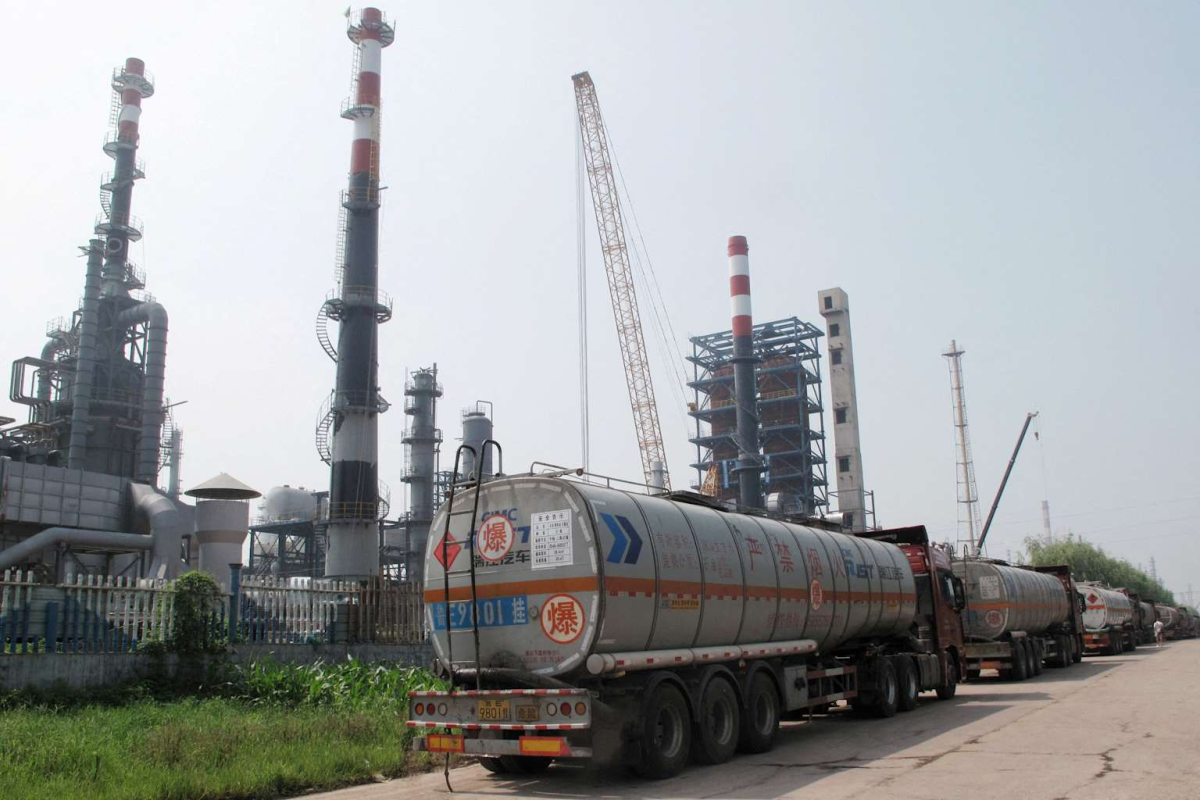
Tankers lined up outside a large oil refinery complex in China, illustrating the scale of the country’s oil transport and refining infrastructure.
The Shadow Fleet: Maritime Sanctions Evasion Operations
Iran’s ability to deliver oil to China despite international sanctions relies heavily on a sophisticated “shadow fleet” of tankers that operate outside normal maritime regulations. This fleet, comprising an estimated 400-600 vessels, employs various techniques to obscure the origin and destination of Iranian crude oil shipments[18][19].
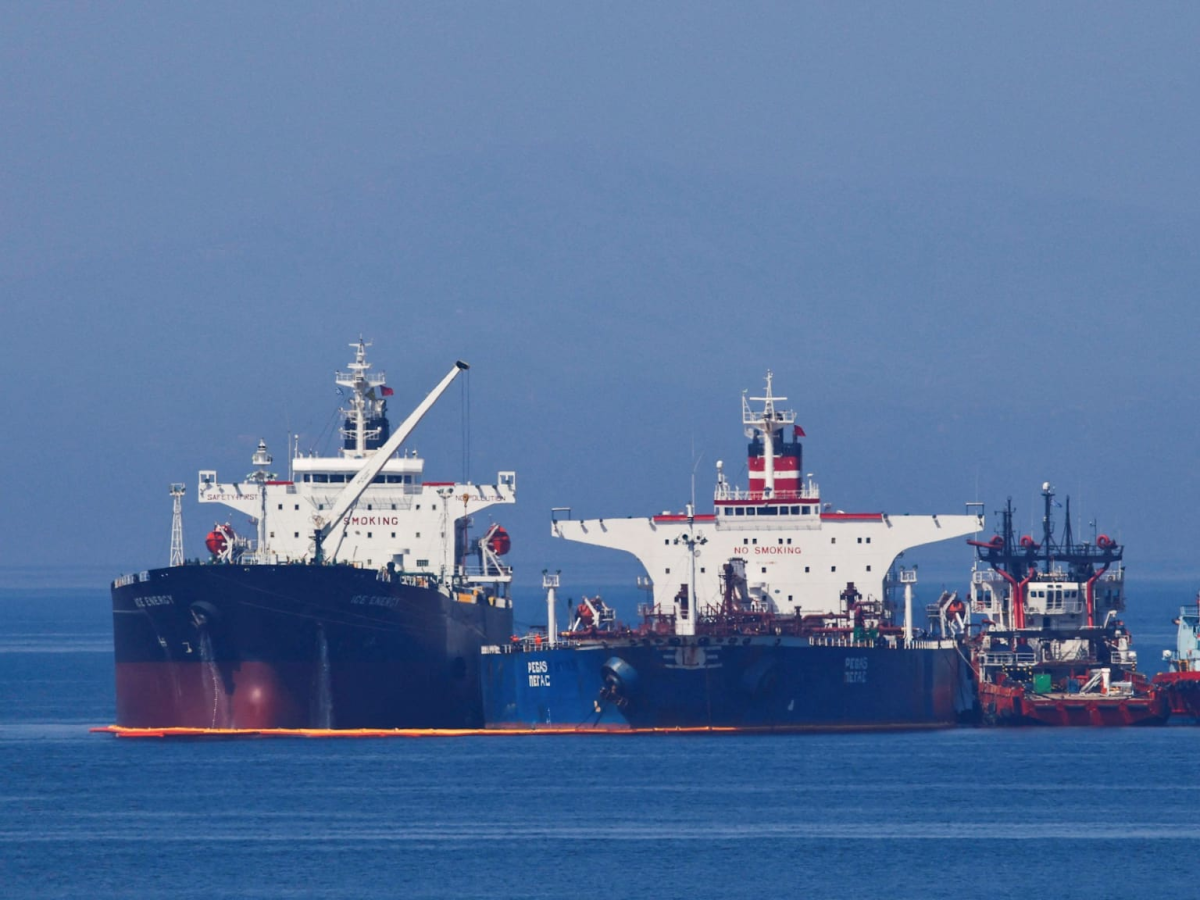
Chinese oil tanker ships involved in maritime oil transport and potential sanctions evasion operations.
The shadow fleet operates through several key mechanisms designed to evade detection and sanctions enforcement. Ships frequently disable their Automatic Identification System (AIS) transponders, effectively disappearing from maritime tracking systems during critical portions of their voyages. They engage in ship-to-ship transfers in international waters, allowing Iranian crude to be transferred to vessels with different documentation and ostensibly different origins[20][18].
Documentation fraud represents another critical component of shadow fleet operations. Iranian oil is routinely rebranded as Malaysian, Omani, or other non-sanctioned crude through falsified bills of lading and customs documents. This practice, known as “blending” or “washing” oil, allows sanctioned crude to enter legitimate supply chains with apparent legal provenance[21][13].
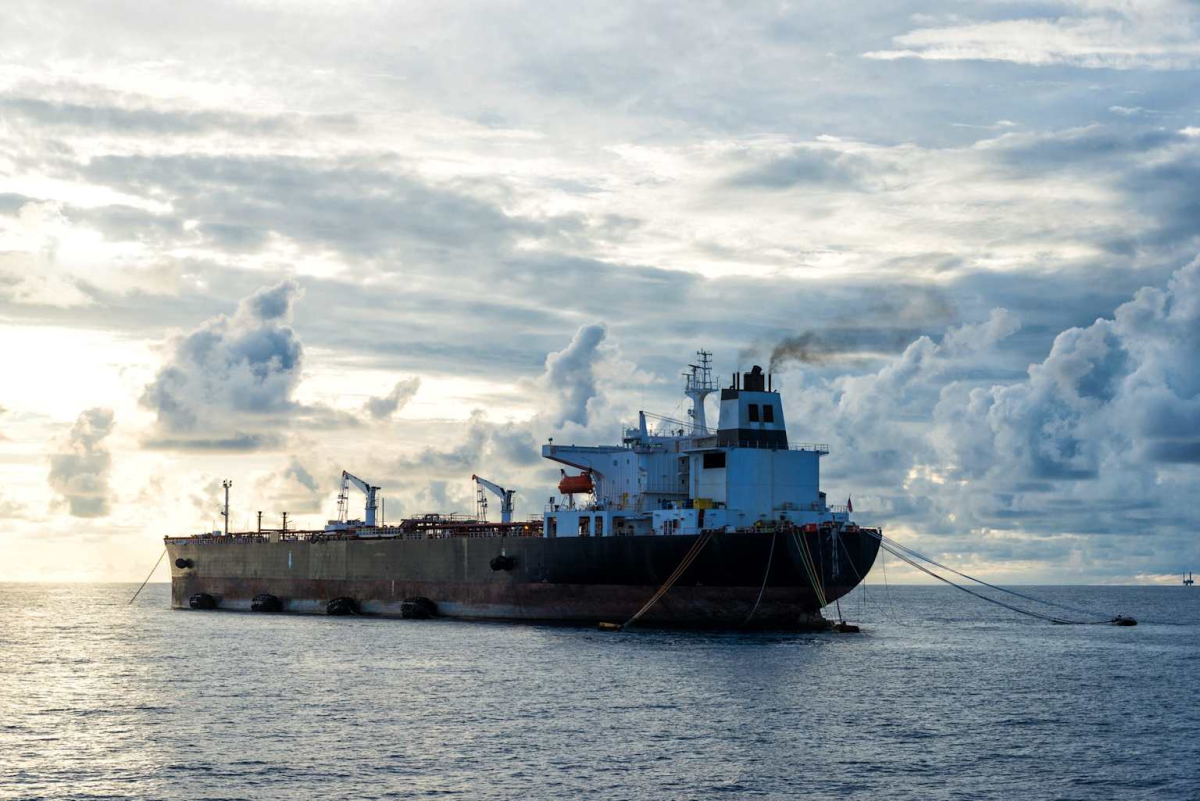
A Chinese oil tanker ship anchored at sea, symbolizing the shadow fleet involved in Iran’s sanctioned oil exports.
The financial scale of shadow fleet operations is enormous. In 2024, Iran exported approximately 1.7 million barrels per day through these clandestine channels, generating over $50 billion in annual revenue[18]. The majority of these shipments reach China, where they are processed by teapot refineries that have become expert at handling oil with questionable provenance.
Critical Infrastructure: Iran’s Export Terminals and China’s Import Facilities
The physical infrastructure supporting the China-Iran oil trade reveals the industrial scale and strategic importance of this relationship. Iran’s primary export terminal at Kharg Island serves as the launching point for the majority of crude shipments to China[20].
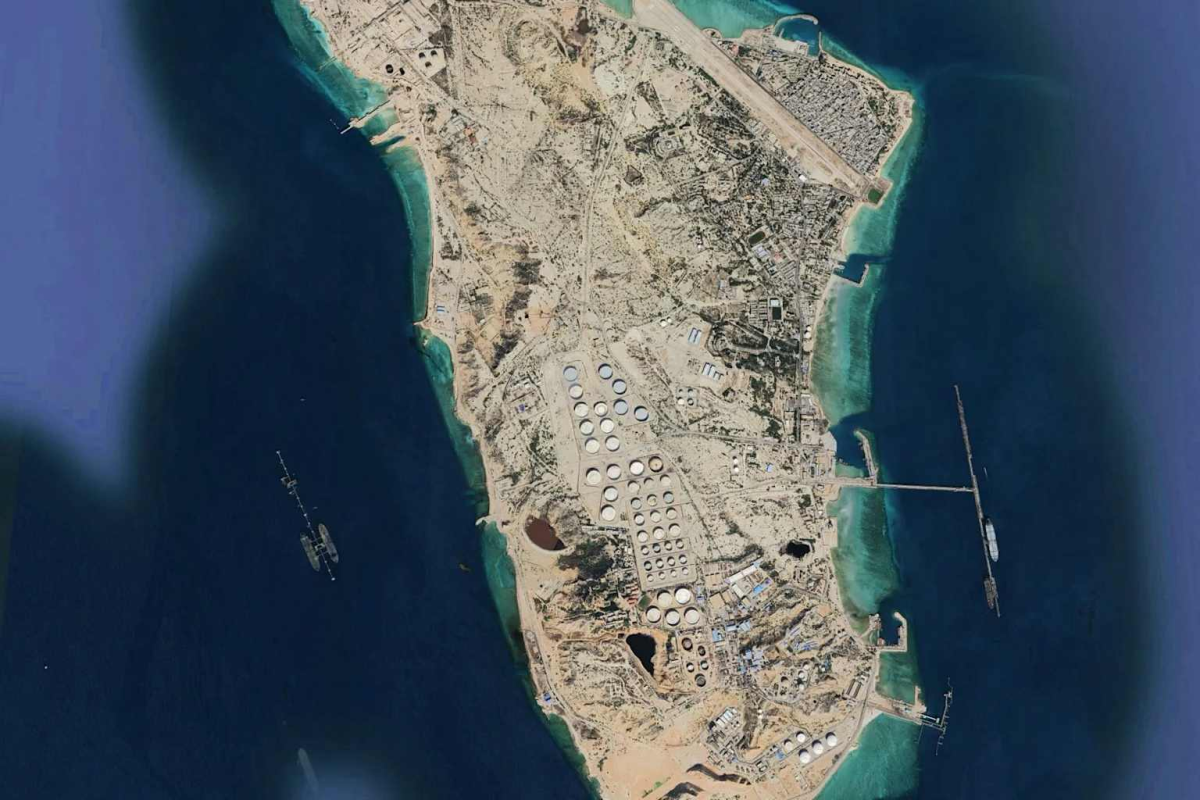
Satellite view of Kharg Island, Iran’s key oil export terminal in the Persian Gulf, showing extensive oil storage and port infrastructure.
Kharg Island’s strategic significance cannot be overstated. This facility, located approximately 30 kilometers off Iran’s coast in the Persian Gulf, handles the bulk of Iran’s crude oil exports through an extensive network of loading terminals, storage tanks, and pipeline infrastructure. The island’s continued operation despite regional tensions and the threat of military action demonstrates Iran’s commitment to maintaining oil export capabilities at all costs.
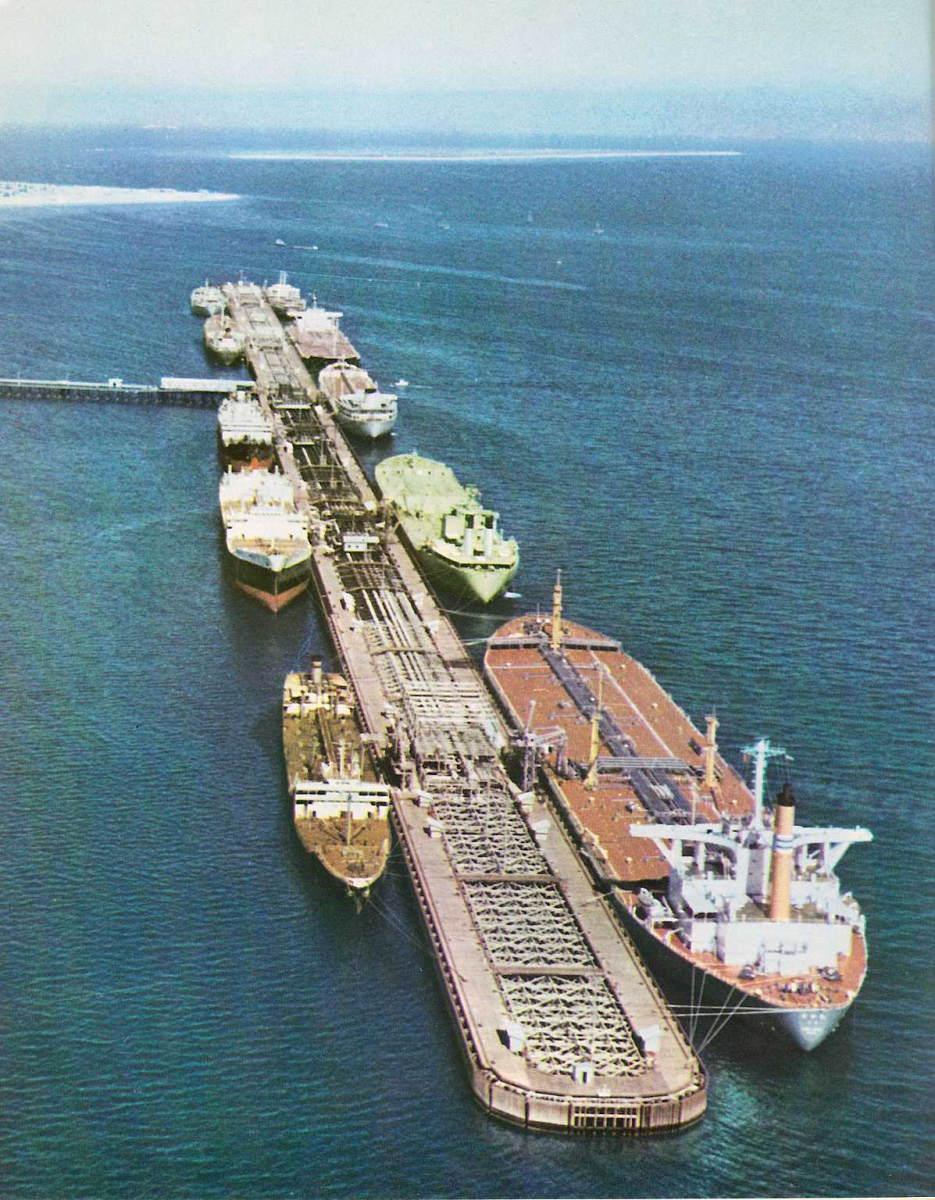
Aerial view of Kharg Island oil loading terminal in the Persian Gulf showing multiple oil tankers docked for crude oil export.
On the receiving end, Chinese port infrastructure has been specifically adapted to handle sanctioned Iranian crude. Major terminals in Shandong Province, including facilities at Qingdao, Rizhao, and Yantai, have become specialized hubs for Iranian oil imports[22][23]. These ports operate sophisticated systems for handling shadow fleet vessels and managing oil with complex documentation histories.
However, recent U.S. sanctions targeting Chinese port operators have forced adaptations in this system. In January 2025, Shandong Port Group issued a directive banning U.S.-sanctioned vessels from its facilities, forcing Iranian oil traders to seek alternative discharge points[22][24]. This development has led to the emergence of new import hubs in southern China, including ports in Zhejiang Province and private terminals that can operate with greater flexibility than state-controlled facilities.
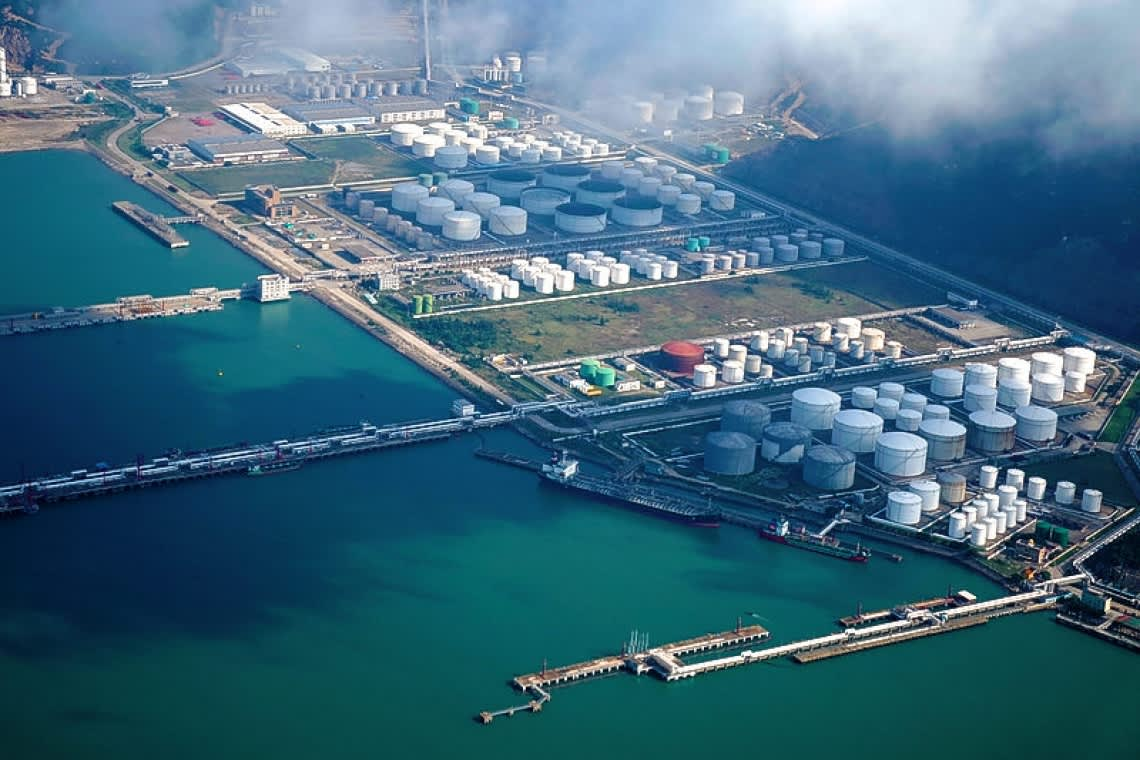
Aerial view of Chinese port oil storage tanks and terminal infrastructure involved in handling large volumes of imported crude oil, including from Iran.
Corporate Networks and Financial Flows
The China-Iran oil trade operates through complex corporate networks that obscure beneficial ownership and facilitate sanctions evasion. While specific company names and individual identities require careful verification, the structural characteristics of these networks are well-documented by sanctions enforcement agencies and intelligence services.
Chinese entities involved in Iranian oil trade typically operate through multiple layers of shell companies and front organizations designed to complicate sanctions enforcement. These networks often include:
Independent Refineries: Small to medium-sized processing facilities that purchase Iranian crude directly or through intermediaries, often paying in Chinese yuan to avoid dollar-denominated transactions that would trigger U.S. sanctions.
Shipping Companies: Entities that own or operate vessels in Iran’s shadow fleet, frequently changing vessel names, flags, and documentation to evade detection.
Trading Companies: Intermediaries that facilitate transactions between Iranian sellers and Chinese buyers, often handling documentation and payment processing through non-U.S. financial systems.
Port Terminal Operators: Companies that control loading and discharge facilities, enabling the physical handling of sanctioned oil shipments.
Financial Institutions: Banks and payment processors that facilitate yuan-denominated transactions outside the U.S. financial system.
The interconnected nature of these networks creates redundancy and resilience against sanctions enforcement. When one entity is designated, transactions can quickly shift to alternative companies within the same broader network[25][26].
U.S. Sanctions Response and Enforcement Challenges
The United States has dramatically escalated its sanctions enforcement efforts targeting the China-Iran oil trade since early 2025. Under President Trump’s renewed “maximum pressure” campaign, the U.S. Treasury Department has imposed sanctions in six major rounds, targeting Chinese companies, port terminals, and shadow fleet vessels[27][28].
The sanctions data reveals the scope and intensity of U.S. enforcement efforts. Since February 2025, Washington has sanctioned 3 Chinese refining companies, 55 tanker vessels, and 3 port terminal operators specifically for their involvement in Iranian oil trade[29][30][31]. These designations represent an unprecedented direct targeting of Chinese commercial entities for sanctions violations.
The impact of these sanctions on Chinese teapot refineries has been significant but not decisive. Several sanctioned refineries have halted Iranian crude purchases, at least temporarily, and larger independent refiners have become more cautious about engaging in transactions that could expose them to U.S. sanctions[32][33]. However, the overall flow of Iranian oil to China has declined only modestly, from a peak of 1.8 million barrels per day to approximately 1.3-1.4 million barrels per day[33][34].
The persistence of Iranian oil flows despite intensive sanctions enforcement highlights fundamental challenges in targeting this trade. Chinese entities have demonstrated remarkable adaptability, quickly developing workarounds for specific sanctions measures. When Shandong ports were pressured to refuse sanctioned vessels, traders simply redirected shipments to alternative terminals. When specific refineries were sanctioned, oil flows shifted to non-designated facilities[23][24].
Regional Security Implications and Proxy Funding
The revenue generated from China’s oil purchases directly enables Iran’s support for proxy forces throughout the Middle East. Intelligence assessments indicate that Iran provides approximately $1 billion annually to Hezbollah, substantial funding to Hamas and Palestinian Islamic Jihad, and significant support to Houthi forces in Yemen[9]. These proxy relationships allow Iran to project power and influence across the region while maintaining plausible deniability for direct involvement in conflicts.
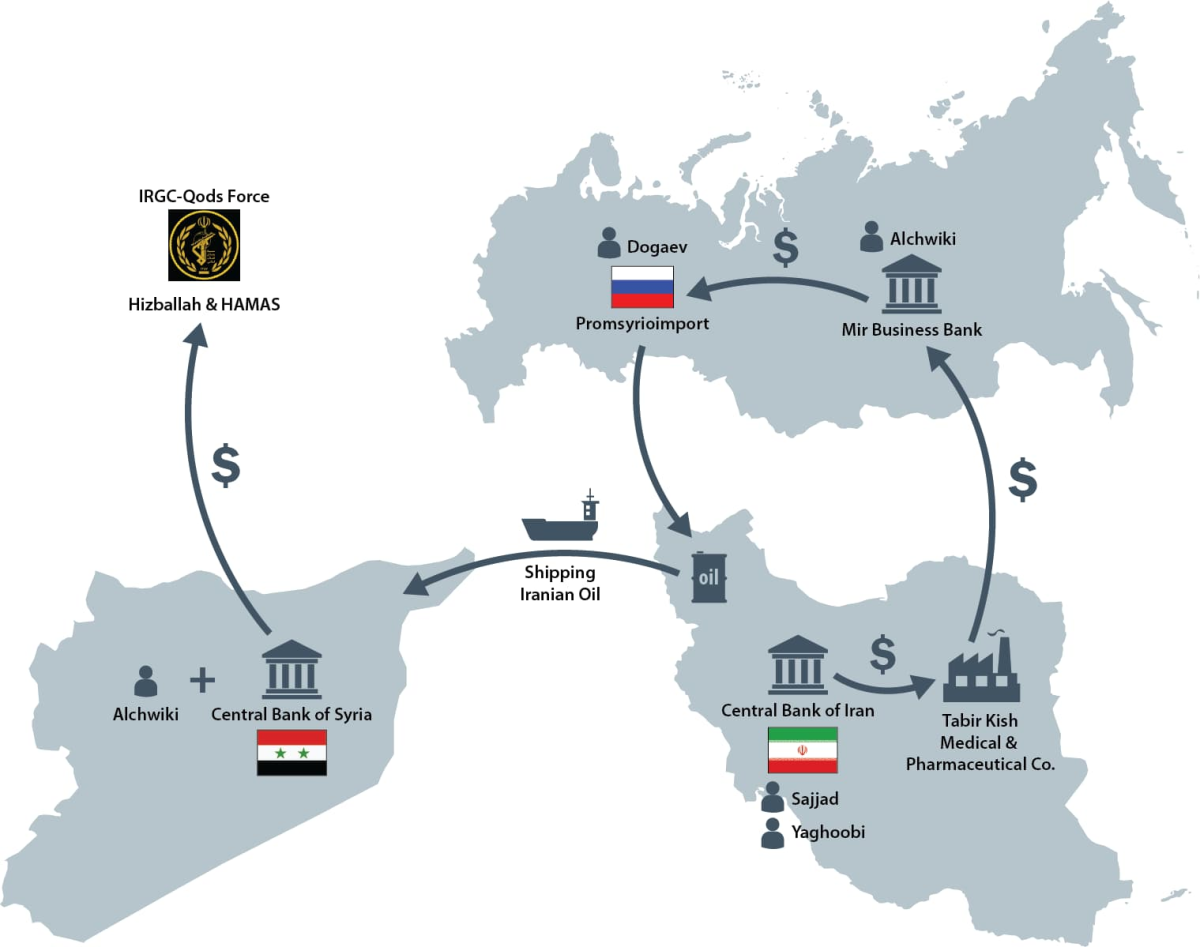
Map illustrating the flow of Iranian oil and financial transactions between Iran, Syria, and Russia, highlighting entities and individuals involved in supporting Iran’s military and proxies.
The IRGC’s expanding control over oil revenues provides direct funding for these proxy relationships while supporting Iran’s ballistic missile and drone programs. The integration of oil revenue into Iran’s military budget means that every barrel purchased by China contributes to weapons systems that threaten U.S. allies and destabilize regional security.
Iran’s nuclear program also benefits from oil revenue through direct budget allocations. Leaked documents reveal that Iran’s Atomic Energy Organization has requested and received billions of dollars worth of crude oil allocations specifically for nuclear facility construction and research programs[35]. This direct connection between oil sales and nuclear development underscores the strategic importance of disrupting Iran’s energy exports.
Economic Dependency and Strategic Leverage
The China-Iran oil relationship has evolved beyond a simple commercial transaction into a strategic dependency that grants both countries significant leverage over the other. China’s position as Iran’s sole major oil customer provides Beijing with enormous influence over Iranian policy and economic decision-making. Simultaneously, Iran’s role as a reliable supplier of discounted crude gives Tehran leverage in broader China-Iran strategic cooperation.
This mutual dependency has created incentives for both countries to deepen their relationship beyond energy trade. The comprehensive strategic partnership agreement signed between China and Iran includes provisions for Chinese investment in Iranian infrastructure, telecommunications, and transportation sectors, potentially valued at hundreds of billions of dollars over the next 25 years[36].
The economic integration facilitated by oil trade has also encouraged the development of financial systems that operate outside U.S. oversight. China and Iran have expanded their use of yuan-denominated transactions and developed alternative payment mechanisms that reduce exposure to dollar-based sanctions. These systems, while initially designed to facilitate oil trade, create infrastructure that could support broader sanctions evasion in other sectors.
Policy Recommendations and Strategic Responses
The scale and sophistication of the China-Iran oil trade network require a comprehensive policy response that addresses both immediate sanctions enforcement challenges and longer-term strategic competition issues. Several key recommendations emerge from this analysis:
Expanded Sanctions Targeting: Rather than pursuing individual designations of refineries and port operators, U.S. policy should target entire corporate networks and supply chains. This approach would require sanctioning multiple entities simultaneously to prevent rapid adaptation and substitution of designated companies.
Secondary Sanctions on Chinese Banks: The current sanctions regime has largely avoided targeting major Chinese financial institutions involved in yuan-denominated Iranian oil transactions. Imposing secondary sanctions on Chinese banks that facilitate these payments would significantly increase the cost and complexity of the trade.
Enhanced Maritime Enforcement: The shadow fleet’s effectiveness depends on the ability to operate in international waters without interference. Increased naval patrols and enhanced cooperation with allied maritime forces could improve detection and interdiction of sanctions-violating shipments.
Technology-Based Solutions: Advanced satellite monitoring, artificial intelligence-powered vessel tracking, and blockchain-based supply chain verification could enhance the ability to detect and prevent sanctions evasion in real-time.
Diplomatic Engagement: While maintaining pressure through sanctions, the United States should also pursue diplomatic initiatives that address Chinese concerns about energy security while creating incentives for reduced Iranian oil purchases.
Alternative Energy Partnerships: Offering China alternative energy partnerships and investment opportunities could reduce Beijing’s dependence on Iranian crude while advancing broader strategic cooperation goals.
Conclusion
The China-Iran oil trade represents a fundamental challenge to international sanctions enforcement and regional security. The dramatic growth in bilateral energy commerce has provided Iran with essential revenue for military modernization and nuclear development while granting China access to discounted crude oil that supports its economic growth. The sophisticated networks of companies, financial institutions, and maritime operators that facilitate this trade demonstrate remarkable resilience against sanctions pressure.
However, the strategic implications of this relationship extend far beyond commercial considerations. Iran’s ability to fund proxy forces, develop weapons systems, and advance nuclear capabilities depends directly on revenue from Chinese oil purchases. The integration of oil income into Iran’s military budget creates a direct connection between energy exports and regional destabilization that cannot be ignored.
The United States and its allies face the complex challenge of disrupting this trade while managing broader strategic relationships with China and maintaining global energy market stability. Success will require sustained commitment to sanctions enforcement, enhanced international cooperation, and innovative approaches that address the fundamental incentives driving this economic partnership.
The stakes of this challenge are enormous. Iran’s continued access to oil revenue enables not only its current destabilizing activities but also its long-term ambitions for regional hegemony and nuclear capability. Cutting off this financial lifeline requires cutting off China’s access to Iranian oil, a goal that will demand unprecedented coordination between economic pressure, diplomatic engagement, and strategic competition across multiple domains.
Sources
- https://www.agbi.com/analysis/oil-and-gas/2025/04/seaborne-oil-exports-from-iran-to-china-hit-record-levels/
- https://freebeacon.com/national-security/exposed-how-china-helps-iran-evade-sanctions-through-multibillion-dollar-oil-scheme/
- https://www.ifmat.org/10/24/iran-to-direct-majority-of-oil-and-gas-revenue-to-irgc/
- https://www.cnbc.com/2025/06/27/china-us-sanctions-shadow-fleet-top-iranian-oil-buyer-trade.html
- https://www.iranintl.com/en/202206015870
- https://www.foxnews.com/politics/iran-triple-revolutionary-guard-budget-oil-revenue
- https://www.tehrantimes.com/news/514536/Iran-China-2-month-non-oil-trade-stands-at-4-631b
- https://www.unitedagainstnucleariran.com/blog/uncovering-chinese-purchasers-of-iranian-oil
- https://iranopendata.org/en/article/iran-military-budget-crude-oil/
- https://www.wsj.com/business/energy-oil/if-irans-oil-is-cut-off-china-will-pay-the-price-95b9c7e1
- https://www.rigzone.com/news/wire/iran_oil_snapped_up_by_chinese_private_refiners_as_market_shifts-06-apr-2023-172467-article/
- https://iranfocus.com/economy/53863-irans-2025-budget-massive-oil-revenues-for-military-and-state-asset-transfers-to-irgc/
- https://energy.economictimes.indiatimes.com/news/oil-and-gas/chinas-iranian-crude-imports-find-new-market-in-northeast/112040905
- https://home.treasury.gov/news/press-releases/sb0090
- https://www.iranintl.com/en/202410232813
- https://www.fdd.org/analysis/2024/05/06/china-lies-about-its-oil-imports-from-iran/
- https://www.ajot.com/news/iran-oil-snapped-up-by-chinese-private-refiners-as-market-shifts
- https://iranfocus.com/economy/52395-fourfold-increase-in-share-of-irans-armed-forces-from-oil-and-gas-export-revenues/
- https://www.tehrantimes.com/news/515068/Iran-s-oil-exports-to-China-hit-record-high-in-June
- https://thediplomat.com/2021/03/china-is-buying-record-amounts-of-iranian-oil/
- https://www.reuters.com/world/us-imposes-sanctions-network-sending-iranian-oil-china-2025-05-13/
- https://nationalinterest.org/feature/how-china-is-quietly-funding-irans-war-machine
- https://www.youtube.com/watch?v=tvgOWlg12dU
- https://globaledge.msu.edu/blog/post/56999/china-invests-billions-in-iran-in-exchan
- https://www.state.gov/sanctioning-entities-purchasing-and-transporting-iranian-oil-to-further-impose-maximum-pressure-on-iran/
- https://www.investing.com/news/commodities-news/us-slaps-iranrelated-sanctions-on-oil-tankers-china-teapot-refinery-3939996
- https://fortune.com/asia/2025/06/25/trump-iran-china-oil-us-crude/
- https://www.iranintl.com/en/202505081213
- https://splash247.com/chinese-teapot-refinery-included-in-latest-round-of-american-sanctions-targeting-iranian-oil/
- https://www.voanews.com/a/chinese-companies-pursue-talk-now-invest-later-with-iran-91116949/165579.html
- https://www.voanews.com/a/us-issues-fresh-iran-sanctions-targets-chinese-uae-firms/6682223.html
- https://www.tampafp.com/u-s-sanctions-chinese-teapot-refinery-in-bid-to-halt-iranian-oil-exports/
- https://onlinelibrary.wiley.com/doi/10.1111/mepo.12669
- https://www.washingtontimes.com/news/2025/may/8/treasury-sanctions-chinese-firms-ships-role-iranian-oil-sales/
- https://www.iranintl.com/en/202504037785
- https://seanews.co.uk/market/tanker/us-sanctions-hit-shadow-fleet-ships-transporting-iranian-oil-to-china-uk-targets-russia/