









Act now
Call For Institutional Neutrality
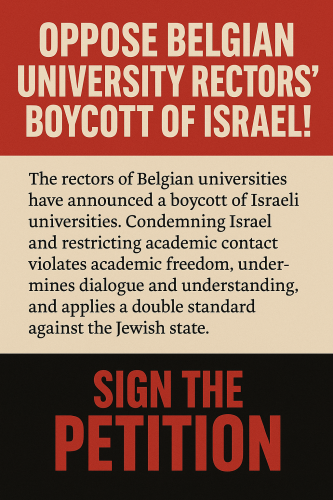
Open Letter from the Academic Community to
the Rectors of Belgian Universities
Academic boycott of Israeli universities is unjust, counterproductive discrimination and violates academic freedom. We urge the rectors of Belgian universities to adopt policies of institutional neutrality.
The Council of Francophone Rectors (Cref) and its Flemish counterpart, the Vlaamse Interuniversitaire Raad (VLIR), have announced their decision to suspend institutional collaborations with organizations that repeatedly support or are directly involved in violations of international law and human rights. However, the only country that appears to be targeted by this new cooperation policy of Cref and VLIR is Israel. Suspending institutional collaborations with Israel would mean the termination of Horizon Europe-funded scientific projects involving Israeli researchers, as well as the end of student exchanges with Israeli universities.
They justify this academic boycott of Israeli universities:
The academic boycott of Israeli universities not only unfairly discriminates against Israeli researchers but also constitutes a serious violation of the academic principles that universities should defend:
Institutional neutrality, or the principle that universities should exercise restraint on controversial issues, is widelyregarded as essential to academic freedom. As the Calven report aptly states: "The neutrality of the university as an institution arises then not from a lack of courage nor out of indifference and insensitivity. It arises out of respect for free inquiry and the obligation to cherish a diversity of viewpoints." By imposing an academic boycott of Israel on the entire Belgian academic community, the rectors of the Cref and the VLIR are enforcing their own perspective on the Israeli Palestinian conflict whose roots are complex and mix religious and territorial claims. This will also have consequences for freedom of expression in Belgian universities.
An academic boycott hinders the free exchange of knowledge by isolating members of specific academic communities from collaboration with their peers. This directly violates the principle of the Universality of Science, which guarantees freedom of association, expression, information, communication, and movement in the context of international scientific activities.
A prolonged academic boycott can severely impact a country's education and healthcare systems, ultimately contradicting the "right to science" enshrined in Article 27 of the 1948 Universal Declaration of Human Rights: "Everyone has the right to freely participate in the cultural life of the community, to enjoy the arts, and to share in scientific advancement and its benefits".
In consequence, all major international institutions that protect academic freedom, freedom of expression, and scientific research officially condemn academic boycotts against Israel as violations of academic freedom. This is the case for the American Association of University Professors (AAUP), the Foundation for Individual Rights and Expression (FIRE), and the International Science Council (ISC). The only reason tolerated by the AAUP for a boycott is to exert pressure to restore academic freedom in the universities being boycotted. This would require proof that academic freedom in Israeli universities is nonexistent or seriously threatened—which is far from being the case.
As current or former members of the academic community, we have a duty to uphold and defend academic freedom, regardless of our position on the Israeli Palestinian conflict. We urge the rectors of Belgian universities to adopt policies of institutional neutrality, as more than a hundred universities did in 2024 including Harvard and Stanford universities.
It is worth recalling that the principle of institutional neutrality in no way implies an obligation for the university to remain silent.
The university is fully entitled to speak out on its core missions — teaching and research — including issues related to their funding. It may also take a stance on societal matters that are the subject of a well-established scientific consensus, such as climate change or the theory of evolution. Conversely, in order to safeguard the academic freedom of its entire community, the university is not intended to promote any specific political orientation, nor to act as a militant body. Such a stance could blur the essential distinction between science and ideology, which lies at the very heart of its mission.
Call for Institutional Neutrality in Belgian Universities (in English)
The rectors of Belgian universities have officially decided to boycott Israeli universities. This entails suspending student exchanges and blocking the submission of new research projects to the European Commission through committees responsible for dual-use concerns and compliance with international law. The rectors are also urging the Commission to revise the EU-Israel agreement, which governs economic, scientific, and cultural relations between the EU and Israel. This political activism, undertaken in the name of the entire Belgian academic community, deviates from the university’s core missions: teaching and research. It undermines academic freedom by preventing researchers from pursuing their projects as they see fit. We call on the rectors to adopt a policy of institutional neutrality, as more than 150 American universities—including Harvard—and Sciences Po Paris have recently done. Neutrality does not mean silence: universities should speak out on their core missions—including how they are funded—and on societal issues where there is strong scientific consensus, such as climate change or the theory of evolution. However, to safeguard the academic freedom of all, the university must refrain from promoting any particular political agenda or acting as a militant institution. Doing so risks blurring the crucial line between science and ideology—a line that lies at the very heart of its mission. Act now! Sign Our Petition.
Appel à la neutralité Institutionnelle
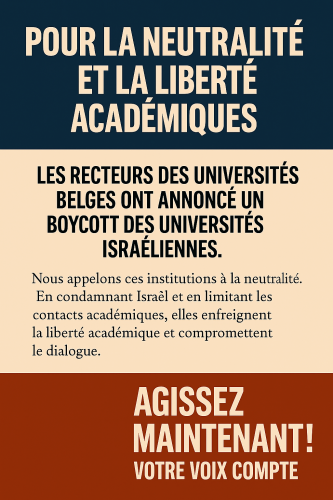
Lettre ouverte de la communauté académique
aux recteurs des universités belges
Le boycott académique des universités israéliennes constitue une discrimination injuste et contre-productive, et porte atteinte à la liberté académique. Nous appelons les recteurs des universités belges à adopter une politique de neutralité institutionnelle.
Le Conseil des recteurs francophones (Cref) et son homologue flamand, le Vlaamse Interuniversitaire Raad (VLIR), ont annoncé leur décision de suspendre les collaborations institutionnelles avec les organisations qui soutiennent de manière répétée ou sont directment impliquées dans des violations du droit international et des droits humains. Cependant, le seul pays qui semble visé par cette nouvelle politique de coopération du Cref et du VLIR est Israël. Suspendre les collaborations institutionnelles avec Israël impliquerait la cessation des projets scientifiques Horizon financés par L'europe, impliquant des chercheurs israélien, ainsi que la fin des échanges d'étudiants avec les universités israéliennes.
Le Cref et le VLIR justifient ce boycott académique des universités israéliennes :
Le boycott académique des universités israéliennes constitue non seulement une discrimination injuste à l’égard des chercheurs israéliens, mais aussi une grave violation des principes académiques que les universités devraient défendre :
La neutralité institutionnelle, ou le principe selon lequel les universités doivent faire preuve de retenue sur les questions controversées, est largement considérée comme essentielle à la liberté académique. Comme l’exprime justement le rapport Calven : « La neutralité de l’université en tant qu’institution ne découle ni d’un manque de courage, ni de l’indifférence ou de l’insensibilité. Elle découle du respect de la libre recherche et de l’obligation de préserver une diversité de points de vue. » En imposant un boycott académique d’Israël à l’ensemble de la communauté académique belge, les recteurs du Cref et du VLIR imposent leur propre vision du conflit israélo-palestinien, dont les racines sont complexes et mêlent revendications religieuses et territoriales. Cela aura également des conséquences sur la liberté d’expression au sein des universités belges.
Un boycott académique entrave l’échange libre des connaissances en isolant des membres de certaines communautés universitaires et en les empêchant de collaborer avec leurs pairs. Cela constitue une violation directe du principe de l’Universalité de la Science, qui garantit la liberté d’association, d’expression, d’information, de communication et de circulation dans le cadre des activités scientifiques internationales.
Un boycott académique prolongé peut avoir des répercussions graves sur les systèmes éducatif et sanitaire d’un pays, contredisant ainsi le « droit à la science » consacré par l’article 27 de la Déclaration universelle des droits de l’Homme de 1948 : « Toute personne a le droit de prendre part librement à la vie culturelle de la communauté, de jouir des arts et de participer au progrès scientifique et aux bienfaits qui en résultent. »
Par conséquent, toutes les grandes institutions internationales chargées de protéger la liberté académique, la liberté d'expression et la recherche scientifique condamnent officiellement les boycotts académiques contre Israël, les considérant comme des violations de la liberté académique. C’est notamment le cas de l’American Association of University Professors (AAUP), de la Foundation for Individual Rights and Expression (FIRE) et du International Science Council (ISC). La seule raison pour laquelle l’AAUP tolère un boycott est lorsqu’il vise à rétablir la liberté académique dans les universités concernées. Cela supposerait de prouver que la liberté académique est inexistante ou gravement menacée dans les universités israéliennes—ce qui est loin d’être le cas.
La liberté académique est un droit fondamental, protégé juridiquement en Europe et en Belgique. Les décisions du Cref et du VLIR de boycotter les universités israéliennes fragilisent cette liberté en restreignant la capacité des chercheurs à collaborer avec les partenaires de leur choix. Cette décision légitime également l’idée dangereuse selon laquelle les membres d’une communauté universitaire seraient responsables des actions de leur gouvernement. En tant que membres actuels ou anciens de la communauté académique, nous avons le devoir de défendre et de préserver la liberté académique, indépendamment de notre position sur le conflit israélo-palestinien. Nous appelons les recteurs des universités belges à adopter des politiques de neutralité institutionnelle, à l’instar de plus d’une centaine d’universités en 2024, dont Harvard et Stanford.
Il convient de rappeler que le principe de neutralité institutionnelle n’implique nullement une obligation de silence de la part de l’université.
Celle-ci est pleinement légitime à s’exprimer sur ses missions fondamentales — l’enseignement et la recherche — y compris sur les enjeux liés à leur financement. Elle peut également prendre position sur des sujets de société faisant l’objet d’un consensus scientifique solide, tels que le changement climatique ou la théorie de l’évolution. En revanche, pour garantir la liberté académique de l’ensemble de sa communauté, l’université n’a ni vocation à promouvoir une orientation politique particulière, ni à se constituer en acteur militant. Une telle posture risquerait de brouiller la distinction essentielle entre sciences et idéologies, au cœur même de ses missions.
Appel à la neutralité institutionnelle des universités belges
Les recteurs des universités belges ont officiellement décidé de boycotter les universités israéliennes. Cela implique la suspension des échanges d’étudiants et le blocage de la soumission de nouveaux projets de recherche à la Commission européenne par le biais des comités responsables des préoccupations liées à l’utilisation duale et au respect du droit international. Les recteurs pressent également la Commission de réviser l’accord UE-Israël, qui régit les relations économiques, scientifiques et culturelles entre l’UE et Israël. Cet activisme politique, entrepris au nom de toute la communauté académique belge, s’écarte des missions fondamentales de l’université : l’enseignement et la recherche. Il porte atteinte à la liberté académique en empêchant les chercheurs de mener leurs projets comme ils l’entendent. Nous appelons les recteurs à adopter une politique de neutralité institutionnelle, comme plus de 150 universités américaines — dont Harvard — et Sciences Po Paris l’ont récemment fait. La neutralité ne signifie pas le silence : les universités doivent s’exprimer sur leurs missions fondamentales — y compris sur leur financement — et sur les questions sociétales où il existe un fort consensus scientifique, comme le changement climatique ou la théorie de l’évolution. Cependant, pour garantir la liberté académique de tous, l’université doit s’abstenir de promouvoir un agenda politique particulier ou d’agir comme une institution militante. Cela risquerait d’estomper la frontière cruciale entre science et idéologie — une frontière qui se trouve au cœur même de sa mission. Agissez maintenant ! Signez notre pétition.

South Africa stands at a critical crossroads
We Ask You to Oppose the Registration of the Islamic State of Africa party (ISA)
A new political party, the so-called Islamic State of Africa (ISA), led by Durban businessman Farhad Hoomer, is seeking official registration. This group is openly calling for the introduction of Shariah law and an Islamic caliphate—an agenda that directly challenges the core values of our Constitution and the principles of our democracy.

Hoomer caught the attention of South African authorities in October 2018 and was arrested with 11 associates for planting incendiary devices near the Imam Hussain Mosque, the only Shiite mosque in the Verulam neighborhood of Durban, and commercial buildings; for stabbing worshippers, killing one. Hoomer and his men were also accused of being affiliated to ISIS and charged with attempted murder, arson, and extortion. The defendants were granted bail on November 27, 2018. However, on July 14, 2020, the Verulam Magistrate’s Court dismissed the case as the state did not have sufficient evidence to proceed. On June 25, 2021, Hoomer, Mohamad Akbar, Nufael Akbar, Tariq Hamid, and Ikkram Khan were arrested after a raid at business premises in the Mayville area of Durban. Police obtained a search warrant for the Mayville property following a lead from a burglary case. Upon their search, police discovered more than 5,000 rounds of ammunition, rifles, seven cellphones, two magazines, as well as diamonds and jewelry. The men appeared at the Durban magistrate’s court on June 28, but the charges were dropped on July 5, 2021, as the state concluded there was insufficient evidence.
On March 1, 2022, the U.S. Treasury Department designated Hoomer as a Specially Designated Global Terrorist (SDGT) for serving as the leader of an ISIS network in South Africa. The US Treasury later added Hoomer’s businesses (Sultans Construction CC, Ashiq Jewellers CC, Ineos Trading (PTY) LTD, and Shaahista Shoes CC) to the Specially Designated National (SDN) list on November 7, 2022.
The Independent Electoral Commission (IEC) is currently seeking your input on the party's registration, following many public objections.
This is your opportunity to have a direct say in a matter that could shape South Africa's political landscape.
Please note: Even if the party is registered, this does not guarantee its participation in future elections. The party must still fulfill all additional legal requirements before it can appear on the ballot.
The party’s name and ideology have already raised serious concerns among citizens, faith communities, and leaders nationwide as it openly advocates for governance based on Shariah Law and seeks to introduce an Islamic caliphate system in South Africa.
- The ideology is incompatible with South Africa’s constitutional values
- The name closely resembles that of the internationally designated terrorist organization ISIS
- It jeopardizes SA unity, security, and international reputation.
Now is the time for your voice to make a real difference.
Do you believe the registration of this party is in the best interest of South Africa? Are you concerned about the direction it proposes for our nation?
We urge you to take action
Please complete the questionnaire below to formally register your opposition to ISA’s registration. Your participation is essential—Stand up for South Africans' constitutional values. Protect South African democracy. Make your voice count!
Have Your Say (ISA)
Have Your Say. Oppose the registration of the ISA political party