
















A Victory for Regional Security and Israeli Interests
Qatar has indeed taken a decisive step back from Hamas, marking a watershed moment that significantly enhances Israeli security and regional stability. The Gulf state’s signing of the July 29, 2025 UN declaration calling for Hamas to disarm and relinquish power in Gaza represents the culmination of sustained international pressure and strategic realignment that serves Israeli interests after decades of Qatari support for terrorism. This transformation from Hamas patron to regional consensus-builder demonstrates both the effectiveness of coordinated diplomatic pressure and the potential for lasting change in Middle Eastern power dynamics.
Qatar’s policy reversal comes after nearly two decades of serving as Hamas’s primary financial lifeline and diplomatic sanctuary, a relationship that directly enabled the October 7, 2023 massacre through systematic funding of the organization’s military capabilities. The emirate’s newfound alignment with Arab League consensus against Hamas marks not merely a tactical adjustment, but rather a fundamental recalibration that strengthens Israel’s security environment and creates unprecedented opportunities for regional cooperation on Palestinian governance.
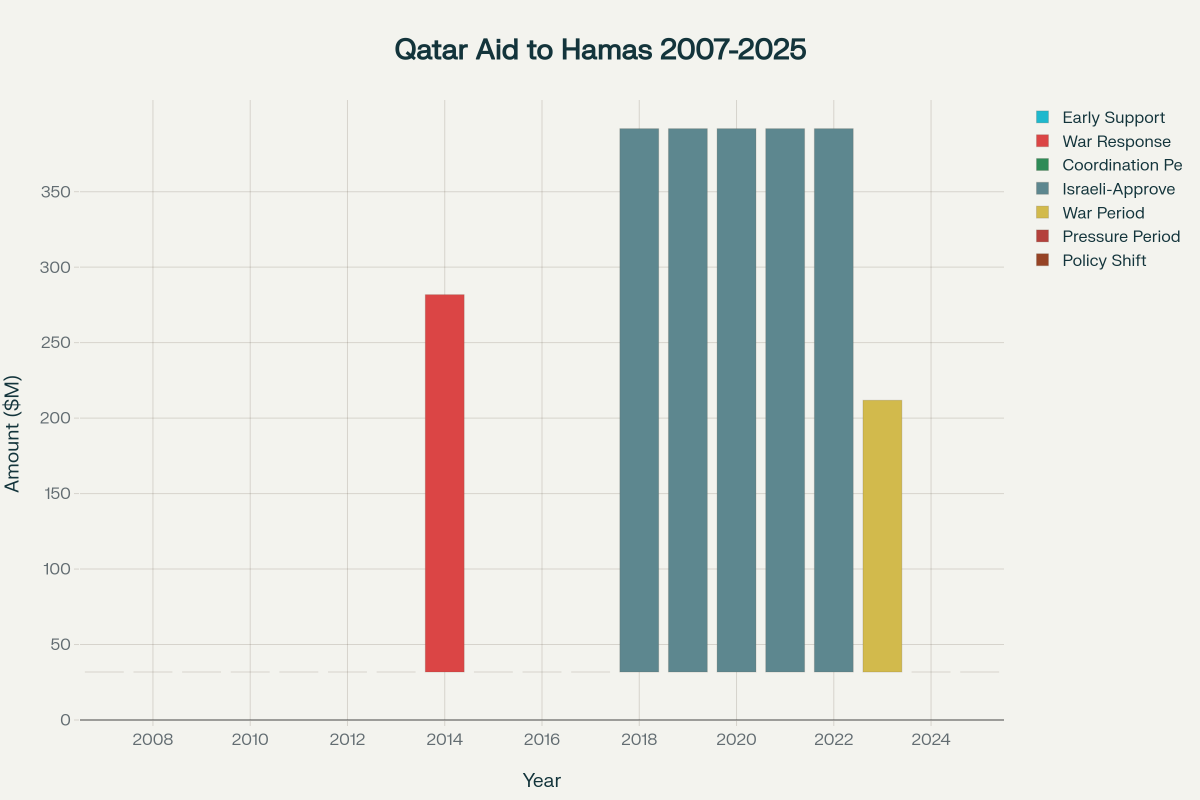
The scale of Qatar’s historical support for Hamas cannot be understated when evaluating the significance of its recent policy shift. Between 2007 and 2024, Qatar transferred over $1.8 billion to Gaza, with documented evidence demonstrating that these funds directly strengthened Hamas’s military capabilities ahead of the October 7 attacks. This massive financial commitment represented far more than humanitarian assistance—it constituted systematic state sponsorship of a designated terrorist organization.
From 2018 to 2021, Qatar provided $30 million monthly to Gaza with Israeli government approval, totaling $360 million annually. While ostensibly designated for civilian purposes, Israeli intelligence assessments conclusively determined that “the flow of money from Qatar to Gaza and its delivery to Hamas’s military wing” enabled the organization to build offensive capabilities subsequently used in the October 7 massacre. Furthermore, documents seized by Israeli forces in Gaza revealed that Hamas political chief Ismail Haniyeh described Qatari funds as the group’s “main artery” and that the Qatari Emir had “agreed in principle” to fund Hamas’s military operations.
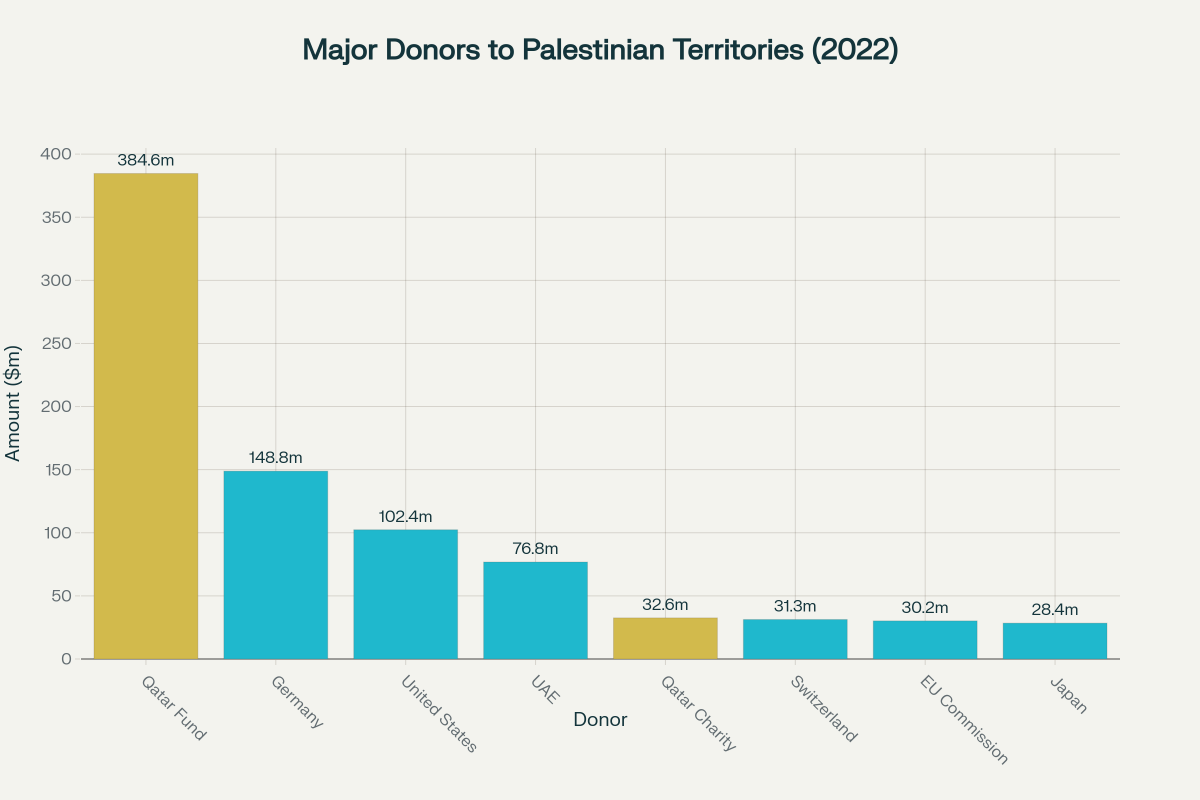
The political dimension of Qatar’s support proved equally damaging to Israeli interests. Since 2012, Qatar has hosted Hamas’s political office in Doha, thereby providing international legitimacy and diplomatic protection to the organization’s leadership. This arrangement allowed Hamas to maintain global political presence while coordinating terrorist activities, effectively weaponizing diplomatic hospitality against Israeli security interests.
The October 7, 2023 Hamas attacks served as a devastating demonstration of how Qatar’s financial support had been converted into terrorist capabilities. Israeli security assessments found that Qatari funding enabled Hamas to develop the sophisticated military infrastructure used in the assault, including tunnel networks, weapons manufacturing capabilities, and specialized training programs. Following the attacks, evidence emerged of direct Qatari financing for Hamas’s military wing, contradicting Doha’s longstanding claims that assistance was purely humanitarian.
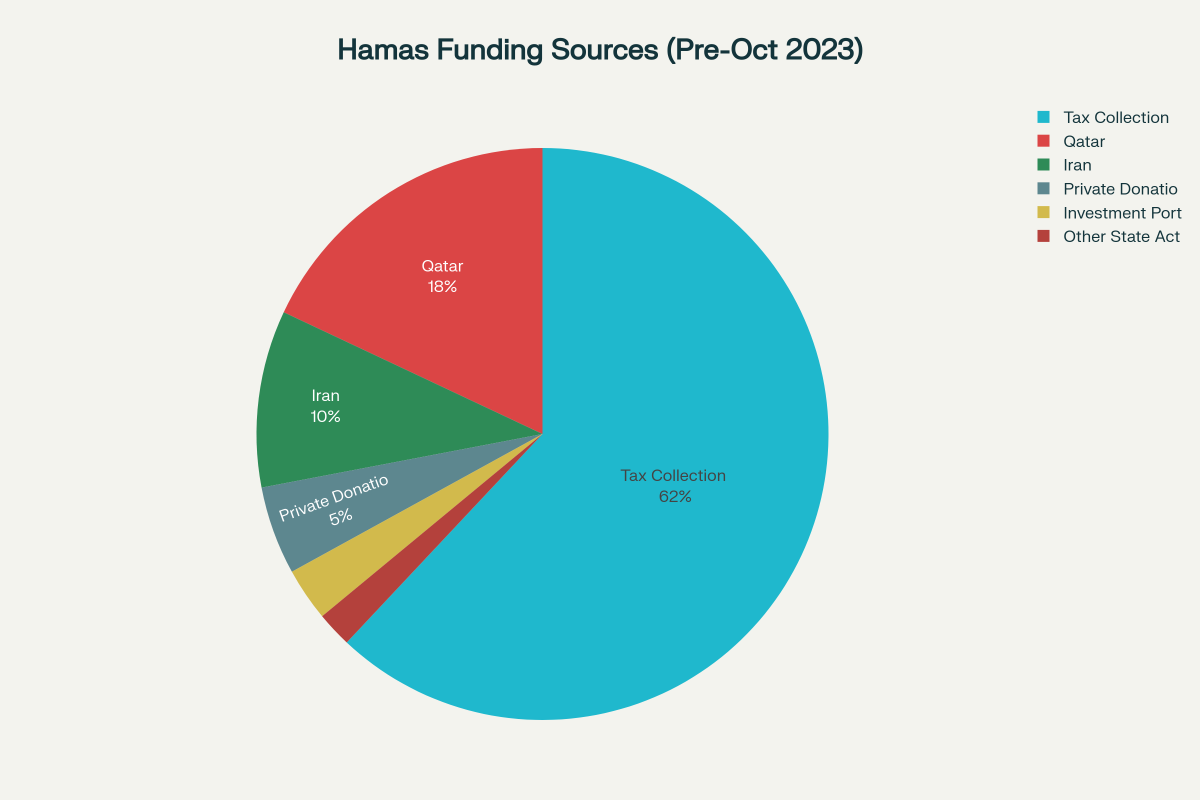
A 2021 document showed Hamas leader Yahya Sinwar receiving confirmation that the Qatari Emir had agreed to provide “discreet financial support” for “resistance” activities, with $11 million already transferred. This revelation exposed the hollow nature of Qatar’s denials and demonstrated the fungible nature of its supposed humanitarian assistance. Moreover, the attacks revealed the strategic dimensions of Qatar’s Hamas relationship. Internal Hamas communications showed the organization viewed Qatar as essential for “promoting its interests” internationally and relied on Qatari diplomatic networks to advance its agenda globally.
The transformation of Qatar’s Hamas policy resulted from sustained international pressure led by the United States and coordinated with Israel. Following Hamas’s rejection of multiple ceasefire proposals and the execution of American hostages, the Biden administration delivered an ultimatum to Qatar in November 2024: expel Hamas leaders or face consequences to the bilateral relationship. The effectiveness of this pressure campaign demonstrated several key principles for Israeli security policy. First, Qatar’s fundamental dependence on American security guarantees and its Major Non-NATO Ally status created decisive leverage that Washington could activate when necessary. Second, coordinated pressure from multiple actors—including Congressional threats and Israeli diplomatic efforts—amplified the costs of continued Hamas support beyond Qatar’s tolerance threshold.
By November 2024, Qatar had ordered Hamas leaders to leave Doha and suspended its mediation role in Gaza negotiations. While Qatar initially characterized this as temporary, the practical effect eliminated Hamas’s primary international headquarters and diplomatic sanctuary. This development represented the first time since 2012 that Hamas lacked a secure base for its external political operations, significantly degrading its international capabilities. Qatar’s signature on the July 29, 2025 UN declaration represents the most significant manifestation of its policy transformation and creates unprecedented opportunities for Israeli security interests. The declaration, signed by 17 countries, the European Union, and the 22-member Arab League, explicitly calls for Hamas to “end its rule in Gaza and hand over its weapons to the Palestinian Authority.”
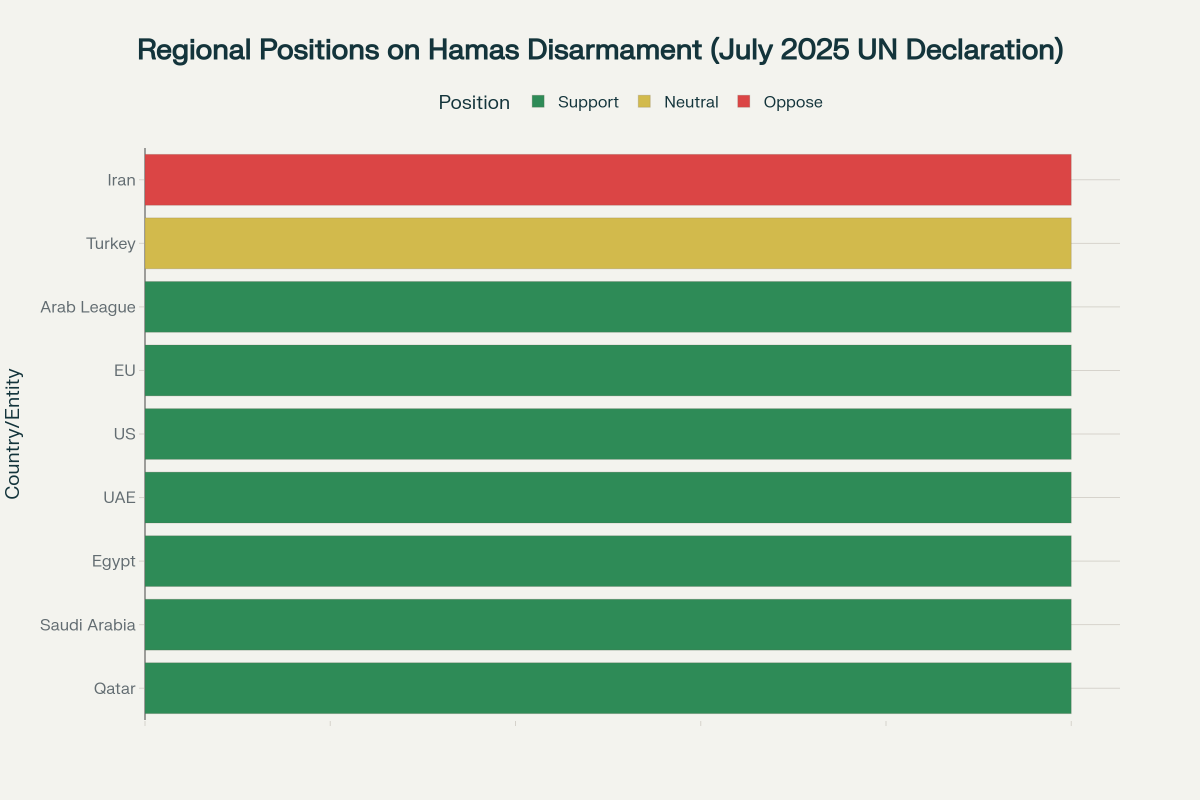
The inclusion of Qatar, Saudi Arabia, and Egypt in condemning the October 7 attacks and demanding Hamas’s disarmament marks the first time Arab states have achieved such consensus against a Palestinian resistance organization. This development fundamentally alters the regional dynamics that have historically constrained Israeli action against terrorist organizations by providing Arab legitimacy for efforts to eliminate Hamas’s military and political capabilities. French Foreign Minister Jean-Noel Barrot characterized the declaration as “historic and unprecedented,” noting that “for the first time, Arab countries and those in the Middle East condemn Hamas, condemn October 7, call for the disarmament of Hamas, call for its exclusion from Palestinian governance.” This regional consensus creates sustainable foundations for post-conflict arrangements that exclude Hamas from governance roles while maintaining Arab world legitimacy. Qatar’s retreat from Hamas generates multiple strategic advantages for Israeli security interests. Most immediately, the elimination of Hamas’s Doha political office removes a key node in the organization’s international network, thereby degrading its diplomatic capabilities and global fundraising operations. The loss of Qatari financial support also creates severe budgetary pressures on Hamas, potentially undermining its ability to maintain governance functions in Gaza while financing military operations.
The regional consensus achieved through the July 2025 declaration provides Israeli operations against Hamas with unprecedented Arab world legitimacy. Historical Israeli military actions in Gaza faced significant regional criticism even when operationally successful. The current Arab League position supporting Hamas’s elimination fundamentally changes this dynamic, creating space for decisive Israeli action without regional diplomatic costs. Qatar’s policy shift also eliminates a major source of international pressure for Israeli restraint in Gaza operations. Previously, Qatar’s mediation role created expectations for Israeli accommodation with Hamas through negotiations. The suspension of this mediation removes diplomatic constraints while the Arab League consensus supports more decisive approaches to eliminating Hamas’s capabilities. The broader implications of Qatar’s Hamas retreat extend to fundamental changes in regional security architecture that favor Israeli interests. The Arab League consensus on Hamas represents the most significant regional alignment with Israeli security objectives since the Abraham Accords, creating potential foundations for expanded cooperation on counterterrorism and regional stability.
Qatar’s alignment with Saudi Arabia and Egypt on Palestinian governance questions enables enhanced Gulf Cooperation Council coordination on regional challenges, thereby reversing the fragmentation that characterized the 2017-2021 blockade period. This realignment creates opportunities for coordinated approaches to Iranian influence operations and proxy warfare that have historically threatened Israeli security. The elimination of Qatar as a Hamas sanctuary also disrupts the broader “axis of resistance” network that Iran has cultivated to threaten Israeli interests. While Iran maintains support for other proxy organizations, the loss of Hamas’s primary external base significantly degrades the network’s operational coordination and international legitimacy.
The July 2025 declaration’s framework for Palestinian governance explicitly serves Israeli security interests by envisioning Palestinian Authority control over Gaza under international supervision. This arrangement would eliminate Hamas as a governing authority while establishing security mechanisms to prevent its return to power. The declaration calls for “the deployment of a temporary international stabilization mission” to Gaza “upon invitation of the Palestinian Authority and under the aegis of the United Nations.” This framework ensures that any transition away from Hamas rule occurs under international oversight with built-in safeguards against the organization’s return to power—a critical Israeli security requirement. The Palestinian Authority’s weakness and lack of popular support in Gaza previously made such arrangements unrealistic. However, the Arab League endorsement provides essential legitimacy for PA governance while international oversight addresses Israeli security concerns about Palestinian Authority capabilities.
Qatar’s policy shift also addresses important economic dimensions of Israeli security. The emirate’s role as a major liquefied natural gas supplier to European markets had created dependencies that constrained international responses to its Hamas support. The elimination of this policy contradiction enables more coherent international cooperation on counterterrorism financing without economic disruptions. Israel’s emerging role as a regional energy hub through offshore gas discoveries creates potential cooperation opportunities with Qatar that were previously impossible due to Hamas connections. The normalization of Qatar’s regional relationships opens possibilities for energy sector collaboration that could enhance Israeli economic security while reducing regional tensions.
Despite the significant benefits of Qatar’s policy shift, several challenges remain for Israeli security planning. Hamas has denied reports of expulsion from Qatar and maintains that its international operations continue normally. The organization’s leadership structure has become increasingly opaque following the deaths of key figures, making it difficult to assess the full impact of losing Qatari sanctuary. Turkey’s emergence as a potential alternative host for Hamas leadership creates new diplomatic challenges. While Ankara lacks Qatar’s financial resources and international influence, it provides Hamas with continued access to international forums and potential funding networks that could partially compensate for Qatari losses. Furthermore, the durability of Qatar’s policy shift remains uncertain given the emirate’s historical pattern of tactical accommodations under pressure while maintaining informal support channels.
The incoming Trump administration inherits unprecedented opportunities to consolidate gains from Qatar’s Hamas retreat while preventing policy reversals. The Foundation for Defense of Democracies recommends that the Trump administration “seize this moment and demand that Qatar shutter Hamas’s Doha office, expel Hamas leaders, and close off any remaining financial arteries to the terrorist group.” Congressional pressure mechanisms that proved effective in forcing Qatar’s initial policy shift remain available for ensuring compliance with Hamas expulsion commitments. The threat to revoke Qatar’s Major Non-NATO Ally status provides continuing leverage to prevent backsliding while potential terrorism designation creates additional pressure for sustained cooperation.
The regional consensus achieved through the July 2025 declaration creates foundations for broader Trump administration initiatives on Middle East peace that exclude Hamas from negotiations while maintaining Arab world legitimacy. This represents a fundamental improvement over previous peace process dynamics that were constrained by Hamas’s spoiler capacity and regional support.
Qatar’s retreat from Hamas represents more than a tactical adjustment—it signals potential transformation of Middle Eastern dynamics that have constrained Israeli security for decades. The Arab League consensus against Hamas eliminates key sources of regional legitimacy for Palestinian terrorism while creating unprecedented alignment with Israeli security objectives. The elimination of Hamas’s primary external sanctuary significantly degrades the organization’s long-term viability as an effective opponent of Israeli interests. Without Qatari financial support and diplomatic protection, Hamas faces severe constraints on its ability to rebuild military capabilities or maintain international relevance. Most significantly, the regional consensus achieved in July 2025 creates sustainable foundations for post-conflict arrangements that serve Israeli security interests while maintaining regional legitimacy.
Qatar’s step back from Hamas represents one of the most significant strategic victories for Israeli security interests in decades. The transformation of a major state sponsor of terrorism into a supporter of Hamas’s elimination fundamentally alters regional dynamics in Israel’s favor while creating unprecedented opportunities for lasting security gains. The $1.8 billion in Qatari support that enabled Hamas’s October 7 capabilities has been eliminated, while the diplomatic sanctuary that provided international legitimacy for terrorist operations has been revoked. The Arab League consensus achieved in July 2025 provides regional legitimacy for Israeli efforts to permanently eliminate Hamas as a security threat.
The effectiveness of coordinated international pressure in achieving this transformation demonstrates the potential for similar approaches to other state sponsors of terrorism. Qatar’s fundamental dependence on American security relationships created decisive leverage that, when properly activated, forced abandonment of long-standing terrorist partnerships. For Israeli strategic planning, Qatar’s Hamas retreat creates unprecedented opportunities to achieve lasting security gains in Gaza while maintaining regional legitimacy. The Arab League framework for Palestinian governance under international oversight addresses core Israeli security requirements while eliminating Hamas’s capacity for future attacks. The transformation also signals broader changes in regional dynamics that favor Israeli interests. The alliance between Qatar and Saudi Arabia on Hamas elimination reverses decades of Gulf fragmentation while creating foundations for enhanced cooperation on counterterrorism and regional stability.
Most importantly, Qatar’s retreat demonstrates that sustained pressure can force fundamental policy changes even from states with deep investments in terrorist relationships. This precedent provides important lessons for addressing other regional challenges while showing that diplomatic and economic leverage, when properly coordinated, can achieve security objectives that military action alone cannot guarantee.
The July 2025 declaration represents not just Qatar’s step back from Hamas, but the broader regional step forward toward alignment with Israeli security interests and lasting Middle East stability. This historic transformation creates the foundations for achieving Israeli security objectives that have remained elusive for decades, while establishing precedents for addressing future challenges through coordinated international pressure rather than military confrontation alone.