
















In the Horn of Africa, strategic shifts and major geopolitical reconfigurations rarely announce themselves with the clarity of formal declarations; they first make themselves legible in the grammar of territorial footprints. A lengthened runway, a reorganised tarmac, expanded dispersal areas, depots appearing at the edge of a secured perimeter: these are low-signal indicators that, well before any communiqué, ratify a new distribution of force. Infrastructure is not merely a technical substrate — it is a text of sovereignty, often written without a signature, yet whose sentences are visible from orbit.
This is precisely what Berbera reveals today: not a proclaimed rupture, but a silent transformation whose grammar is only legible to those willing to read geography before listening to diplomacy. Seven kilometres west of the urban centre of Berbera, the economic capital of Somaliland, the airport — where civil logic and military anticipation have long been superimposed — has, since October 2025, been undergoing a metamorphosis that far exceeds its original civilian vocation. Satellite imagery does not lie: runway extensions, a multiplication of parking aprons, the opening of new operational zones, and the installation of logistical elements consistent with a function of stationing, rotation, and power projection — that is, with the hypothesis of a durable military permanence. The construction does not merely signal a capability; it already suggests an intention.
In a regional environment where international recognition remains a scarce currency and where coastal access constitutes a lever of negotiation, the hypothesis — increasingly evoked by various regional actors — of a base conceived for tripartite cooperation between the United Arab Emirates, the United States, and Israel takes on a significance that transcends the mere question of implantation: bases are no longer simply instruments of force; they tend to become decisions already taken, which can at best be named, but not truly contested. This logic is characteristic of de facto recognised yet de jure contested margins: security is constructed there as an architecture, and that architecture in turn becomes a diplomatic argument. Berbera, accordingly, is no longer reducible to an airport under transformation; it becomes a political operator, a dispositif that materialises — in concrete, asphalt, and fencing — the possibility of an alignment, and thus a reconfiguration of dependencies.
It is here that satellite imagery assumes its full significance: we have entered an era in which secrecy is no longer the absence of information, but the management of its visibility. Diplomats may delay, qualify, deny; construction sites, by contrast, accumulate evidence. Interpretations are debatable, but infrastructure does not merely “reflect” a strategy — it precedes it, renders it practicable, and sometimes makes it considerably harder to undo.
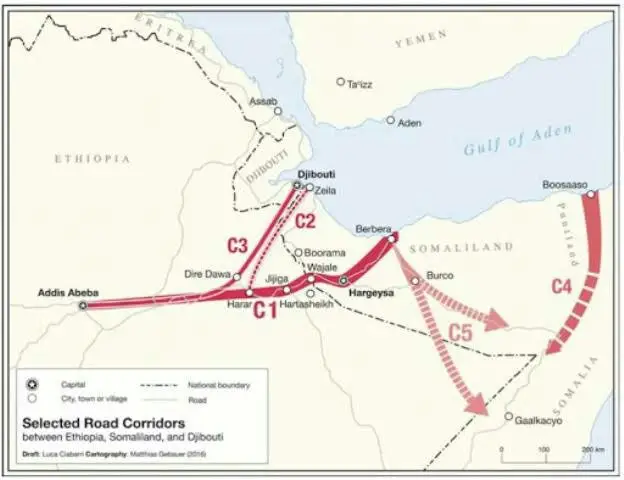
If Berbera is today becoming the nucleus of a new strategic configuration, it is above all because one actor has played a long game there: the United Arab Emirates. As early as 2017, the Somaliland parliament granted Abu Dhabi authorisation to establish a military base at Berbera, underpinned by a port concession operated by DP World and the modernisation of the airport. The Emirates invested more than 400 million dollars in the port and its associated logistical infrastructure, making the ensemble a critical node for their own operations in the Red Sea and the Gulf of Aden, but also an instrument of regional power projection toward Ethiopia — a landlocked country almost entirely dependent on Djibouti for its foreign trade.
To fully grasp why Berbera has become the object of such intense competition among Western powers and their Gulf allies, one must appreciate the scale of the silent crisis that has been corroding the American military dispositif in Djibouti for several years. Since the early 2000s, the American military architecture in the Horn of Africa has rested on a single pivot: Camp Lemonnier, the principal U.S. installation on the African continent, housing approximately four thousand military personnel, civilians, and contractors according to Pentagon data.
But since 2017, this pivot is no longer a sanctuary. The first permanent military installation China has ever opened abroad was established in Djibouti, just a few kilometres from American facilities.
This Sino-American proximity constitutes, in the history of contemporary military affairs, a near-singular case. It is not merely a question of the operational inconvenience produced by an unwanted neighbourhood, but of a structural contradiction: the two powers whose rivalry defines the central axis of twenty-first century global politics share the same geographic space and survey one another across a fence.
The documented harassment incidents — high-powered laser attacks directed at American pilots, disruptions to communications systems, systematic short-range electromagnetic intelligence collection — are not anecdotal. They proceed from the very logic of a cohabitation that geography has rendered possible and that rivalry makes increasingly untenable.
But the Djiboutian constraint extends beyond the security register. It is, more fundamentally, political — and it is this dimension that analyses centred on Sino-American competition tend to underestimate. The government of Ismail Omar Guelleh, whose economic survival depends substantially on Chinese capital invested in national infrastructure — the Port of Doraleh, the Addis Ababa–Djibouti railway, special economic zones — has reportedly refused to authorise American forces to conduct offensive strikes toward Yemen from its territory.
This restriction, formulated with the characteristic discretion of tacit arrangements between small states and great powers, is of decisive consequence in the context of the Houthi campaign in the Red Sea. What this means concretely is that Camp Lemonnier — despite being the most geographically well-positioned base in the entire American regional dispositif — is also one of the most operationally constrained. It can monitor, collect, relay, and support; it cannot strike freely. A base whose host controls its uses is less an instrument of power projection than a symbol of presence — costly, visible, but operationally limited.
Somaliland offers, by contrast, a radically different profile. Hargeisa has no structural reason to accommodate the Houthis — nor Iran, their financier and strategic patron — and possesses considerable political motivation to accept very broad operational clauses from Washington: American diplomatic recognition, whose attainment would condition the territory’s access to the Bretton Woods institutions, international bond markets, and multilateral aid programmes currently closed to it by virtue of its unrecognised status. As one American security source puts it: “Somaliland is willing to make any compromise to obtain recognition from Washington.” This formulation, in its analytical brutality, encapsulates the asymmetric exchange logic structuring this nascent relationship: very broad military access in exchange for a prospect of sovereign recognition — a barter that reveals as much about the strategic imperatives of great powers as about the existential vulnerability of the weaker partner.
Berbera’s geographic position facing the Yemeni coastline constitutes a rare tactical advantage within the region as a whole. Approximately two hundred kilometres from the Yemeni coast, the base under construction would offer a depth of power projection against Houthi positions that naval units operating in the Red Sea cannot sustainably match. This superiority is not merely geometric; it is also operational: a land-based aircraft enjoys greater endurance, a larger payload capacity, and reduced vulnerability to enemy countermeasures compared to a carrier-based aircraft compelled to operate within a narrow maritime corridor.
Since October 2023, the Houthis have transformed the Red Sea into a zone of permanent friction for global commerce. More than a hundred commercial and military vessels have been attacked or harassed; maritime insurance premiums have surged; shipping routes have been massively diverted around the Cape of Good Hope. The case of Eilat serves as a concrete reminder of what control of Bab el-Mandeb actually means: not a geopolitical abstraction, but the capacity to subject a national economy to a de facto blockade without a formal declaration of war.
The successive American operations — Prosperity Guardian and then Rough Rider — have exposed the structural limitations of an exclusively naval response to an asymmetric land-based threat. The Houthis compensate for material attrition through dispersal, redundancy, and tactical innovation. With Iranian technology transfers, they now possess weapons systems sophisticated enough to render surface vessels increasingly vulnerable within a constrained maritime space. A permanent land base at Berbera would thus offer a more sustainably viable deep-strike instrument.
It is in this context that one must read the operational triangulation taking shape at Berbera. The Emirates provide the financing, regional networks, and project management; the United States, strike capability and interoperability; Israel, intelligence, electronic warfare, and a direct strategic interest. Though not yet formally assumed, such an architecture would constitute one of the most concrete translations of the security division of labour inaugurated by the Abraham Accords in 2020.
For Israel, the stakes extend beyond coalition solidarity. Since Ansar Allah undertook the systematic blockade of Israeli-linked maritime transit through the Strait of Bab el-Mandeb, the Houthis have imposed a de facto partial blockade with severe and lasting economic effects. A presence at Berbera would allow Tel Aviv to shift its response posture: rather than an essentially defensive stance — predicated on the interception of Houthi missiles and drones — Israel could contribute to striking Houthi capabilities at their source. Somaliland would then cease to be a mere peripheral partner and become a forward operational outpost of strategic depth.
Yet this sequence must be read at another scale: that of the Sino-American competition for mastery over global maritime routes. Confronted with China’s base in Djibouti and Beijing’s port expansion within the framework of the Maritime Silk Road, Berbera represents for Washington a potential point of support outside the direct Chinese sphere of influence. Project 2025 has explicitly identified Somaliland as a credible alternative to Djibouti — a sign that this convergence is not merely conjunctural, but the culmination of long-term strategic deliberation.
Somaliland is not merely a coveted geographic space. It is a political society endowed with a history, a memory, and a project. Thirty-three years of effective self-governance since the 1991 declaration of independence, several peaceful democratic transitions of power, an original institutional architecture articulating the formal structures of the modern state with traditional mechanisms of clan governance: Somaliland is frequently presented as one of the most remarkable experiments in state-building on the African continent. And it is precisely this characteristic that renders it, paradoxically, so vulnerable. For international recognition — that irreducible horizon structuring the entirety of Hargeisa’s foreign policy since 1991 — has the quality of a receding horizon: the closer one approaches, the more the conditions for its attainment grow complex and accumulate counterparts whose terms the local populations never architect.
This dependency creates a radical asymmetry of negotiation that possesses an interior dimension which geostrategic analyses too often neglect. The Somaliland population is not a passive variable. It observes, deliberates, and holds deep religious convictions — the vast majority of its members are Sunni Muslims — as well as a vivid political memory of what it means to be sacrificed on the altar of great-power interests. The generation that survived the bombings of Siad Barre, whose army used Soviet weapons to destroy Hargeisa in 1988, has not forgotten that foreign powers were silent at the time. The generation that today watches images of Gaza on its mobile phones is not necessarily disposed to welcome an Israeli presence on its territory as the reasonable price of a recognised passport. This tension between the imperative of recognition and the convictions of Somaliland civil society may well constitute the most undervalued variable in the entire dispositif — and potentially the most destabilising one over the medium term.
The Djiboutian case is, in this regard, of considerable illustrative power. Djibouti has built the essential architecture of its economic model on the monetisation of its geographic position — and has found itself, by simultaneously hosting the American, Chinese, French, Japanese, and Italian bases on a territory of twenty-three thousand square kilometres, in a situation of constrained neutrality that structurally limits its foreign policy. It is precisely this plurality of partners that affords Djibouti a minimal margin of manoeuvre that Somaliland — were it to anchor itself exclusively to the Washington–Tel Aviv–Abu Dhabi axis — would not possess. By inscribing itself within a logic of exclusive dependency vis-à-vis a single constellation of partners, Hargeisa would deprive itself of the diversification that constitutes, for any small state in a condition of structural vulnerability, the minimal precondition for the preservation of genuine decisional autonomy.
The totality of these dynamics — the Israeli–Somaliland rapprochement, the hypothesis of a more formalised diplomatic representation, the possible construction of a tripartite military base at Berbera, American resolve to reduce its dependency on Djibouti, and the persistent and growing sophistication of the Houthi threat — traces the contours of a new regional security system in formation in the Horn of Africa and the northern Indian Ocean. This system articulates several superimposed logics, none of which can be isolated without losing an essential part of its intelligibility: an anti-Iranian logic binding together Israel, the United States, and the Sunni monarchies of the Gulf; an anti-Chinese logic motivating the recomposition of the American dispositif beyond Djibouti; a commercial and transit logic compelling all maritime powers to secure Bab el-Mandeb; and a recognition logic driving Somaliland to contemplate conditions that no already-recognised sovereign state would readily accept under other circumstances.
This emergent system will inevitably provoke counter-reactions whose speed and diversity it would be imprudent to underestimate. Iran commands a considerable repertoire of destabilisation instruments: political and economic pressure on Mogadishu to exacerbate the territorial dispute with Somaliland, financial and ideological support for internal Islamist opposition movements, activation of jihadist networks present in the Horn — notably al-Shabaab. China will mobilise its considerable economic leverage over the region’s states to diplomatically isolate the Somaliland entity. Federal Somalia will actively seek partners capable of reversing the balance of forces — in the direction of Turkey, whose military presence in Somalia since 2017 already constitutes a non-negligible factor of power, or even Russia, which is multiplying its attempts at implantation across sub-Saharan Africa.
This multi-actor game, whose rules are still being elaborated and whose outcome is by no means predetermined, constitutes one of the most complex and consequential geopolitical theatres for the configuration of the world order over the coming two decades. Berbera is not merely an airport undergoing transformation in the northern Horn of Africa: it is the first visible construction site of a new regional order whose foundations are still fiercely contested, whose architects have not yet disclosed the entirety of their plans, and whose inhabitants — the Somalilandis — remain simultaneously the indispensable hosts of this collective ambition and the actors least well-positioned to define its terms and control its consequences. In this region that has witnessed, since the nineteenth century, the successive designs of British, French, Italian, Soviet, and American powers, local societies have always ultimately survived the architectures that foreign powers built upon their lands — sometimes at the cost of tragedies whose memory remains vivid. Berbera may well become a global strategic pivot. But it will remain, first and foremost, an inhabited place.