















Contextualizing MTN within the Evolution of Terrorism Financing Prosecution
The criminal investigation into South Africa’s MTN Group represents a potential watershed moment in corporate accountability that could fundamentally redefine how multinational corporations operate in conflict zones. This case synthesizes two decades of legal precedent evolution while introducing unprecedented elements that may establish new benchmarks for corporate liability in terrorism financing. Understanding MTN’s position within this legal landscape requires examining how corporate accountability has transformed from modest civil remedies into existential criminal penalties, and why this particular case represents the culmination of prosecutorial trends that began in the aftermath of 9/11.
Legal Framework Architecture: The Foundation for Corporate Terrorism Prosecution
The prosecution of corporations for terrorism-related conduct rests upon a complex architecture of overlapping statutes that have evolved to address the changing nature of global commerce and international terrorism. This legal framework provides the jurisdictional and substantive foundation for understanding how cases like MTN’s can proceed despite the foreign nationality of defendants and the overseas location of alleged misconduct.
Criminal prosecution pathways typically proceed under several key statutes: the International Emergency Economic Powers Act (IEEPA) for sanctions violations, the Bank Secrecy Act (BSA) for money laundering, and material support for terrorism laws under 18 U.S.C. § 2339A and 2339B. These statutes carry massive financial penalties and allow prosecutors to pursue foreign corporations whose conduct impacts U.S. interests. The evolution of these enforcement mechanisms reflects a fundamental shift from viewing terrorism financing as a peripheral compliance issue to treating it as core national security prosecution priority.
Civil litigation frameworks have developed along parallel tracks, with the Alien Tort Statute (ATS) providing initial pathways for foreign victims to seek U.S. court remedies, while the Anti-Terrorism Act (ATA) and Justice Against Sponsors of Terrorism Act (JASTA) specifically address harm to U.S. persons from international terrorism. Critically, these civil statutes allow victims’ families to pursue corporate defendants even after criminal prosecutions conclude, creating persistent liability exposure that can span decades.
Extraterritorial jurisdiction principles have expanded dramatically since 2001, with U.S. courts increasingly willing to assert authority over foreign corporations whose conduct affects Americans or utilizes U.S. financial systems. The MTN investigation exemplifies this trend, as a South African corporation faces potential prosecution for conduct in Afghanistan and Iran that allegedly harmed U.S. service members. This represents the maturation of post-9/11 legal theories that treat terrorism financing as inherently international conduct subject to universal jurisdictional principles.
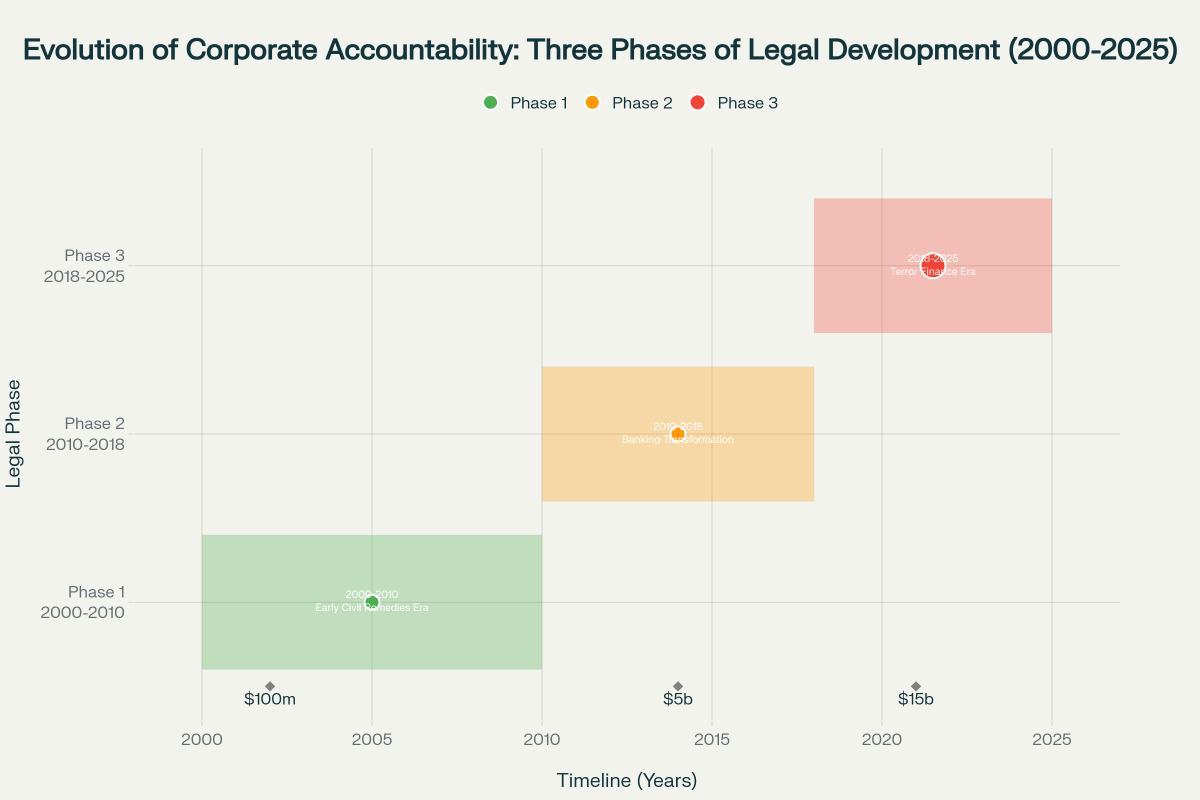
Three-phase evolution of corporate accountability showing progression from civil remedies to criminal prosecution with exponentially increasing penalties
The Three-Phase Evolution: From Civil Remedies to Criminal Megapenalties
Corporate accountability for terrorism-related conduct has undergone a systematic evolution across three distinct phases, each characterized by expanding legal theories, escalating penalties, and broadening jurisdictional reach. This progression reveals how legal frameworks have adapted to address increasingly sophisticated forms of corporate complicity in international terrorism.
Phase One (2000-2010): Establishing Civil Precedents
The foundational period began with pioneering civil cases that established basic principles of corporate liability for overseas human rights violations. The Doe v. Unocal case in 2005 proved transformative, demonstrating that U.S. courts would exercise jurisdiction over multinational corporations for conduct occurring entirely outside U.S. territory. Unocal’s joint venture with Myanmar’s military regime to construct the Yadana gas pipeline resulted in systematic forced labor, rape, torture, and murder by military forces protecting the project. Although the settlement amount remains undisclosed, the case established that the Alien Tort Statute provided viable pathways for corporate accountability and that voluntary market entry into conflict zones implied acceptance of foreseeable consequences.
This phase established several enduring principles: corporate defendants cannot claim ignorance of local political conditions when entering conflict markets; business necessity defenses fail when corporations voluntarily choose to operate in territories controlled by violent actors; and U.S. courts will assert jurisdiction over foreign corporations when their conduct violates international law. However, penalties remained modest, typically involving undisclosed settlements that, while symbolically significant, did not create the massive financial deterrence that would characterize later phases.
Phase Two (2010-2018): Banking Sector Transformation and Billion-Dollar Penalties
The second phase marked a revolutionary expansion in both the scale of corporate penalties and the sophistication of prosecution theories, primarily targeting financial institutions whose sanctions violations and money laundering facilitated terrorism financing. This transformation reflected enhanced post-9/11 enforcement capabilities and the recognition that global banking systems had become critical infrastructure for terrorist financing networks.
The BNP Paribas prosecution established the template for modern corporate terrorism enforcement, resulting in an unprecedented $8.9 billion settlement in 2014. Between 2005 and 2012, BNP systematically circumvented U.S. sanctions by processing over 3,800 transactions involving Sudan, Iran, Cuba, and Myanmar while concealing references to sanctioned parties through elaborate SWIFT message manipulation. The magnitude of this penalty reflected both the systematic nature of violations and the geopolitical significance of sanctioned regimes accused of supporting terrorism and weapons proliferation. Critically, BNP’s conduct directly undermined U.S. foreign policy objectives in regions central to counterterrorism efforts.
The HSBC settlement of $1.9 billion in 2012 demonstrated how money laundering prosecutions could encompass terrorism financing theories. HSBC’s operations served as conduits for $881 million from Mexican drug cartels while providing banking services to entities in Saudi Arabia and Bangladesh with documented al-Qaeda connections. The case revealed institutional failures so systematic that cartel members customized cash deposit boxes to fit HSBC Mexico teller windows, highlighting how corporate cultures prioritizing profits over compliance could create vulnerabilities exploited by terrorist-linked organizations.
Standard Chartered’s repeated violations, culminating in $1.1 billion in penalties by 2019, illustrated how corporations could become recidivist offenders in terrorism-related compliance failures. The bank’s conduct proved particularly egregious because violations continued despite explicit regulatory warnings and prior settlements, with recent whistleblower allegations suggesting the bank facilitated “many billions of dollars” for Iran and “international terror groups” through front companies. This pattern of persistent violations established precedents for enhanced penalties against repeat offenders and demonstrated that initial settlements would not shield corporations from additional prosecution for continued misconduct.
Phase Three (2018-Present): Direct Terrorism Financing and Record-Breaking Exposure
The current phase represents the most aggressive expansion of corporate accountability, targeting companies that directly financed designated terrorist organizations rather than merely facilitating such financing through negligent compliance. This evolution reflects prosecutors’ growing confidence in applying terrorism financing statutes to corporations whose business operations systematically strengthen terrorist capabilities.
The Lafarge prosecution in 2022 marked a watershed moment, as the cement manufacturer pleaded guilty to conspiracy charges and paid $778 million for making direct payments to ISIS and other terrorist groups in Syria between 2011 and 2015. Like MTN’s alleged Taliban arrangement, Lafarge’s conduct involved deliberate payments to maintain operations in terrorist-controlled territory, with payments evolving from protection money into revenue-sharing arrangements allowing ISIS to collect “taxes” proportionate to cement sales. The case definitively established that corporations cannot claim extortion defenses when voluntarily operating in terrorist territories, and that predictable strengthening of terrorist organizations through corporate payments constitutes material support regardless of business justifications.
The Chiquita verdict in 2024, awarding $38.3 million to Colombian terrorism victims, demonstrated the persistent nature of terrorism financing liability. Despite paying $25 million in criminal fines in 2007 for financing AUC paramilitaries, Chiquita faced continued civil litigation spanning nearly two decades. The recent verdict established that corporate knowledge of terrorist designation, combined with material support through financial payments, creates proximate causation liability for specific acts of terrorism committed by supported organizations. The 17-year gap between criminal settlement and civil verdict illustrates how terrorism financing cases generate cascading legal consequences that can persist indefinitely.
These precedent cases demonstrate an exponential progression in both penalty scales and legal sophistication. Where early civil cases generated modest settlements, recent prosecutions impose penalties that can exceed corporate market capitalizations and establish liability theories extending far beyond traditional regulatory violations to encompass direct complicity in international terrorism.
MTN’s Precedential Synthesis: Combining the Worst Elements of Two Decades
MTN’s alleged conduct represents an unprecedented synthesis of the most serious elements from every major corporate accountability precedent, creating potential liability that could exceed all previous cases combined. Unlike earlier prosecutions that typically involved single violation categories or limited timeframes, the MTN investigation encompasses systematic terrorism financing across two decades, two conflict zones, and two of the world’s most significant terrorist organizations.
Operational Structure and Geographic Scope: MTN’s operations in Afghanistan (2006-2021) and Iran (2005-2025) position the company in precisely the territories that represent the gravest threats to U.S. national security interests
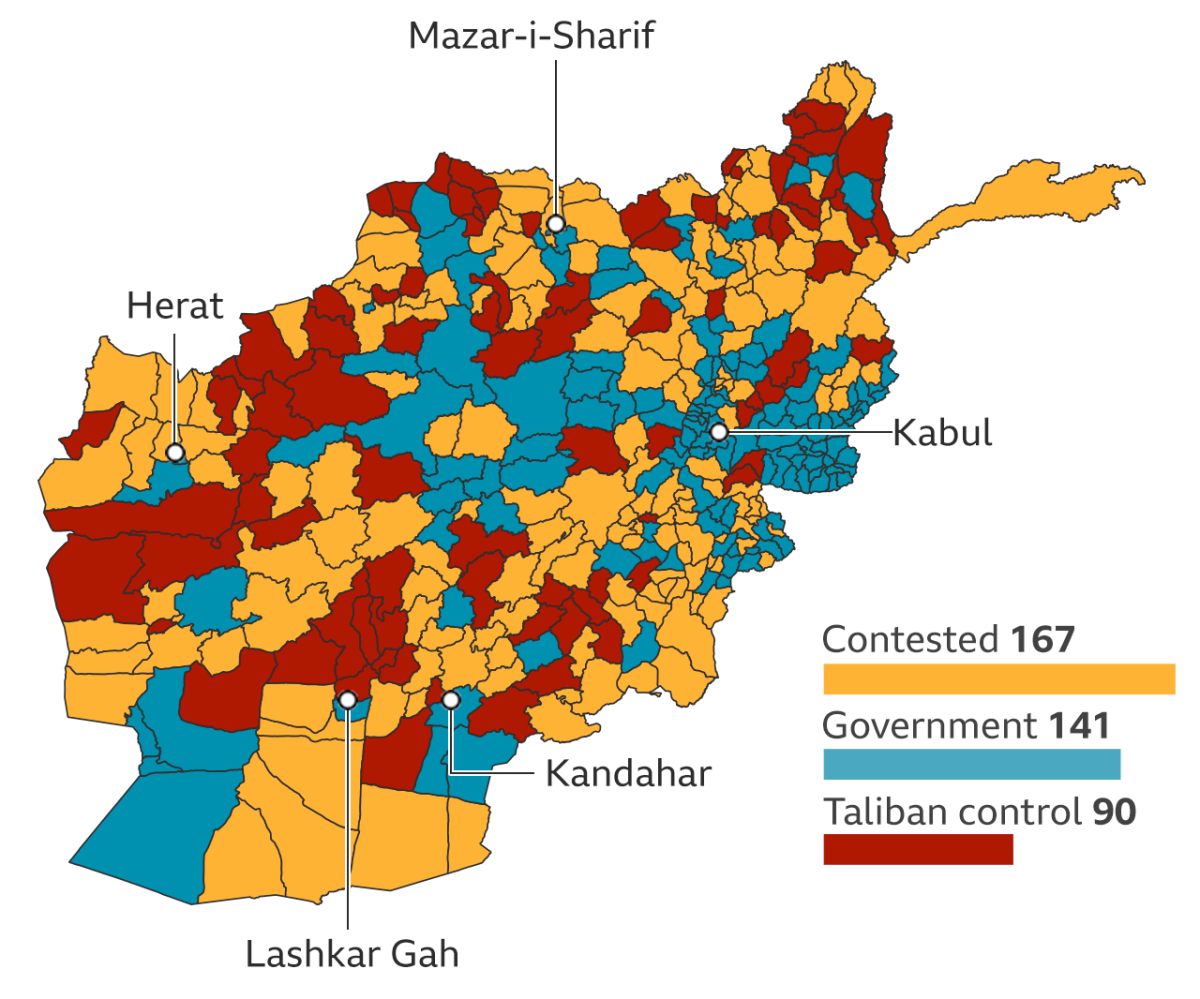
Color-coded map showing Afghanistan’s districts by control status: contested, government, and Taliban-held areas during the conflict.
. The Afghanistan allegations involve direct protection payments to Taliban militants controlling territory through which MTN operated telecommunications infrastructure, creating systematic revenue flows to the organization responsible for killing thousands of American service members and contractors. Simultaneously, MTN’s 49% stake in MTN-Irancell allegedly channeled billions in revenue to Iran’s Supreme Leader, Ministry of Defense, and the Islamic Revolutionary Guard Corps. This dual-theater operation creates liability exposure across the two most significant U.S. counterterrorism priorities of the past two decades.
Financial Scale and Duration: The temporal scope of MTN’s alleged conduct—spanning fifteen years in Afghanistan and twenty years in Iran—exceeds every precedent case while involving revenue flows potentially measuring in the tens of billions of dollars. Where BNP Paribas faced $8.9 billion penalties for seven years of sanctions violations involving billions in transaction processing, MTN’s joint venture structure generated sustained revenue sharing with terrorist-controlled entities over periods three times longer. The mathematical progression of penalty calculations based on duration, revenue scale, and terrorist organization significance suggests potential financial exposure that could approach or exceed $15-20 billion.
Legal Framework Convergence: MTN faces prosecution under the Anti-Terrorism Act and Justice Against Sponsors of Terrorism Act—statutes specifically designed to address harm to U.S. persons from international terrorism. Unlike sanctions violation cases involving abstract compliance failures, MTN’s alleged conduct directly contributed to attacks that killed identifiable American victims, creating powerful causal narratives linking corporate payments to specific terrorist operations. The involvement of both Taliban and IRGC—two organizations designated as among the world’s most dangerous terrorist entities—provides prosecutors with compelling evidence of knowing material support to America’s primary enemies.
Corporate Defense Vulnerabilities: The standard corporate defenses deployed successfully in earlier cases appear particularly weak when applied to MTN’s situation. Extortion claims fail when corporations voluntarily choose to operate in terrorist-controlled territories for extended periods while maintaining profitable operations. Lack of control arguments become irrelevant under material support theories that require only predictable strengthening of terrorist capabilities. Business necessity justifications cannot excuse violations of anti-terrorism laws when alternatives like market withdrawal remained available throughout the alleged twenty-year period. Jurisdictional challenges face their strongest opposition given direct harm to U.S. service members and the use of international financial systems to facilitate terrorist revenue flows.
This convergence of aggravating factors—unprecedented duration, massive financial scale, direct harm to Americans, involvement of designated terrorist organizations, and weak defense options—positions MTN for potentially record-breaking penalties that could establish new benchmarks for corporate accountability in terrorism financing cases.
Implications for Global Business and Legal Evolution
The MTN investigation represents far more than an isolated prosecution; it signals fundamental transformations in how legal systems address corporate complicity in international terrorism and how multinational businesses must evaluate operational risks in conflict zones. These implications extend across regulatory frameworks, business strategy, and geopolitical enforcement mechanisms with consequences that will reshape corporate behavior for decades.
Regulatory and Compliance Revolution: Every multinational corporation must now recognize that routine business operations in certain territories can generate existential terrorism financing liability regardless of corporate nationality or primary jurisdiction. The compliance costs alone will reshape global business models as companies invest billions in enhanced due diligence, operational monitoring, and legal protections sufficient to identify and prevent inadvertent terrorist financing. Traditional risk assessment frameworks focused on political instability and regulatory compliance must expand to encompass terrorism financing liability that can result in penalties exceeding corporate market capitalizations. Board-level oversight of terrorism financing risks becomes a fiduciary duty, with potential criminal liability for systematic failures to identify and prevent material support to terrorist organizations.
Market Access and Strategic Withdrawal: The MTN precedent will force corporations to reconsider fundamental assumptions about frontier market entry and operational persistence in conflict zones. Entire regions may become economically inaccessible if operational requirements predictably generate terrorism financing liability exceeding potential profits. The case establishes that corporations cannot compartmentalize business operations from political contexts when those contexts involve designated terrorist organizations. Strategic withdrawal from profitable markets may become necessary when continued operations risk generating liability that threatens corporate survival.
Extraterritorial Enforcement Evolution: MTN’s prosecution demonstrates the weaponization of corporate accountability to advance U.S. geopolitical objectives without requiring military action or diplomatic agreements. Corporate penalties become instruments of economic warfare, disrupting enemy financing through the American justice system while encouraging reciprocal enforcement by other nations targeting American corporations for activities their governments consider terrorism support. This trend transforms corporate accountability from domestic law enforcement into international conflict by legal proxy, with multinational corporations becoming strategic targets in broader geopolitical competitions.
Victim-Centered Justice Expansion: The shift from regulatory penalties to victim-centered compensation creates powerful moral narratives that resonate with juries, judges, and public opinion. Terrorism financing becomes not abstract regulatory violation but personal betrayal of American families, generating emotional dimensions that can produce jury verdicts reflecting popular outrage rather than calculated financial deterrence. This personalization of corporate accountability ensures that terrorism financing cases will continue generating persistent legal exposure as victims’ families pursue civil remedies spanning multiple decades.
Conclusion: The End of Consequence-Free Globalization
The MTN investigation marks the culmination of a twenty-year evolution in corporate accountability that began with the 9/11 attacks and has steadily expanded to encompass every aspect of multinational business operations that might facilitate international terrorism. What originated as narrow sanctions enforcement has become comprehensive regulation of corporate conduct in conflict zones, with criminal liability for systematic failures and civil liability for predictable consequences extending across all jurisdictions and all time periods.
This case establishes that no corporation is too large, too international, or too economically important to escape accountability for terrorism financing, regardless of corporate structure, operational complexity, or claimed business necessity. The era of corporate impunity—built upon assumptions that multinational corporations could operate above or beyond national legal systems—has definitively ended. In its place emerges a global accountability framework where corporate actions anywhere generate legal consequences everywhere, and where business decisions must account for their impact on international security and American lives.
For the broader business community, MTN represents both warning and precedent: the post-9/11 legal framework treats terrorism financing as the most serious category of corporate misconduct, with penalties sufficient to destroy corporate legacies and eliminate shareholder value entirely. Companies operating in conflict zones or maintaining relationships with state sponsors of terrorism face unprecedented legal risks that can result in existential financial penalties regardless of their primary jurisdiction, operational legitimacy, or economic importance to host countries.
The transformation from modest settlements of the early 2000s to potential penalties exceeding $20 billion reflects not merely inflation in enforcement priorities but fundamental evolution in how legal systems conceptualize corporate responsibility for international terrorism. MTN’s case will likely establish new precedents for holding corporations accountable not merely for regulatory violations but for structural business decisions that materially support international terrorism, creating liability standards that will influence corporate behavior across all industries and jurisdictions for generations to come.
The message to multinational corporations is unmistakable: the era of consequence-free globalization has ended, and the costs of operating in conflict zones now include potential penalties that can exceed the total value of global operations. Corporate accountability has become an instrument of national security policy, and terrorism financing liability represents an existential business risk that no compliance program can entirely eliminate and no corporate structure can definitively avoid.