










How the Doha Strike Repeats France’s Historical Diplomatic Humiliation
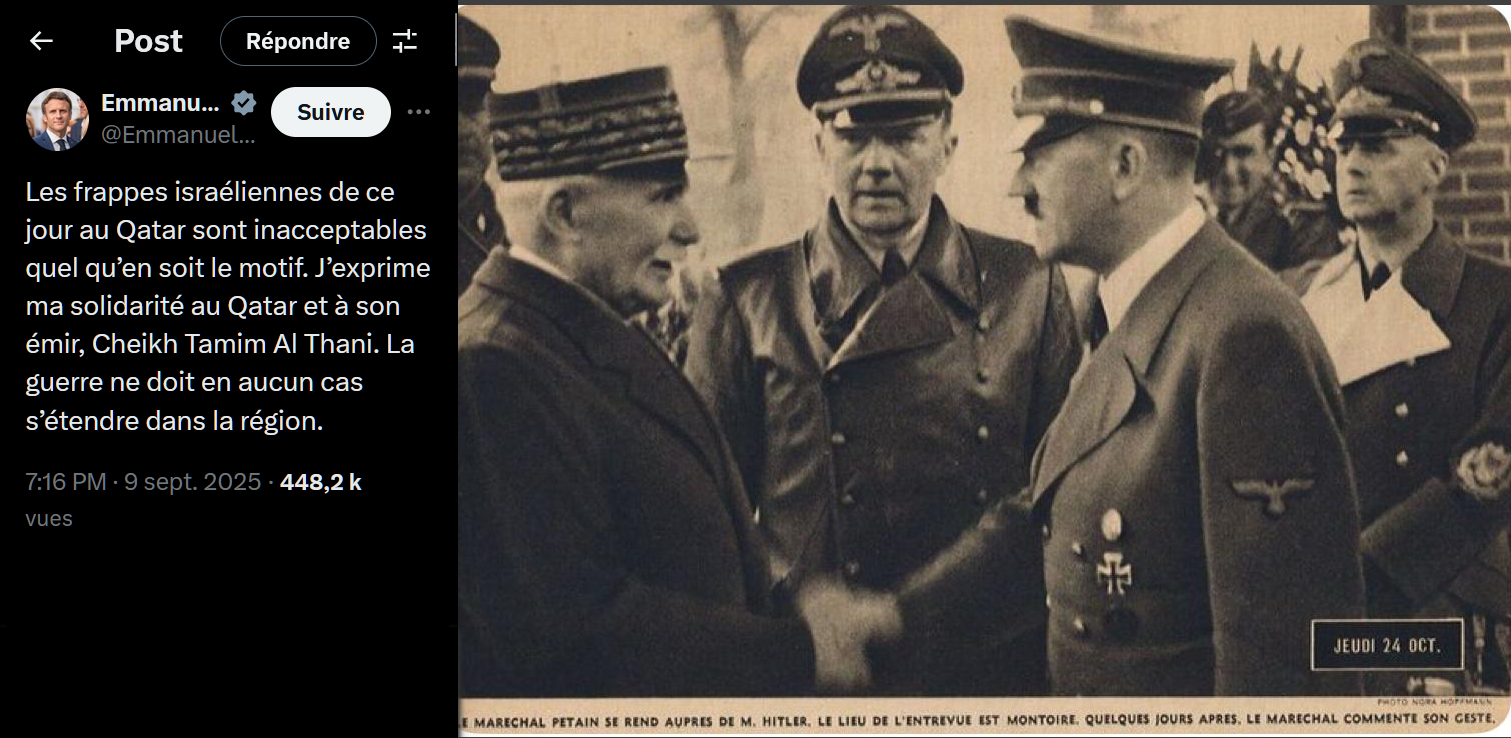
Eighty-five years after Pétain’s capitulation at Montoire, Macron appears as a mere “kinglet” at the Élysée, ensnared by the Doha strike that lays bare the failure of his Middle Eastern diplomacy. Nevertheless, this historical parallel is not merely anecdotal: it reveals the powerlessness of a president trapped by his own ambitions. French diplomacy proves to be of extreme fragility in the Middle East, caught between domestic turmoil and substantial Qatari financial stakes.
Macron refrained from explicitly condemning the attack, merely stating in factual terms that “today’s Israeli strikes in Qatar are unacceptable regardless of their motive,” as if he already controlled the narrative. This linguistic nuance effectively suggests knowledge of the operation’s particular circumstances: he deliberately accommodates his allies so as not to jeopardize his September 22nd conference on the two-state solution and avoid fracturing his traditional Middle Eastern support base. Macron’s measured response reveals the depth of his diplomatic impasse, particularly given that France has consistently been quick to denounce Israeli military operations, especially in a country where it has invested significant diplomatic and financial capital. This restraint reflects France’s complex strategic calculations.
The strike coincided with Hamas discussions regarding a ceasefire proposed by Trump. This simultaneity indicates coordination between Tel Aviv and Washington, all the more plausible given that Qatar hosts the American Al-Udeid base, sheltering over 10,000 military personnel. As one specialist observes, the base provides no protection if the Americans authorize an attack. This alignment undermines Qatari sovereignty and exposes the country’s dependence on its allies.
Constrained between the fear of isolation vis-à-vis Tel Aviv and the imperative to accommodate Doha, France adopts a strategy of inertia: abstaining from any formal condemnation, postponing or diminishing the conference’s scope, and privileging behind-the-scenes negotiations to contain the crisis. The French president must save face: any frontal criticism of Israel would risk compromising participants’ adherence to the “two-state solution.” In New York, the American visa refusal for Palestinian delegations and the elimination of Hamas leadership already render it obsolete. He must furthermore preserve Qatari relations; France cannot alienate Doha. Indeed, the ten billion euros committed by Doha in February 2024 remains one of the most significant foreign financial partnerships in recent French history, granting it influence over French domestic policy. Beyond ownership of Paris Saint-Germain and major stakes in LVMH, Katara Hospitality, and Printemps, the emirate is associated with TotalEnergies in exploiting Qatar’s North Field gas reserves. This economic and energy dependence poses a moral dilemma for Paris: denouncing Doha would risk jeopardizing industrial projects and energy security crucial to French autonomy.
Finally, internal instability exacerbates the crisis: the fall of the Bayrou government on September 8th, the eve of the strike, deprives Macron of all credibility and maneuvering room to conduct bold diplomacy. This temporal coincidence reinforces the impression of an isolated president, constrained to navigate between contradictory interests without room for maneuver. His tweet brilliantly illustrates the collapse of the French mediation project in the Middle East and reveals how economic dependencies and geopolitical realities can reduce a great diplomatic power to calculated declarations of impotence. Paradoxically, this weakness reinforces his international isolation. His cynical calculation henceforth serves solely to preserve appearances.
One year after Hezbollah’s “beep beep” alerts, the Doha strike constitutes a new escalation in Israeli strategy. It proves that with American approval, Israel can strike anywhere, even within a major U.S. ally’s territory. Macron not only acknowledges his powerlessness, for financial and strategic dependence never harmonizes with a mediator’s role in a region where power dynamics evolve at breakneck speed. He discovers the limitations of European soft power against determined American-Israeli coordination. His sole option: accommodate Doha without alienating Tel Aviv and Washington. Between the fear of isolation from Israel and the necessity of not offending the emirate, French strategy will likely orient toward public quasi-inertia, namely mobilizing discrete channels to limit the incident without disrupting equilibria, avoiding any formal condemnation of the Qatar strike, and postponing or reducing the conference’s ambitions should diplomatic conditions fail to evolve.
Ultimately, Doha has buried the Élysée kinglet’s illusion and sealed the interment of his purported regional influence. Qatar officially renounces any mediating role, and Paris witnesses, powerless, the diplomatic reversal it believed it was orchestrating. Like Pétain at Montoire, Macron wagered on the wrong horse: an illusory mediation backed by fragile financial alliances that collapse at the first show of force. Incapable of defending his interests and partners, the French president appears for what he is: a leader of fine speeches but without any tangible capacity for action against petrochemical realpolitik and the American umbrella.
This Middle Eastern disillusionment should resonate as the epitaph of his “French model” of mediation, revealing that in diplomacy as in 1940, choosing the losing side leads inexorably to humiliation.