















South Africa stands on the threshold of an unprecedented legal development: the imminent prosecution of apartheid-era crimes as offenses against humanity.
The COSAS 4 Case: Judicial Recognition of Crimes Against Humanity
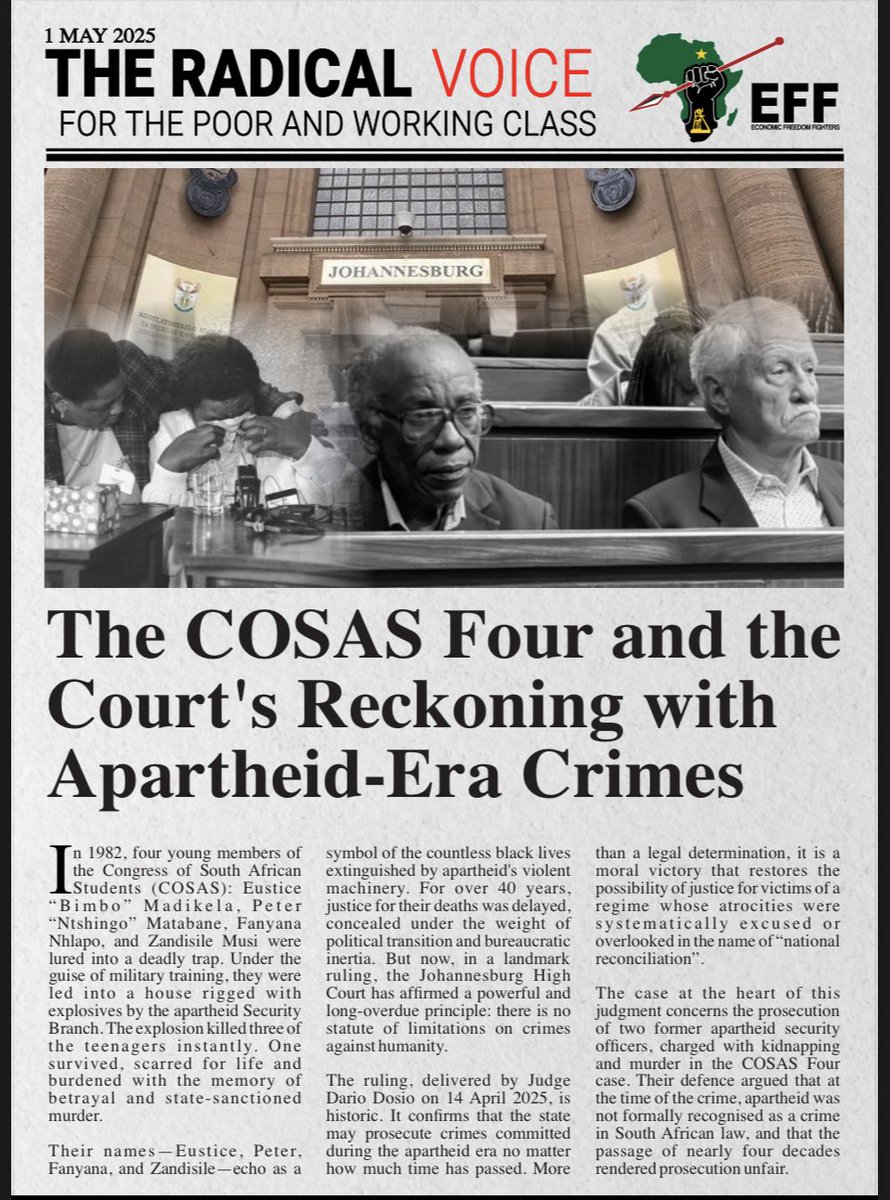
In April 2025, a South African High Court rendered a seminal decision, affirming that individuals accused of orchestrating the murder of three anti-apartheid student activists—members of the Congress of South African Students (COSAS)—and the grievous wounding of a fourth, may be prosecuted for their alleged actions dating back forty-three years. This historic progression, catalyzed by a recent High Court ruling, rekindles aspirations for justice among survivors and their families, many of whom have endured decades of impunity and silence. The accused, whose application for judicial recusal was summarily dismissed, now face charges not only of murder but, crucially, of perpetrating crimes against humanity under the rubric of apartheid.
This case, colloquially known as the “COSAS 4,” is momentous not merely for the redress it offers to aggrieved families after nearly half a century, but for its broader legal ramifications: it marks the first instance in which a South African court will adjudicate allegations of apartheid as a crime against humanity. Notably, this is also the inaugural occasion globally where apartheid, as such, is prosecuted in a criminal forum.
The Imperative of the Rule of Law: Justice, Not Political Retribution
It is of paramount importance to underscore that the initiation and conduct of such prosecutions must be firmly anchored within the strictures of the rule of law. These proceedings must not devolve into instruments of political vengeance or be co-opted to serve the divisive interests of identity politics, irrespective of the racial or political identities of the accused or the prevailing government. The pursuit of justice for apartheid-era crimes must be impartial, equitable, and devoid of any ulterior motive to exact retribution upon individuals based solely on their association with the former regime or their racial identity. Justice, in its purest form, demands that the process be insulated from manipulation by any political entity, including the African National Congress (ANC) or any other governing authority, which might seek to exploit such cases for populist or retaliatory ends.
Factual and Legal Background
On February 15, 1982, four COSAS members—Eustice ‘Bimbo’ Madikela Mathlapo, Peter ‘Ntshingo’ Matabane, Fanyana Nhlapo, and Zandisile Musi—were allegedly lured to an explosives-rigged mine in Krugersdorp, resulting in the deaths of three and the serious injury of Musi. The alleged perpetrators, then operatives of the apartheid state, were implicated during the Truth and Reconciliation Commission (TRC) hearings in 1999. However, indictments against two surviving suspects, Christiaan Siebert Rorich and Tlhomedi Ephraim Mfalapitsa, were only issued in 2021, with the remaining accused having since died.
The protracted delay in prosecution has been attributed to alleged political interference, institutional inertia within law enforcement, and contentious legal debates regarding the temporal jurisdiction of South African courts over pre-1994 offenses.
Legal Arguments and Judicial Reasoning
The accused advanced two principal defenses: first, that a statute of limitations should preclude prosecution for crimes committed over two decades prior; and second, that South Africa lacked jurisdiction to prosecute crimes against humanity committed before its accession to relevant international conventions, such as the Rome Statute of the International Criminal Court.
The High Court, concurring with the National Prosecuting Authority (NPA), rejected both contentions. It affirmed that neither murder nor crimes against humanity are subject to statutory limitation, and that customary international law—by virtue of South Africa’s Constitution—forms an integral part of domestic law. The Court further recognized the state’s enduring obligation to investigate and prosecute international crimes, irrespective of the date of their commission.
Broader Implications and the Path Forward
This jurisprudential milestone not only facilitates the prosecution of the COSAS 4 case but also creates a legal pathway for the adjudication of other apartheid-era atrocities that may qualify as crimes against humanity. The evidentiary burden, however, remains formidable: the prosecution must establish that the acts in question were part of a widespread or systematic attack against a civilian population, reflecting the policies and practices of the apartheid regime.
To mitigate the risk of acquittal should the threshold for crimes against humanity not be met, the accused have also been charged with common law offenses of kidnapping and murder, both of which carry severe penalties.
The Role of Civil Society and the State’s Obligations
This judicial development vindicates the persistent advocacy of South African civil society organizations—such as the Legal Resources Centre, Foundation for Human Rights, and Southern Africa Litigation Centre—which have tirelessly championed the cause of victims’ families. In response to litigation by survivors and relatives, President Cyril Ramaphosa recently announced the establishment of a Commission of Inquiry to investigate allegations of political interference in the prosecution of these cases.
Justice as a Universal Imperative
Ultimately, the pursuit of justice for apartheid-era crimes must be guided by the principles of fairness, impartiality, and the rule of law. It must serve the interests of truth, accountability, and healing for victims and their families, rather than being appropriated as a vehicle for political retribution or identity-based manipulation. The COSAS 4 judgment exemplifies the TRC’s original vision—embodied in the transfer of over 300 cases to the NPA in 2003—for a society in which no perpetrator of gross human rights violations enjoys impunity.
While formidable challenges remain, this landmark ruling unequivocally affirms that apartheid and its attendant crimes are subject to prosecution under both South African and international law, irrespective of the passage of time. The imperative now is to ensure that the administration of justice remains unsullied by political expediency, and that it continues to serve, in the fairest manner possible, the cause of justice for all