
















Converting De Facto Statehood into Durable Regional Architecture in the Horn of Africa
If Somaliland formally joins the Abraham Accords, the Horn of Africa will not be remade in a single diplomatic gesture, nor will the region’s legal cartography instantly change. The more plausible—and more strategically significant—outcome is an incremental but cumulative reconfiguration of the Horn’s operational order: new patterns of security coordination, new channels for risk underwriting and investment, and new logistics routines that, over time, harden into a “taken-for-granted” equilibrium.
In that sense, the central analytic question is not the symbolism of accession, but the institutional depth that follows it. The decisive variable is whether Somaliland is absorbed into the Accords’ working machinery: standing coordination mechanisms, budgeted security cooperation, bankable project pipelines, compliance and financial intermediation channels, and credible third-party de-risking instruments. Where those layers materialize, Somaliland’s sovereignty becomes more than an argument; it becomes a repeated practice—and repetition is how international politics normalizes contested realities.
Against that backdrop, strong regional reporting and expectations indicate that President Abdirahman Mohamed Abdullahi (Irro) may sign the Abraham Accords on 20 January 2026, alongside a separate bilateral agreement with the Government of Israel. If this occurs, the consequence will not primarily be reputational; it will be structural—provided that accession is translated into operational commitments rather than declaratory alignment.
Somaliland’s core strategic advantage has long been that it behaves like a state in the ways that matter most to security planners and investors: governance continuity, relative stability, and an ability to police territory and coastlines more effectively than many regional comparators. In international relations terms, Somaliland has accumulated significant empirical statehood, even where juridical statehood remains disputed. Abraham Accords integration matters because it can accelerate the conversion of empirical statehood into functional recognition-by-routine—a dynamic whereby external actors (banks, insurers, port users, security partners, logistics firms, donor agencies) begin interacting with Somaliland as a distinct jurisdiction because it is operationally efficient to do so, regardless of formal diplomatic language. This is not semantic. It is the mechanism by which contested polities become progressively harder to ignore.
A pro‑Israel assessment here is grounded in capabilities and institutional effects, not sentiment. Israel offers a rare combination of security competence and innovation capacity that directly matches Somaliland’s developmental and strategic constraints:
- Water security and arid-zone agriculture (irrigation efficiency, drought-resilient production, food systems planning);
- Public health and emergency preparedness (systems that scale under strain);
- Cyber resilience and digital governance (protecting critical infrastructure, financial networks, and state data);
- Intelligence fusion and counter-terrorism methods relevant to the Horn’s threat environment;
- Critical infrastructure protection for ports, corridors, and energy/communications nodes.
Equally important is the credibility multiplier: when Israel engages through an Abraham Accords framework, it often helps create a structured ecosystem that Gulf capital, Western risk insurers, and private logistics actors can plug into. For Somaliland, that translates into one of the most decisive shifts available to an unrecognized or partially recognized polity: lowering the non-recognition risk premium that inflates the cost of capital and suppresses long-term investment.
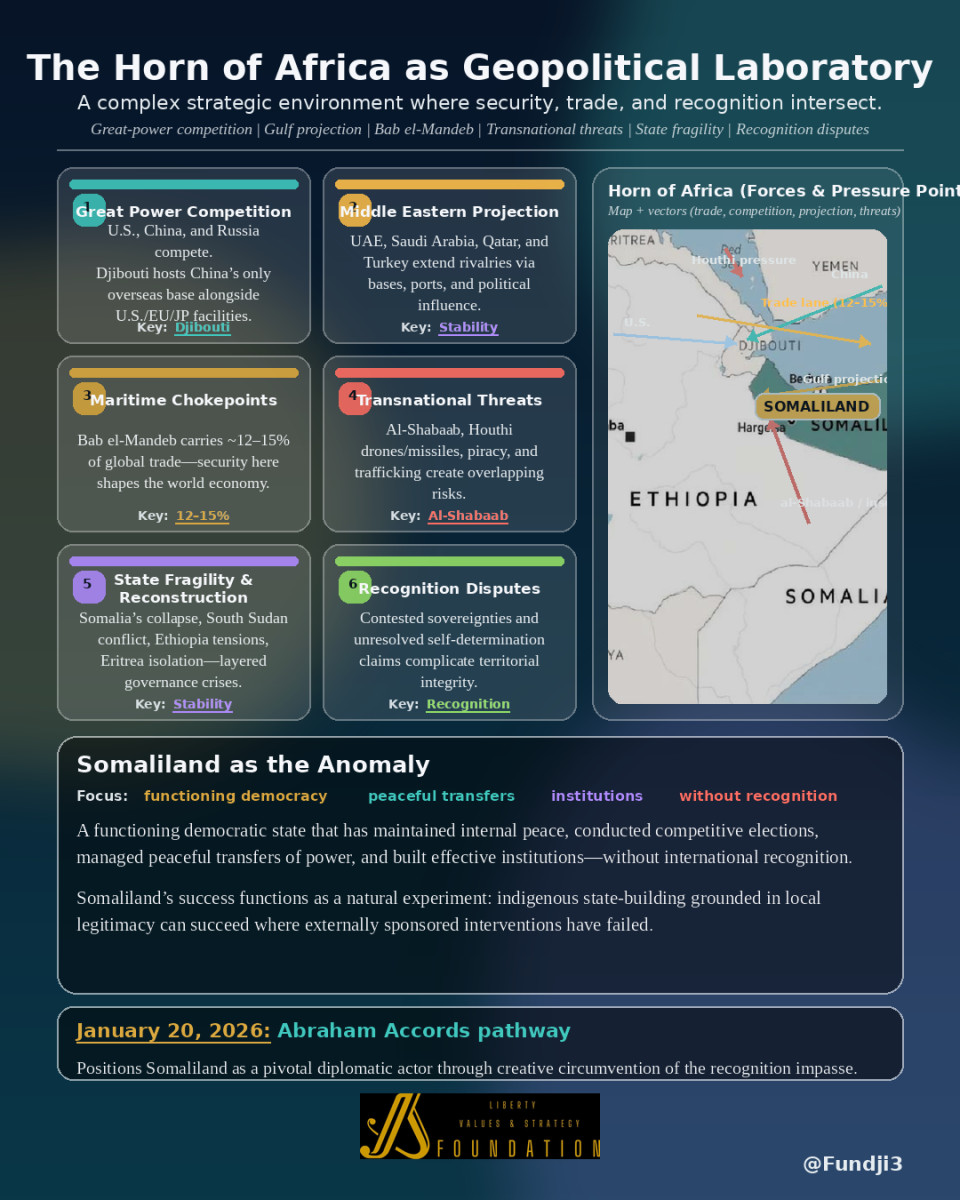
Framing Somaliland–Israel cooperation as “anti-region” is analytically shallow. The more accurate frame is pro‑Horn: maritime stability and corridor redundancy are regional public goods. The Bab el‑Mandeb/Red Sea-Gulf of Aden system is not just a trade lane; it is a strategic bloodstream for food, fuel, and manufactured imports across the Horn and beyond. Disruption—whether by piracy, trafficking networks, extremist financing, or missile threats—operates like a tax on every economy in the neighborhood. Somaliland’s location and security performance make it a plausible anchor for a stabilizing corridor. If Abraham Accords-linked cooperation hardens port security, improves coastal monitoring, and strengthens the investability of logistics infrastructure, the effects diffuse outward: trade becomes more predictable; freight costs and insurance premiums can fall; and extremist groups lose exploitable seams. That is not “alignment for its own sake.” It is regional risk management.
If integration becomes operational, Ethiopia is positioned to gain early and materially. As a large landlocked economy, Ethiopia’s vulnerability is structural: dependence on a single dominant maritime outlet is an enduring strategic exposure. Djibouti has served as Ethiopia’s principal trade conduit, but concentration generates risk—particularly when the wider Red Sea environment becomes more contested and when great-power competition, regional rivalries, or supply shocks can convert logistics into politics. Berbera has long been one of the few plausible diversification options, yet it has been weighed down by uncertainty linked to Somaliland’s contested status. Abraham Accords integration would not erase legal debates, but it could change what matters to financiers: security guarantees, predictable governance, and credible de-risking. If Berbera becomes easier to insure, easier to finance, and easier to protect, then it becomes less a political gamble and more a strategic asset. For Ethiopia, that is strategic breathing room—an insurance policy against chokepoint dependency.
Somalia’s federal government rejects Somaliland’s independence claim, and the African Union’s territorial integrity doctrine remains a strong brake on formal recognition. Yet the question is not whether Mogadishu contests Somaliland rhetorically; it is whether Mogadishu can operationalize its claim. Where Somaliland deepens security cooperation and investment routinization through a structured international framework, Somalia’s claim risks drifting from an active dispute into a largely declaratory position—especially as foreign governments and firms begin to behave, repeatedly, as if Somaliland is a separate administrative and commercial reality. This is how international systems evolve: not only through formal recognition, but through accumulated practice. A pro‑Horn stance can still be clear here: normalization of Somaliland’s operational role need not be pursued as humiliation of Somalia. It should be pursued as a pathway to regional stability, economic resilience, and the shrinking of violent non-state space.
The UAE’s role is best understood as architectural rather than theatrical. Abu Dhabi’s investments in Berbera through DP World are not merely commercial; they are infrastructure that can scale into a broader logistics and security platform. Layering Israeli technological capacity onto Gulf capital and corridor development can yield a pragmatic model: build systems that make stability profitable. A UAE–Israel–Somaliland track, if developed prudently, could enhance:
- port resilience and hardening,
- maritime domain awareness,
- customs efficiency and trade facilitation,
- and infrastructure security in an era where ports and corridors are increasingly strategic targets.
Serious analysis must assume contestation. Turkey’s deep engagement in Mogadishu and Qatar’s influence networks mean that a visible Somaliland–Israel deepening will be read competitively. The likely response will emphasize political warfare tools—media, narrative framing, diplomatic pressure—seeking to portray institutional alignment as foreign imposition rather than sovereign choice. Somaliland’s best defense is not rhetorical escalation; it is governance performance: transparency, demonstrable public benefit, and disciplined security planning that reduces the effectiveness of propaganda and spoilers.
Accords-based alignment can strengthen deterrence: Somaliland becomes harder to isolate, and adversaries must consider the risk of wider consequences. But visibility can also increase targeting incentives, especially against ports and logistics nodes that carry symbolic and economic weight. Therefore, the strategic imperative is to complement diplomacy with credible defensive capacity—surveillance, hardening, rapid response, and layered protection of critical infrastructure. Deterrence is political and contingent; defense is operational and immediate. A mature state-building approach treats this as non-negotiable.
The most meaningful economic impact would be psychological and financial rather than instantaneous GDP growth: lowering Somaliland’s perceived risk premium. Non-recognition inflates transaction costs—banking friction, insurance pricing, enforcement doubts, reputational risk. Integration into a structured framework like the Abraham Accords can create functional workarounds: clearer compliance pathways, more plausible political-risk insurance, and stronger comfort for large funds. Israeli expertise becomes easier to translate from pilot projects into scalable investment—particularly in water, agriculture, and digital security. This is not a promise of miracles. It is a credible pathway from endurance economics to development economics.
The long-run irreversibility of the shift will depend on whether major actors—especially the United States—adopt policies that function as de facto recognition across finance and security bureaucracies. Even partial shifts can trigger second-order effects in markets. The AU’s territorial integrity norm remains a durable constraint, rooted in fears of precedent. But even within that constraint, “working normalization” can expand: trade arrangements, port access, security coordination, and technical agreements that treat Somaliland as a functional partner.
Somaliland’s prospective entry into the Abraham Accords—coupled with a reported bilateral agreement with Israel—should be read as a strategy to institutionalize what Somaliland has already demonstrated: governance, security capacity, and reliability as a partner. It is pro‑Somaliland because it converts performance into structured external relationships and reduced investment friction. It is pro‑Israel because it extends the Accords’ peace-through-cooperation model into a maritime zone where Israeli security and innovation have direct relevance. It is pro‑Horn of Africa because stronger corridors, safer sea lanes, and investable infrastructure reduce regional volatility and weaken the political economy of disruption.
The correct summary is therefore not that this creates a “new map,” but that it can create durable facts—habits of cooperation, routinized finance, hardened infrastructure, and normalized diplomatic practice—that the region will feel long before formal legal consensus catches up.