













South Africa burns through R130 million on international legal theatrics while its economy crumbles and half a million jobs hang in the balance. This isn’t just poor judgment—it’s economic sabotage disguised as moral posturing.
The Devastating Reality Behind South Africa’s Misguided Priorities
While South Africa grapples with a staggering 32.9% unemployment rate and a manufacturing sector in free fall, the government has allocated R130 million to pursue an International Court of Justice (ICJ) case against Israel. This expensive legal battle represents a troubling pattern of misplaced priorities that’s costing the nation real economic opportunities. This isn’t just poor judgment—it’s economic sabotage disguised as moral posturing.
A comprehensive analysis of South Africa’s foreign policy reveals a fundamental disconnect between the country’s international positioning and its urgent economic needs. As other African nations surge ahead with pragmatic trade policies, South Africa’s ideological approach is leaving it behind.
The Numbers Don’t Lie: South Africa Falls Behind
The data paints a stark picture of South Africa’s economic underperformance compared to its African peers. And SA numbers tell a devastating story: 32.9% unemployment, manufacturing collapsed from 25% to 13% of GDP, and R130 million vanishing into legal proceedings that create zero jobs and zero economic value. Meanwhile, European partners who provide 77% of South Africa’s foreign investment and support over 500,000 jobs watch in bewilderment as their most important African partner chooses courtroom drama over economic development. While countries like Kenya achieve 26% intra-African trade growth and Rwanda sustains 15% growth, South Africa manages only 8% – significantly below the regional average of 15%.
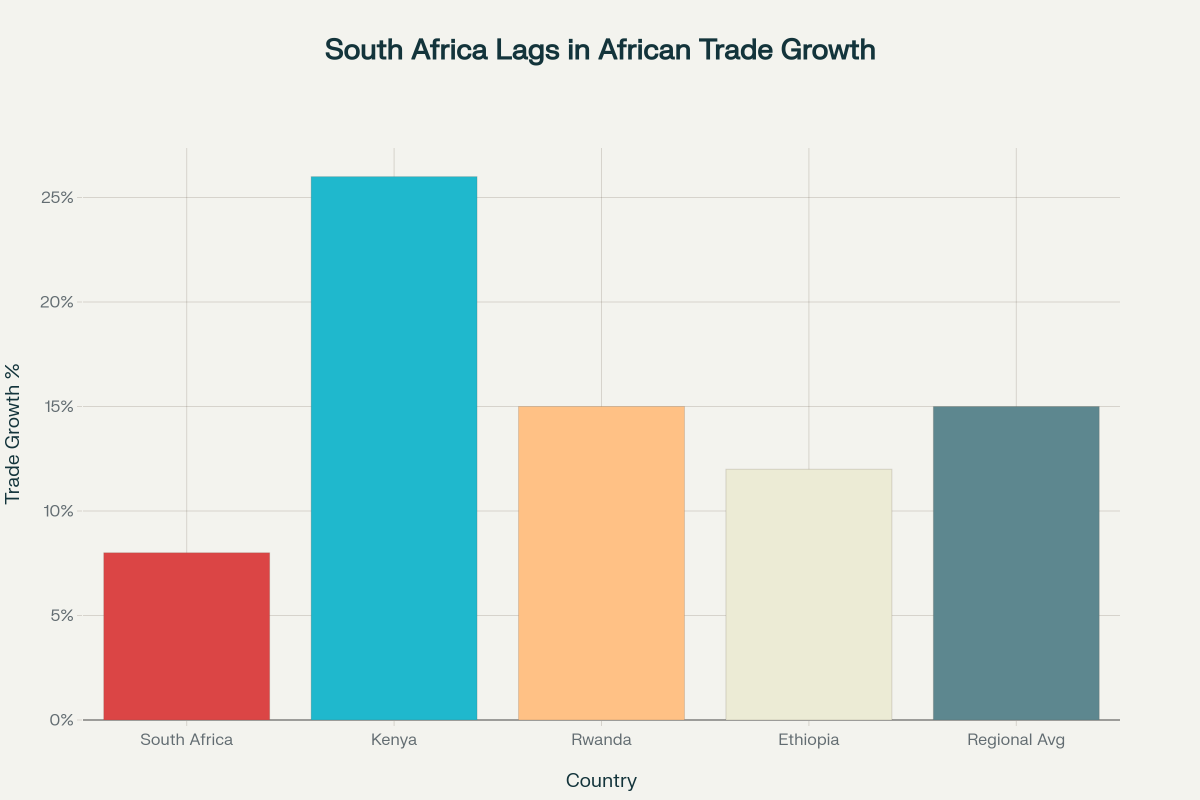
South Africa’s intra-African trade growth significantly underperforms compared to regional leaders
This underperformance isn’t just about statistics. While countries like Kenya and Rwanda focus on practical economic policies that deliver results, South Africa’s resources are being diverted to costly international legal proceedings that generate zero economic benefits for its citizens.
Manufacturing Sector in Crisis
Perhaps most alarming is the collapse of South Africa’s manufacturing sector. Once contributing 25% of GDP, manufacturing now accounts for just 13% of the country’s economic output. This decline isn’t just a statistic—it represents over 1.6 million jobs and the backbone of South Africa’s industrial economy.
Compare this to other African success stories:
- Ethiopia: Maintains 18% manufacturing share of GDP
- Rwanda: Sustains 16% manufacturing share of GDP despite being a smaller economy
These countries have demonstrated that strategic focus on industrial development and export growth delivers tangible results for their citizens.
The European Investment Reality
While South Africa’s government pursues expensive BRICS alignments and international legal battles, the economic reality tells a different story. European investment dominates South Africa’s economy in ways that BRICS partnerships simply don’t match.
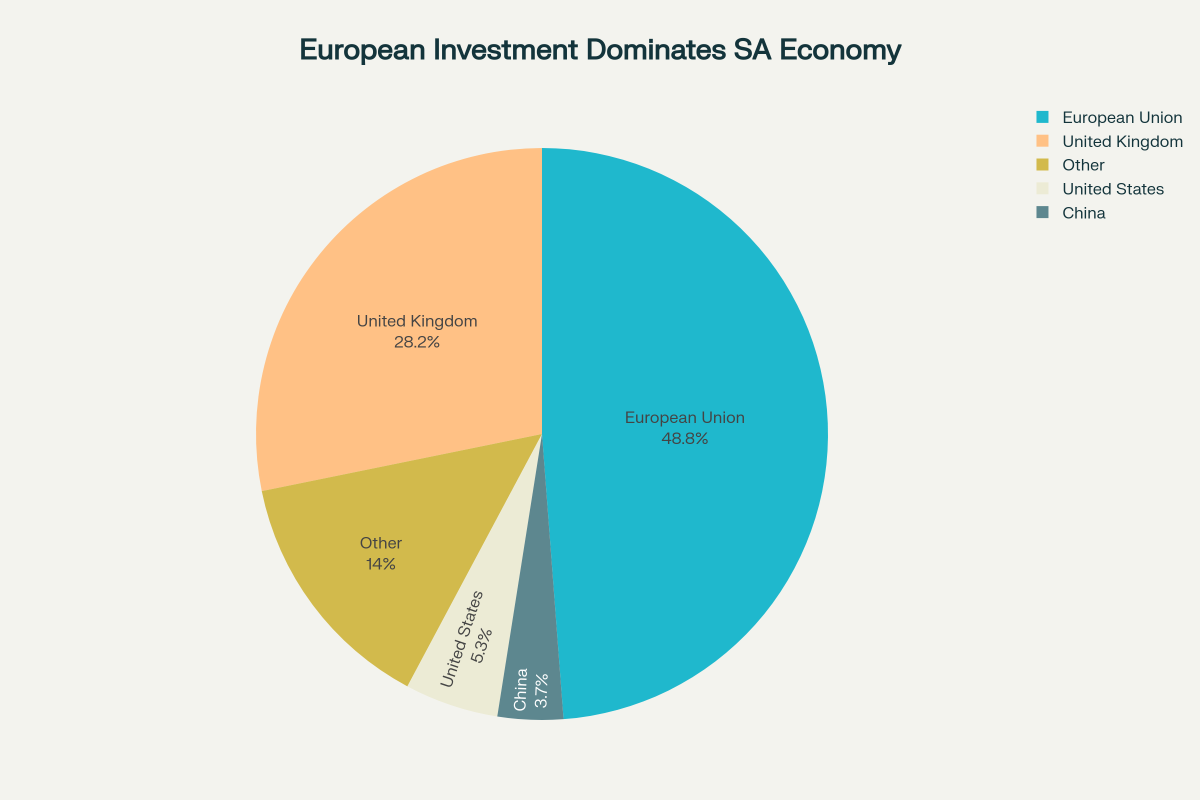
European Union and UK account for 77% of South Africa’s foreign direct investment
European Investment Dominance:
- 77% of total foreign direct investment comes from the EU and UK combined
- EU alone: 48.8% of South Africa’s FDI ($122 billion)
- UK: 28.2% of South Africa’s FDI ($70.6 billion)
- Over 2,500 European companies operate in South Africa
- 500,000+ jobs created by European investment
In contrast, China—despite being a major BRICS partner—contributes just 3.7% of South Africa’s foreign direct investment. The numbers reveal where South Africa’s real economic partnerships lie.
The Opportunity Cost of Misplaced Priorities
This isn’t just about R130 million—it’s about 650 small and medium enterprises that could have been supported with export programs. It’s about manufacturing jobs that could have been saved. It’s about infrastructure projects that could have connected South Africa to the African Continental Free Trade Area’s 1.3 billion consumers and $3.4 trillion market. Instead, this money disappears into legal proceedings with no measurable economic benefit for South African citizens struggling with unemployment and economic hardship.
The Manufacturing Meltdown: Industrial Suicide by Design
The African Continental Free Trade Area (AfCFTA) represents South Africa’s biggest economic opportunity:
- Market size: 1.3 billion people
- Combined GDP: $3.4 trillion
- Potential to lift 30 million people out of poverty
- Could boost regional income by $450 billion
Yet South Africa’s underperformance in intra-African trade growth suggests the country is failing to capitalize on this massive opportunity. While other African nations are building trade relationships and manufacturing capacity, South Africa is spending millions on international legal battles.
South Africa’s manufacturing sector didn’t just decline—it was systematically destroyed by misguided priorities. From 25% of GDP to 13% represents 1.6 million jobs lost and an industrial base gutted by neglect.
Compare South Africa’s Manufacturing Disaster to African Success:
- Ethiopia maintains 18% manufacturing share of GDP
- Rwanda sustains 16% manufacturing share despite smaller size
- Kenya achieves 26% intra-African trade growth
- South Africa manages only 8% trade growth—a national embarrassment
European Trade Success vs. BRICS Disappointment
The contrast between South Africa’s trade relationships is revealing:
European Trade Balance:
- EU-South Africa trade: Relatively balanced
- Exports to EU: $23.1 billion
- Imports from EU: $26.0 billion
- Manageable deficit: $2.9 billion
Chinese Trade Imbalance:
- Trade deficit with China: $9.71 billion in 2023
- Relationship pattern: South Africa exports raw materials, imports manufactured goods
- Undermines local manufacturing: Creates competition for South African producers
The European relationship demonstrates balanced, mutually beneficial trade, while the Chinese relationship perpetuates colonial-style resource extraction patterns.
While South Africa’s government obsesses over distant legal battles, European companies create tangible prosperity:
European Investment Impact:
- €122 billion EU investment (48.8% of total FDI)
- €70.6 billion UK investment (28.2% of total FDI)
- Over 2,500 companies operating across South Africa
- 500,000+ jobs created in high-value sectors
- Balanced trade relationships with manageable deficits
The Path Forward: Strategic Realignment
South Africa needs an immediate strategic realignment that prioritizes economic development over ideological positioning:
1. Redirect Resources to Economic Development
- Stop the ICJ spending: Redirect remaining funds to export promotion
- Focus on manufacturing: Support programs that rebuild industrial capacity
- Invest in trade facilitation: Improve infrastructure for African market access
2. Maximize African Continental Free Trade Area Opportunities
- Develop comprehensive AfCFTA strategy: Target continental markets systematically
- Build trade relationships: Focus on practical partnerships that generate economic benefits
- Leverage manufacturing advantages: Use South Africa’s industrial base to serve African markets
3. Deepen European Partnerships
- Expand the EU-South Africa partnership: Build on the €4.7 billion Global Gateway Investment Package
- Focus on technology transfer: Enhance manufacturing competitiveness through European cooperation
- Develop balanced trade relationships: Learn from successful European trade models
4. Reform Foreign Policy Decision-Making
- Implement cost-benefit analysis: Require economic impact assessments for major foreign policy initiatives
- Coordinate departments: Ensure foreign policy supports economic objectives
- Measure performance: Track economic outcomes of international relationships
The Bottom Line: Economics Over Ideology
South Africa faces a clear choice: continue pursuing expensive ideological positions that deliver no economic benefits, or embrace pragmatic policies that create jobs and drive growth.
The evidence is overwhelming:
- European partnerships create 500,000+ jobs
- BRICS relationships show structural trade imbalances
- Other African countries are outperforming South Africa through practical policies
- The AfCFTA offers massive opportunities being missed
While South Africa spends R130 million on international legal battles, countries like Kenya, Rwanda, and Ethiopia are building manufacturing capacity, expanding trade relationships, and creating jobs for their citizens.
Time for pragmatic Leadership
South Africa’s economic challenges demand pragmatic solutions, not expensive symbolic gestures. The country possesses significant advantages—sophisticated financial infrastructure, established manufacturing capacity, and strong international relationships with Europe—that could drive substantial economic growth.
However, realizing this potential requires leadership that prioritizes economic development over ideological positioning. The R130 million spent on the ICJ case represents more than just wasted money—it symbolizes a fundamental misalignment between South Africa’s foreign policy priorities and its citizens’ economic needs.
The path forward is clear: redirect resources toward practical economic development, maximize opportunities in the African Continental Free Trade Area, deepen successful European partnerships, and reform foreign policy decision-making to ensure economic objectives guide international relations.
South Africa’s citizens deserve a government that focuses on creating jobs and opportunities rather than pursuing expensive international legal battles that deliver no economic benefits. The time for strategic realignment is now—before other African nations capture the opportunities that South Africa is currently squandering.
The Choice Is Clear: Prosperity or Posturing
South Africa can choose economic development through pragmatic partnerships and strategic focus, or it can continue down the path of ideological posturing that impoverishes its citizens while enriching lawyers and diplomats.
The 32.9% unemployment rate demands the former. The manufacturing sector collapse requires urgent intervention. The missed opportunities in European partnerships and African integration need immediate action.
South Africa’s future depends on leaders who choose economics over ideology, citizens’ needs over elite preferences, and measurable outcomes over symbolic gestures.
The R130 million legal addiction ends now—or South Africa’s economic prospects die with it.
This isn’t just economic incompetence—it’s democratic failure. While 32.9% of South Africans are unemployed and millions more struggle with economic marginalization, political elites pursue symbolic gestures that serve their ideological preferences rather than citizens’ material needs. The R130 million legal spending represents what Pierre Bourdieu would recognize as symbolic capital deployment—elites maintaining legitimacy through moral posturing while imposing material costs on the population least able to bear them.
This analysis is based on comprehensive research examining South Africa’s foreign policy priorities, trade relationships, and economic development challenges. The data reveals systematic patterns of resource misallocation that prioritize symbolic gestures over practical economic outcomes.