









Sudan is currently experiencing what international observers and humanitarian organizations refer to as the gravest humanitarian crisis on the global stage. Over the past two years, the country has descended into a multifaceted civil war marked by atrocities against civilians, mass displacement, and the total collapse of state institutions.
Recent events in North Kordofan underscore the escalating violence perpetrated by the Rapid Support Forces (RSF), a paramilitary group led by General Mohamed Hamdan Dagalo, also known as Hemedti. Between July 10 and 13, 2025, RSF elements reportedly massacred at least 300 civilians—among them women, children, and pregnant women—in coordinated attacks across several villages near the city of Bara. The village of Shag Alnom alone accounted for over 200 deaths, while other villages such as Hilat Hamid and surrounding areas witnessed dozens more fatalities. Concurrently, RSF drones targeted the villages of Al-Fula and Abu Zabad in West Kordofan, where schools sheltering internally displaced families were among the sites attacked.
These events illustrate a broader strategy of terror employed by the RSF, reminiscent of the scorched-earth campaigns the Janjaweed militia—as the RSF’s predecessor—conducted in Darfur during the early 2000s. The violence in North Kordofan is thus not an isolated incident but part of a systematic campaign of ethnic cleansing, population control, and resource-driven militarization.
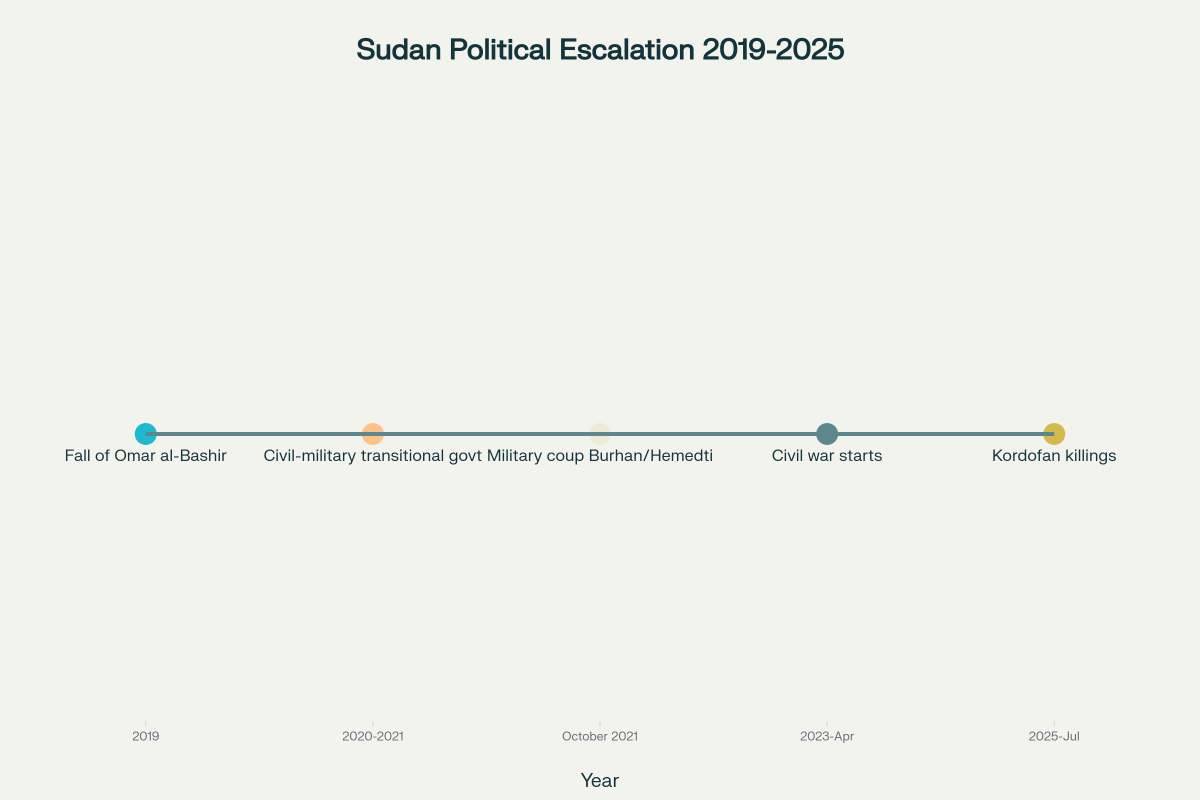
Sudan’s ongoing crisis is the culmination of years of political instability, violent power struggles, and humanitarian disaster. Major events—from the ousting of President Omar al-Bashir in 2019, through transitional governance, to the most recent massacres—define a nation in turmoil.
The conflict in Sudan originates from a power struggle between two formerly allied military factions: the Sudanese Armed Forces (SAF), under General Abdel Fattah al-Burhan, and the RSF. Their alliance disintegrated in April 2023 following disagreements over power-sharing and plans for military integration in the wake of the 2019 revolution and the subsequent 2021 military coup that ousted the civilian transitional government. This breakdown revealed the structural fragility of Sudan’s governance mechanisms and the toxicity of its militarized political culture.
The magnitude of the humanitarian crisis is unparalleled: over 12 million people have been forcibly displaced, making this the largest displacement crisis in the world. Of these, 10.1 million are internally displaced, and over 4 million have sought refuge abroad. The war has killed tens of thousands, while widespread famine and disease endanger millions more. According to the World Food Programme, 24.6 million people—more than half of Sudan’s population—face acute food insecurity, and 637,000 are experiencing famine-like conditions. The public health infrastructure has effectively collapsed, with cholera and measles spreading rapidly amid the destruction of more than 75% of healthcare facilities in conflict zones. These realities exemplify the intersection of direct, structural, and cultural violence, as conceptualized in Johan Galtung’s typology of conflict, whereby systemic historical oppression, ethnically biased governance, and militarized identities reproduce cycles of organized violence.
The RSF’s access to international networks of finance and arms further complicates efforts at peacebuilding. The group reportedly maintains gold mining operations that fund their paramilitary activities and benefits from external sponsorship, including from actors such as the United Arab Emirates. The SAF, in turn, is reportedly supported by Egypt, whose concerns primarily revolve around border stability and control over Nile waters. This dynamic has effectively transformed Sudan into a geopolitical proxy battlefield wherein regional powers pursue strategic goals at the expense of Sudanese sovereignty and civilian security.
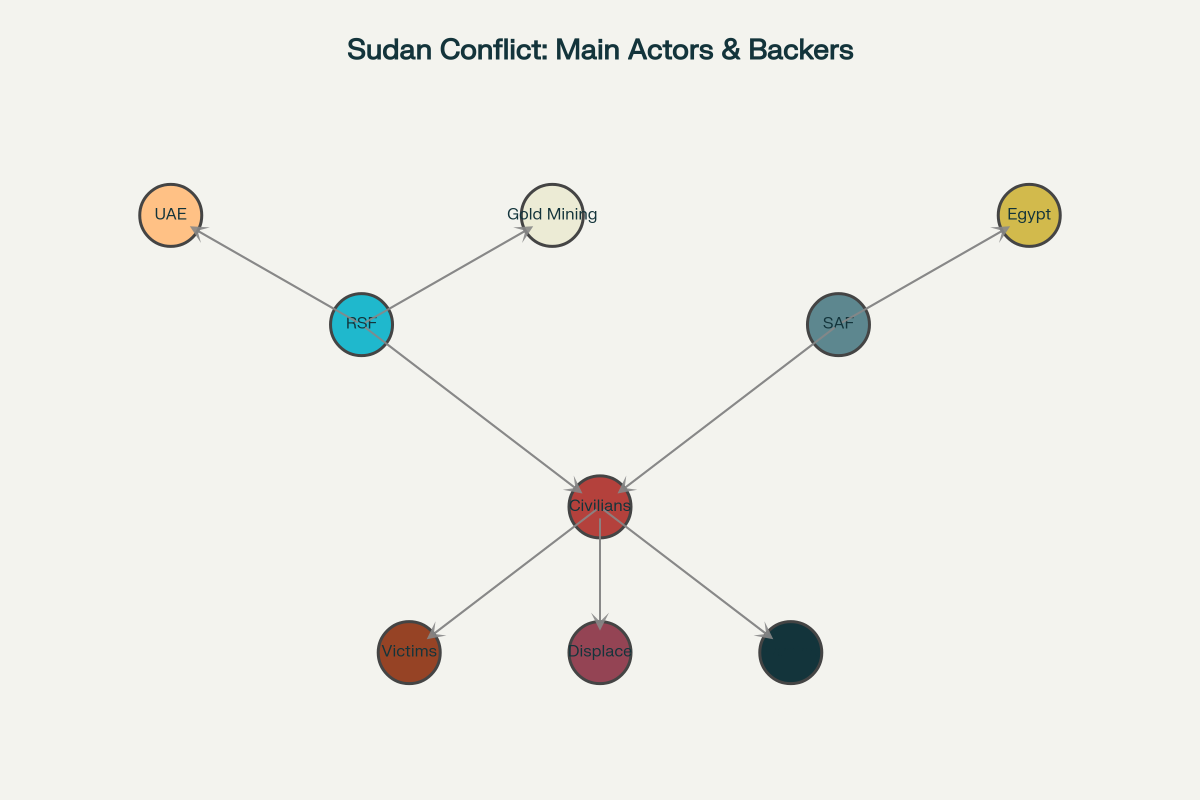
The actors at the center of Sudan’s conflict form a complex network. The Rapid Support Forces (RSF) receive external backing, particularly from the UAE, supported by gold mining revenues. The Sudanese Armed Forces (SAF) are aligned with Egypt. Caught between them is the civilian population, suffering the brunt of violence, displacement, and famine.
While Western states such as the United States have enacted targeted sanctions against both the SAF and RSF, material leverage remains limited. Notably, in January 2025, the U.S. government sanctioned key RSF leaders for gross human rights violations, followed by similar measures against the SAF in April for deploying chemical weapons. These sanctions, while symbolically significant, have yet to render meaningful constraints on the warring factions’ ability to perpetrate violence. During a United Nations Security Council session on July 10, U.S. Acting Representative Dorothy Shea criticized the International Criminal Court for what she described as a politically selective emphasis on Israel, arguing that the ICC has underprioritized the systematic atrocities engulfing Sudan.
The international failure to address Sudan’s deteriorating situation reveals major shortcomings in global humanitarian governance. The ICC’s limited jurisdiction—confined largely to Darfur—reflects a broader issue of legal fragmentation and selective intervention. While Sudan’s internal conflict meets the criteria for crimes against humanity and potentially genocide under international law, consistent enforcement and international will remain absent. Moreover, global media and activist attention have focused disproportionately on conflicts such as the Israel-Gaza war, while Sudanese civilians endure mass murder, rape, famine, and displacement with minimal international outcry or coordinated intervention. This discrepancy reveals not only geopolitical bias but also a crisis of credibility within international human rights advocacy and multilateral institutions.
The atrocities in Sudan are not merely the consequence of war but are driven by “economies of predation.” Both SAF and RSF are engaged in competition over mineral resources, trade corridors linking Port Sudan to the Sahel, and illicit cross-border networks. The financialization of armed groups and the erosion of civilian governance have transformed state institutions into militarized enterprises where violence is not merely instrumental but economically profitable. The mass killings in North Kordofan and Darfur mirror this logic: systematic displacement allows for territorial control, seizure of economic assets, and the consolidation of power through fear.
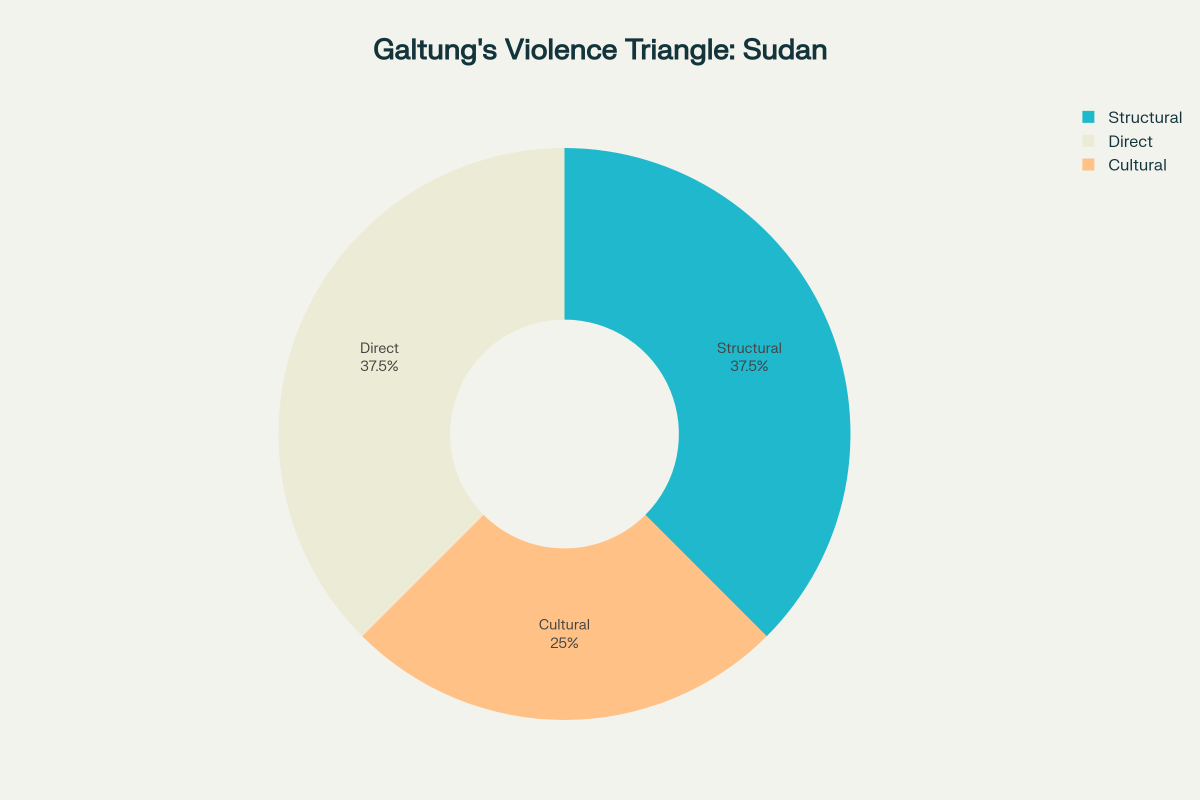
The multidimensional nature of violence in Sudan is illuminated by Galtung’s Triangle: structural violence (institutionalized inequality, famine), cultural violence (ideologies legitimizing discrimination), and direct violence (killings, assaults). These forms interact to perpetuate the crisis.
From an anthropological standpoint, the instrumentalization of masculinity, ethnicity, and patronage networks plays a central role in the conflict. The RSF’s identity is built upon reinvigorated tribal hierarchies, informal economic arrangements, and the glorification of wartime masculinity. These sociocultural constructs are abetted by a legacy of colonial administrative design that fragmented Sudanese society along racial and ethnic lines—a pattern that continues to serve contemporary military elites. Studies in peace anthropology would categorize post-2019 Sudan as a paradigmatic case in which the failure to establish positive peace (defined by inclusive institutions and social justice) led rapidly to renewed internal warfare.
If left unresolved, Sudan’s fragmentation poses serious geostrategic risks beyond its borders. The country sits at the crossroads of the Sahel, the Horn of Africa, and the Red Sea—regions already destabilized by insurgency, climate change, and state fragility. Unchecked collapse in Sudan could disrupt Red Sea maritime trade routes, exacerbating global energy and supply chain instability. Furthermore, the regional spread of weapons and fighters may further destabilize fragile neighboring states such as Chad, South Sudan, and Ethiopia.
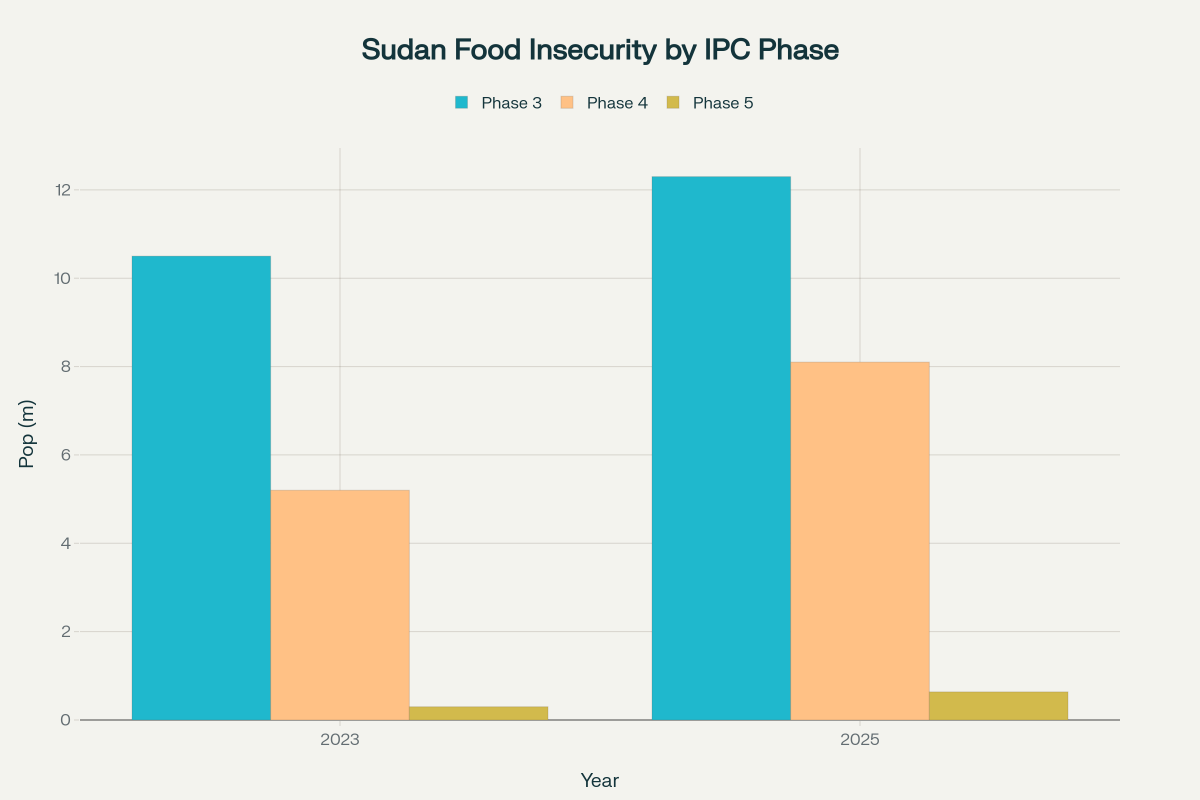
Food insecurity has dramatically worsened since the start of renewed hostilities. Millions are experiencing acute and even catastrophic hunger, with Sudan now recording the highest number of people in “famine-like” conditions globally. This escalation from 2023 to 2025 demonstrates the profound impact of conflict on basic survival.
Resolving Sudan’s crisis demands both robust international engagement and the reimagining of domestic statehood. First, humanitarian access must be significantly expanded. Second, regional powers must cease proxy support and instead coordinate a unified diplomatic framework for mediation. Third, international legal mechanisms must expand ICC jurisdiction, and where politically impossible, independent hybrid courts should be established to try atrocities committed beyond Darfur. Finally, peacebuilding must transcend mere power-sharing among elites and incorporate grassroots transitional justice processes that confront the social, ethnic, and economic roots of the conflict.
In summary, Sudan’s descent into violence is not an inevitable byproduct of tribal animosities or mere governance failure; it is a result of deliberate militarized statecraft, geopolitical opportunism, and systemic international neglect. The RSF’s brutal campaign in North Kordofan is emblematic of broader patterns of state-sponsored terror that reflect both the historical legacy of Sudanese governance and the moral failure of the international system to uphold its humanitarian and legal obligations. This crisis demands urgent academic, diplomatic, and moral attention, lest a country of over 45 million be consigned to irreversible collapse.