










How the ANC Betrayed Mandela’s Legacy for Tehran’s Gold
South Africa’s increasingly brazen embrace of America’s strategic adversaries presents a compelling case study in the calculated risks of challenging hegemonic power in an era of multipolar realignment. The African National Congress (ANC) government, emboldened by what appears to be a fundamental misreading of both American resolve and its own strategic position, has embarked upon a course of confrontational diplomacy that threatens to transform a historically manageable bilateral relationship into a paradigmatic contest of wills.
The contemporary phase of this deteriorating relationship reached a decisive inflection point with ANC Secretary-General Fikile Mbalula’s provocative challenge to the Trump administration, essentially daring Washington to “bring on” sanctions. This rhetorical gambit, delivered with characteristic South African bravado, exemplifies the post-Mandela ANC’s strategic miscalculation. Rather than representing a principled stand based on coherent foreign policy doctrine, Mbalula’s posturing reflects the governing party’s desperate attempt to marshal domestic legitimacy through anti-Western posturing—a tactic that has become increasingly central to the ANC’s political survival strategy in the face of mounting internal pressures.
The structural context of South Africa’s defiance reveals profound shifts in the country’s strategic orientation since the end of apartheid. Where Nelson Mandela’s government pursued a carefully calibrated non-aligned foreign policy that balanced pragmatic cooperation with Western partners against solidarity with the Global South, the contemporary ANC has systematically abandoned this nuanced approach. Instead, Pretoria has embraced what can only be characterized as strategic antagonism toward the United States and its allies, whilst simultaneously deepening ties with authoritarian regimes whose interests fundamentally diverge from those of democratic governance.
The Architecture of South African Alignment with Authoritarian Powers
The recent intensification of South Africa’s military cooperation with Iran represents perhaps the most provocative dimension of this strategic realignment. When South African Defense Force Chief General Lawrence Mbatha travelled to Tehran to enhance bilateral military ties, the symbolism was unmistakable—a country that once fought for liberation from racial oppression was now actively partnering with a theocratic regime that systematically oppresses its own citizens whilst funding terrorist organizations across the Middle East. This development cannot be dismissed as routine diplomatic engagement; rather, it constitutes a deliberate signal of South Africa’s willingness to challenge fundamental Western security interests.
Similarly, Deputy President Paul Mashatile’s concurrent visits to China and Russia served to consolidate South Africa’s position within what Beijing and Moscow have termed the “community of shared future”—a euphemistic framework for challenging American global leadership. The announcement that both powers would again participate in naval exercises off South Africa’s coast in November 2024 further demonstrated Pretoria’s commitment to providing strategic infrastructure for activities designed to undermine Western maritime security in the Indian Ocean.
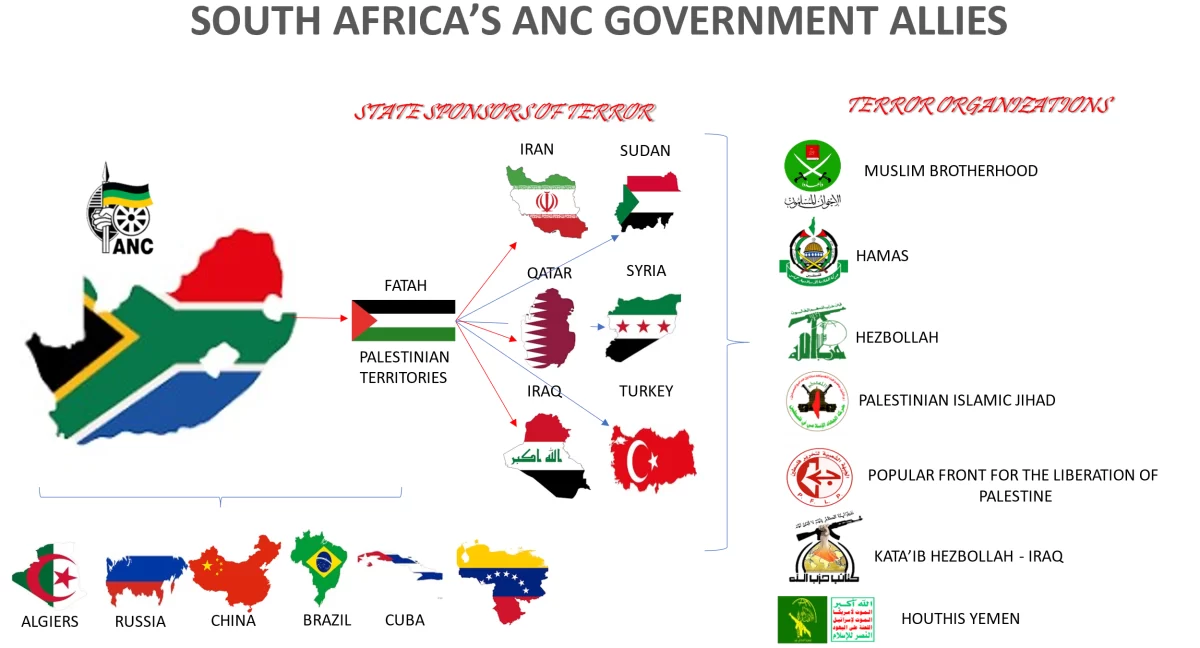
These developments must be understood within the broader context of South Africa’s participation in BRICS+, the expanded iteration of the original BRICS grouping that now includes Iran, Egypt, Ethiopia, and the United Arab Emirates. The 2025 Brazilian presidency of BRICS has adopted the theme “Strengthening Global South Cooperation for More Inclusive and Sustainable Governance”—language that barely conceals the organisation’s primary objective of constructing alternative institutions to challenge Western-dominated multilateral frameworks. South Africa’s enthusiastic participation in these initiatives reflects a fundamental strategic choice to align with revisionist powers rather than working within existing international systems to achieve incremental reform.
The Domestic Political Imperatives Driving Foreign Policy Adventurism
The ANC’s confrontational approach toward the United States cannot be divorced from the party’s desperate domestic political circumstances. Having lost its parliamentary majority in the 2024 elections for the first time since 1994, the ANC faces an existential crisis that has fundamentally altered its strategic calculations. The party’s declining electoral fortunes, combined with widespread public dissatisfaction over corruption, economic mismanagement, and service delivery failures, have created powerful incentives for the governing elite to seek legitimacy through populist anti-Western rhetoric.
This dynamic is particularly evident in the ANC’s handling of the Israel-Palestine conflict, where the party has adopted increasingly extreme positions that align closely with Iran’s regional objectives. South Africa’s decision to bring genocide charges against Israel at the International Court of Justice, whilst maintaining conspicuous silence about systematic human rights abuses in China’s Xinjiang province or Iran’s brutal suppression of domestic dissent, reveals the selective nature of the ANC’s supposed commitment to human rights. Such positioning serves primarily to mobilize domestic support among constituencies that view anti-Western posturing as evidence of authentic African leadership.
The Trump administration’s immediate and decisive response to these provocations demonstrates a sophisticated understanding of South Africa’s vulnerabilities. By ending all American assistance programmes in February 2025, expelling South Africa’s ambassador, and imposing substantial tariffs on South African exports, Washington has effectively called Pretoria’s bluff. These measures, whilst economically significant, represent merely the opening phases of what could develop into a comprehensive campaign of strategic isolation.
The Implications of Trump’s Foreign Aid Suspension
The Trump administration’s comprehensive review and suspension of foreign aid programs has created unprecedented leverage over countries that have grown dependent on American largesse whilst simultaneously pursuing policies inimical to American interests. The suspension of the President’s Emergency Plan for AIDS Relief (PEPFAR), which has provided life-sustaining treatment to over 20 million individuals globally, demonstrates Washington’s willingness to weaponize humanitarian assistance when strategic interests are at stake.
For South Africa specifically, the loss of PEPFAR funding threatens to destabilize a healthcare system already struggling with one of the world’s highest HIV/AIDS burdens. Epidemiological modelling suggests that complete cessation of American health assistance could result in up to 565,000 additional HIV infections and 601,000 HIV-related deaths by 2034. Such catastrophic outcomes would inevitably generate domestic political pressure on the ANC government to reconsider its antagonistic approach toward Washington.
The broader suspension of USAID programs has similarly dramatic implications for South Africa’s development trajectory. With American assistance historically supporting everything from educational initiatives to agricultural development programs, the sudden withdrawal of funding threatens to exacerbate existing socio-economic challenges whilst demonstrating the tangible costs of strategic defiance. The psychological impact of this isolation may prove even more significant than the immediate material consequences, as it signals to South African elites that their country’s historical relationship with the West cannot be taken for granted.
The Financial Action Task Force as a Tool of Strategic Pressure
Perhaps the most sophisticated dimension of the Trump administration’s response involves leveraging South Africa’s precarious position on the Financial Action Task Force’s grey list. FATF’s designation of South Africa as a jurisdiction of concern regarding money laundering, terrorist financing, and corruption creates significant reputational risks that translate directly into reduced international investment and increased borrowing costs. The country’s desperate attempts to secure removal from this list provide Washington with considerable leverage over Pretoria’s policy choices.
The interconnection between South Africa’s FATF designation and its strategic relationships with Iran, Russia, and China creates a compelling narrative for maintaining grey list status. South Africa’s hosting of terrorist financiers linked to Hamas, Hezbollah, and ISIS, combined with its deepening ties to regimes heavily involved in illicit financial flows, provides ample justification for maintaining enhanced scrutiny. The recent suspension of South Africa’s police minister over allegations related to dismantling units investigating political killings further undermines any claim to effective law enforcement capabilities.
Maintaining South Africa on the FATF grey list serves multiple strategic objectives simultaneously. It provides a multilateral framework for applying pressure, thereby avoiding accusations of unilateral American bullying. It creates ongoing compliance costs that strain government resources. Most importantly, it signals to international financial institutions that South Africa represents an elevated risk environment, thereby constraining the country’s access to global capital markets.
Targeted Sanctions and Strategic Communications
The legislative framework currently under consideration in Congress provides additional tools for escalating pressure on specific individuals within the South African government. The proposed requirement for presidential identification of ANC figures eligible for sanctions over corruption and human rights abuses creates a powerful mechanism for personalizing the costs of anti-American policies. Potential targets include not only senior government officials like Deputy President Mashatile and Mineral Resources Minister Gwede Mantashe, but also non-governmental actors who facilitate terrorist financing.
The identification of figures like Emad Saber, a senior Hamas official operating within South Africa, and organizations like the Al-Quds Foundation of South Africa, demonstrates the breadth of networks that could be subjected to American sanctions. Even more provocatively, the inclusion of politically prominent figures like Mandla Mandela, grandson of the liberation icon, would send powerful symbolic messages about the costs of supporting designated terrorist organizations.
Such targeted measures would prove particularly effective because they exploit existing factionalism within the ANC whilst avoiding the humanitarian consequences that might generate sympathy for the South African government. By focusing on individuals who have enriched themselves through corrupt practices or terrorist financing, American sanctions would resonate with ordinary South Africans frustrated by elite impunity.
The Strategic Limitations of South African Defiance
Ultimately, South Africa’s confrontational approach toward the United States reflects a fundamental misunderstanding of the country’s strategic position and leverage. Despite its important geographic location at the Cape of Good Hope and substantial reserves of critical minerals, South Africa remains economically vulnerable and politically fragmented in ways that limit its capacity for sustained confrontation with a global superpower.
The country’s persistent economic challenges—including chronic unemployment exceeding 30 percent, widespread corruption, and deteriorating infrastructure—create structural dependencies that cannot be easily replaced through partnerships with China, Russia, or Iran. Whilst these authoritarian partners may offer alternative sources of investment and diplomatic support, they cannot provide the market access, technological transfer, and institutional capacity that have historically driven South African development.
Moreover, the ANC’s domestic political weakness undermines its capacity for coherent strategic action. The party’s coalition government, necessitated by its loss of parliamentary majority, includes partners with fundamentally different views on foreign policy. The Democratic Alliance, which governs key provinces including the Western Cape, maintains strongly pro-Western orientations that conflict with the ANC’s increasingly anti-American positions. This internal contradiction limits the government’s ability to sustain confrontational policies in the face of mounting economic pressure.
The Trump administration’s strategic response to South African defiance thus represents a calculated test of American resolve in the emerging multipolar order. By demonstrating willingness to impose significant costs on a historically important partner that has chosen alignment with American adversaries, Washington signals to other wavering allies the consequences of strategic miscalculation. The South African case becomes a laboratory for testing the effectiveness of economic leverage in an era where traditional military tools prove increasingly inappropriate for managing interstate competition.
The ultimate resolution of this confrontation will likely depend on the ANC’s capacity for strategic recalibration in the face of mounting pressure. However, the party’s historical tendency toward ideological rigidity, combined with its domestic political investment in anti-Western positioning, suggests that course correction may prove elusive until the economic and political costs become truly unsustainable.
Consequently, the Trump administration’s measured escalation—maintaining FATF grey list status, implementing targeted sanctions, and sustaining aid suspensions—represents a sophisticated approach to coercive diplomacy that avoids the humanitarian catastrophes associated with comprehensive economic warfare whilst maintaining pressure for behavioral change. The South African case thus offers valuable insights into the evolving dynamics of great power competition in an increasingly fragmented international system.