















Legal Violations, Sanctions Circumvention, and the Erosion of International CounterTerrorism Architecture
The French Republic’s extensive financial support for Palestinian organizations with documented connections to designated terrorist entities represents a profound contradiction between France’s stated commitment to counterterrorism and its actual funding practices. This systematic pattern of legal violations under French law, international obligations breaches, and diplomatic hostility toward Israel reveals a troubling nexus of state-sponsored terrorism financing that undermines both European security architecture and international legal frameworks designed to prevent terrorist financing.
The evidence demonstrates that French authorities have maintained knowing and willful financial relationships with organizations explicitly designated as terrorist entities, while simultaneously circumventing their own domestic legal prohibitions against boycott campaigns targeting Israel. This article examines these violations through multiple academic lenses—counterterrorism studies, international law, geopolitics, and diplomatic analysis—to reveal the broader implications for European security and international legal compliance.
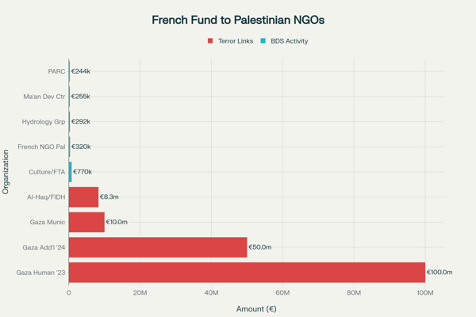
French Government Funding to Palestinian Organizations and BDS Groups: Legal Violations and Terror Connections (2010-2024)
The International Legal Framework for State Responsibility in Terrorism Financing
The International Convention for the Suppression of the Financing of Terrorism (1999) establishes binding legal obligations on states to criminalize terrorist financing and prevent their territories from being used for such activities. Article 2 of the Convention defines terrorist financing offences as the provision or collection of funds “with the intention that they should be used or in the knowledge that they are to be used, in full or in part, in order to carry out terrorist acts”.
France’s ratification of this Convention creates primary obligations under international law that extend beyond mere criminalization to encompass preventive measures, asset freezing, and cooperation with other states in combating terrorism financing. The Convention’s Article 21 explicitly requires that all counter-terrorism financing measures be implemented “in accordance with international law, including international humanitarian law, international human rights law and international refugee law”.
Under Article 16 of the Articles on State Responsibility, a state that “aids or assists another State in the commission of an internationally wrongful act” becomes internationally responsible if it acts “with knowledge of the circumstances of the internationally wrongful act”. This principle extends to situations where states provide financial support to non-state actors engaged in terrorism, creating derivative state responsibility for terrorist activities.
The International Court of Justice’s jurisprudence in cases involving state responsibility for terrorism establishes that states cannot shield themselves from responsibility by channeling support through intermediary organizations or by claiming ignorance of the ultimate recipients’ activities. The Court’s analysis in the Bosnia Genocide case demonstrates that the obligation to prevent terrorism necessarily encompasses positive duties to ensure that state resources do not facilitate terrorist activities.
Academic scholarship on state responsibility for terrorism financing emphasizes that knowledge and intent standards are satisfied when states continue funding despite clear evidence of terrorist connections. The “knowingly and intentionally” standard established in EU anti-circumvention jurisprudence applies equally to state actors who maintain financial relationships with designated terrorist entities.
French Legal Violations: BDS Funding Despite Domestic Criminalization
In October 2015, the French Court of Cassation definitively ruled that calls for boycotts of Israeli products constitute criminal offenses under French anti-discrimination law, punishable by one year imprisonment and €45,000 in fines. This ruling established France as “the only country in the world to make calls for boycott of Israeli products a criminal offence”, creating a binding legal precedent that applies to all organizations operating within French jurisdiction. The Court’s decision was based on French authorities’ interpretation that BDS campaigns constitute discriminatory targeting based on national origin, falling under France’s criminal law provisions against incitement to discrimination. Despite this clear legal prohibition, French government funding to BDS-promoting organizations has not only continued but dramatically expanded.
The Platform of French NGOs for Palestine (PFP) received €320,000 from the French government’s Agence Française de Développement between 2020-2023, despite its explicit promotion of BDS campaigns that are illegal under French law. The AFD acknowledged that PFP “provides the analytical elements, political and legal, necessary for a good understanding of the situation,” effectively legitimizing criminal activities through state funding. This violation is particularly egregious given that the Council of Île de France Region had already established a precedent in 2016, excluding from funding “organizations calling for a boycott of the State of Israel, especially those involved in the Boycott Divestment and Sanctions (BDS) movement, as these appeals constitute a criminal offense”. The national government’s continued funding despite this regional precedent demonstrates willful disregard for French legal obligations.
In January 2022, France implemented the “Strengthening the respect of the republican values” law, requiring organizations receiving French governmental funding to “reject all forms of racism and anti-Semitism” and “not to provoke hatred or violence towards anyone”. However, this law appears to be selectively enforced, as documented BDS-promoting and terror-linked organizations continue receiving French funding despite clear violations of these principles. The selective enforcement of the Republican Values Law reveals institutionalized bias in French counterterrorism policy. While the law theoretically provides mechanisms to defund organizations that promote hatred or violence, its application has been systematically avoided in cases involving anti-Israel organizations. This selective enforcement undermines the law’s stated objectives and demonstrates that French authorities prioritize political considerations over legal compliance.
The Al-Haq Network: A Case Study in Sanctions Circumvention and State Complicity
In October 2021, the Israeli Ministry of Defense designated Al-Haq as a “terrorist organization” because it operates as part of “a network of organizations” that functions “on behalf of the Popular Front for the Liberation of Palestine (PFLP)”. The PFLP is designated as a terrorist organization by the United States, European Union, Canada, and Israel, making support for PFLP-linked entities a violation of international counter-terrorism obligations. The designation was based on extensive evidence of Al-Haq General Director Shawan Jabarin’s documented ties to the PFLP terrorist organization. Israeli Supreme Court decisions in 2007, 2008, and 2009 consistently found that Jabarin maintains “involvement in the activity of terrorist entities” and acts “as an activist in a terror organization which has not shied away from murder and attempted murder”. In 1985, Jabarin was convicted for “recruiting and arranging training for members for the PFLP”.
Following the terrorist designation and the cessation of credit card processing by Visa, Mastercard, and American Express in 2018 due to PFLP ties, Al-Haq established Al-Haq Europe in Brussels on September 27, 2022. This Belgian entity represents a systematic attempt to circumvent international sanctions and restore access to Western financial systems.
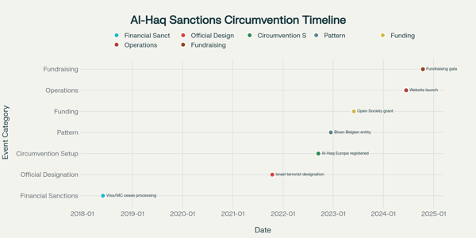
Al-Haq Europe Sanctions Circumvention Timeline: A Case Study in Systematic Evasion of Terror Finance Controls
The organizational ties between Al-Haq Europe and the designated terrorist entity are extensive and undeniable. The Belgian entity’s board includes multiple former Al-Haq officials: Ghassan Abdulah (former Al-Haq board member and treasurer), Maha Abdallah (former Senior Legal Researcher), Rula Shadeed (former Head of Monitoring and Documentation), and Asem Khalil (Al-Haq general assembly member since 2015).
The most serious aspect of this sanctions circumvention involves direct French government complicity. In February 2024, AFD authorized a massive €8.3 million grant to the International Federation for Human Rights (FIDH) for a four-year program to fund 22 NGO partners, including Al-Haq. This funding provides the designated terrorist entity with substantial resources despite its documented connections to the PFLP. The timing of this funding is particularly significant, occurring more than two years after Al-Haq’s terrorist designation and well after the establishment of Al-Haq Europe as a circumvention vehicle. French authorities cannot claim ignorance of Al-Haq’s status, making this funding a willful violation of international counter-terrorism obligations.
The Al-Haq case is not isolated but represents a broader pattern of systematic sanctions circumvention facilitated by European legal frameworks. The December 2022 registration of Bisan, another PFLP-linked organization designated by Israel, also in Belgium demonstrates the systematic nature of this evasion strategy. According to Belgian anti-Israel advocacy NGO Viva Salud, “Labeling social organizations in Palestine as terrorists is one of Israel’s repressive strategies. This is why Bisan, with the help of Viva Salud, opened an office in Brussels”.
The October 2024 Al-Haq Europe fundraising gala at the Dorchester Hotel in London, which raised over £630,000 with Shawan Jabarin present, demonstrates the success of this circumvention strategy. The presence of Husam S. Zomlot, Head of the Palestinian Mission to the United Kingdom, who declared his pride in calling Jabarin “my brother, and my friend,” shows official Palestinian Authority support for these circumvention efforts.
French Middle East Policy and Anti-Israel Positioning
France’s current Middle East policy reflects a fundamental shift from Charles De Gaulle’s “Arab policy” toward an increasingly confrontational stance against Israel. This evolution has been driven by domestic political considerations, including concerns about importing Middle East conflicts into French society and managing France’s large Muslim population.
The “reassurance approach” adopted by successive French governments seeks to foster stability by providing Middle Eastern partners with reassuring responses to their perceived anxieties. However, this strategy has failed to gain France the influence it seeks and has instead created contradictions between France’s stated values and its actual partnerships with authoritarian regimes.
France’s insistence on maintaining dialogue with all stakeholders in the Middle East has led to a pragmatic acceptance of relationships with entities connected to terrorism. This approach prioritizes diplomatic engagement over legal compliance, creating the conditions for the systematic legal violations documented in this analysis.
Recent diplomatic incidents demonstrate the escalating nature of Franco-Israeli tensions that provide context for France’s financial support of anti-Israel organizations. The November 2024 detention of French consulate staff at a French-administered holy site in Jerusalem represents the latest escalation in diplomatic relations. French Foreign Minister Jean-Noël Barrot’s declaration that this incident “risks undermining the ties I had come to nurture with Israel at a time when we all need to move forward the region on the path to peace” reveals the fundamental dishonesty of French diplomatic posture. While claiming to seek peace, France simultaneously funds organizations dedicated to Israel’s delegitimization and destruction through BDS campaigns.
The French decision to recognize Palestinian statehood in September 2025 represents a unilateral violation of existing agreements between Israel and the Palestinian Liberation Organization, which determined that disputed issues would be solved through negotiation. This recognition, combined with France’s systematic funding of anti-Israel organizations, demonstrates a coordinated strategy to isolate and delegitimize Israel internationally.
France’s Middle East policy creates significant strategic vulnerabilities for European security architecture. By funding organizations connected to terrorist entities while simultaneously claiming to combat terrorism, France undermines the credibility of European counter-terrorism efforts and creates legal precedents that can be exploited by other actors. The disconnect between France’s domestic security concerns and its international funding practices reveals fundamental contradictions in French strategic thinking. While French authorities implement strict domestic measures against terrorism, including the dissolution of PFLP-linked organizations like Collectif Palestine Vaincra, they simultaneously fund similar organizations operating internationally.
These contradictions reflect France’s desire to maintain influence in the Middle East without accepting the security consequences of such engagement. By funding anti-Israel organizations, France seeks to demonstrate solidarity with Muslim populations both domestically and internationally, while avoiding direct confrontation with Western allies.
International Law /EU Legal Framework Violations and State Responsibility
France’s funding of organizations with documented terrorist connections constitutes multiple violations of primary obligations under international counter-terrorism law. The International Convention for the Suppression of the Financing of Terrorism requires states to “take appropriate measures and to co-operate in the prevention and suppression of offences of financing acts of terrorism”. The €8.3 million AFD grant to FIDH for Al-Haq funding directly violates Article 2 of the Convention, which prohibits the provision of funds “with the knowledge that they are to be used, in full or in part, in order to carry out terrorist acts”. French authorities’ knowledge of Al-Haq’s terrorist designation and PFLP connections satisfies the knowledge requirement for criminal culpability.
France’s actions also violate European Union anti-circumvention regulations. EU Council Regulation 269/2014 prohibits “knowingly and intentionally” participating in activities “the object or effect of which is to circumvent prohibitions”. By funding Al-Haq through FIDH after the organization’s terrorist designation, France facilitates systematic circumvention of international sanctions. The EU’s 14th sanctions package against Russia demonstrates the seriousness with which European authorities view circumvention activities. The package includes “prohibitions on financing of political parties, non-governmental organizations and media service providers” from sanctioned entities. France’s funding of Al-Haq through European intermediaries follows the same pattern as sanctioned Russian influence operations.
Under the International Law Commission’s Articles on State Responsibility, France’s conduct gives rise to derivative state responsibility for terrorist activities conducted by Al-Haq and other funded organizations. Article 16’s requirement that aid or assistance be provided “with knowledge of the circumstances of the internationally wrongful act” is clearly satisfied given France’s awareness of the terrorist designations. The continuing nature of French funding after clear notice of terrorist connections transforms what might otherwise be negligent oversight into willful complicity in terrorism financing. International legal scholarship emphasizes that states cannot avoid responsibility by claiming to fund legitimate humanitarian activities when they know the recipients are engaged in terrorism.
Policy Implications and Recommendations
The systematic nature of French legal violations requires immediate remediation through multiple channels. Israeli authorities should consider formal complaints to international legal bodies, including the International Court of Justice, regarding France’s breach of counter-terrorism financing obligations. European Union institutions must investigate France’s violations of EU anti-circumvention regulations and consider formal infringement proceedings to ensure compliance with European legal standards. The selective enforcement of France’s Republican Values Law undermines European counter-terrorism cooperation and requires EU-level oversight.
The diplomatic costs of French behavior must be clearly articulated through international forums. Israel’s conditional approach to diplomatic engagement, including restrictions on high-level visits until France ceases funding terrorist-linked organizations, represents an appropriate response to systematic legal violations. International pressure through multilateral forums, including the Financial Action Task Force (FATF) and UN counter-terrorism bodies, should be applied to ensure French compliance with international standards. France’s role as a G7 leader in counter-terrorism financing makes its violations particularly damaging to international cooperation.
The French case demonstrates fundamental weaknesses in European counter-terrorism architecture that enable systematic sanctions circumvention. Enhanced information sharing mechanisms between European intelligence services and national authorities are essential to prevent terrorist-linked organizations from exploiting jurisdictional differences. Standardized enforcement mechanisms across EU member states for organizations receiving government funding would prevent the selective enforcement that characterizes French implementation of counter-terrorism laws. The development of EU-wide databases of terrorist-designated entities would eliminate claims of ignorance regarding funding recipients.
Conclusion
The evidence presented in this article demonstrates that France has systematically violated its domestic and international legal obligations through extensive funding of organizations with documented connections to designated terrorist entities. These violations are not inadvertent oversights but represent a deliberate pattern of conduct designed to support anti-Israel organizations while maintaining plausible deniability.
The Al-Haq Europe circumvention scheme, facilitated by French government funding, represents a paradigmatic case of state complicity in terrorism financing. The establishment of European entities to evade international sanctions, combined with continued French financial support, demonstrates the urgent need for enhanced international cooperation in counter-terrorism enforcement.
France’s diplomatic hostility toward Israel, manifested through systematic funding of BDS organizations and recognition of Palestinian statehood, creates a context that explains these legal violations. However, geopolitical considerations cannot justify violations of fundamental counter-terrorism obligations that undermine international security and legal stability.
The international community must respond to these violations through coordinated legal, diplomatic, and economic measures designed to ensure French compliance with established counter-terrorism standards. The precedent established by French conduct threatens to undermine the entire international framework for combating terrorism financing, making decisive action essential to preserve the integrity of global counter-terrorism cooperation. State responsibility for terrorism financing cannot be evaded by using intermediary organizations or making claims of humanitarian purpose. France’s systematic legal violations demonstrate the continuing relevance of international legal mechanisms designed to hold states accountable for their complicity in terrorist activities, regardless of the political motivations underlying such support.
Bibliography
Agence Française de Développement. (2024, July 17). France. NGO Monitor.
Al-Haq. (2021, October 22). Of six Palestinian civil society organisations as “terror … – Al-Haq.
Amnesty International. (2022, October 26). France: Landmark ECtHR judgement finds boycott campaign against Israel cannot be criminalized.
Baldassi and Others v. France, European Court of Human Rights, HUDOC, Judgment, No. 15271/15 (2020).
Brandeis Center. (n.d.). France Upholds Ruling That BDS Is Discrimination.
Chatham House & Moynihan, H. (2016, November 11). Challenges in Armed Conflict and Counterterrorism.
Court of Cassation, France. (2015, October). Ruling on BDS Campaigns.
European Commission. (2023, June). FAQs: Sanctions, Russia, Circumvention and Due Diligence.
Fordham International Law Journal. (2023, May 21). State Responsibility for Human Rights Violations Perpetrated in the Context of Counterterrorism.
Fayet, S. (2023, September). What Strategic Posture Should France Adopt in the Middle East? Focus stratégique n°112. Institut français des relations internationales
French Ministry of Foreign Affairs. (2021, May 17). Terrorism: France’s International Action.
Human Rights Watch. (2021, October 22). Israel/Palestine: Designation of Palestinian Rights Groups as Terrorists.
International Convention for the Suppression of the Financing of Terrorism. (1999, December 8). United Nations Treaty Collection.
Mayer Brown LLP. (2024, June 24). EU Adopts 14th Sanctions Package Against Russia.
NGO Monitor Reports – ngomonitor.org
Office of Counter-Terrorism, United Nations. (n.d.). International Legal Framework.
Opinio Juris. (2020, June 16). Baldassi and Others v. France: Criminal Convictions of BDS Activists Violate Freedom of Expression Under the European Convention on Human Rights.
Parliamentary Assembly of the Council of Europe. (2021, October 11). Israel’s Decision to Designate Six Palestinian Human Rights NGOs as Terror Organizations.
Times of Israel. (2025, September 4). Israel: ‘No place’ for Macron visit if Paris persists with Palestinian state recognition.
United Nations Office on Drugs and Crime (UNODC). (2022, February 1). Fight against the financing of terrorism.