







Betty Boop at Ninety-Five: A Heimishe Meidel’s American Dream

Betty Boop at Ninety-Five: A Heimishe Meidel’s American Dream

Hameyvin Yavin – המבין יבין

Betty Boop celebrates her ninety-fifth birthday this year—a milestone that finds this animated flapper not merely surviving but thriving in contemporary popular culture, her boop-oop-a-doo as infectious today as it was in 1930. For someone who shares this remarkable birth year, Betty represents far more than a cartoon character; she embodies the Jewish immigrant experience, the evolution of American entertainment, and the complex negotiations between tradition and modernity that defined the early twentieth century.


The Genesis of a Cultural Icon

The story of Betty Boop begins with Max Fleischer (born Majer Fleischer), a visionary animator whose journey from Kraków to Brooklyn encapsulates the Jewish-American dream. Born in 1883 to Aaron Fleischer, a tailor, and Malka “Amelia” Pałasz, Max emigrated with his family to the United States in 1887, settling in New York City where the realities of immigrant life—from prosperity to poverty—would profoundly shape his artistic vision.

Fleischer’s early career trajectory reflects the quintessential Jewish intellectual path of his generation. After studying at Cooper Union and the Art Students League, he worked as staff cartoonist for The Brooklyn Daily Eagle and served as art editor for Popular Science Magazine. This technical background proved instrumental in his later innovations in animation, including the revolutionary Rotoscope technique and the integration of live-action with animation.

The establishment of Fleischer Studios in 1929, co-founded with his younger brother Dave, represented a distinctly Jewish alternative to the emerging Disney empire. While Disney’s California-based operation specialized in “sweet fairytales,” the Fleischers created cartoons that were “modern, urban, scruffy, sardonic, political, often ethnic and occasionally suggestively Jewish”. This fundamental difference in artistic philosophy would define Betty Boop’s character and cultural significance
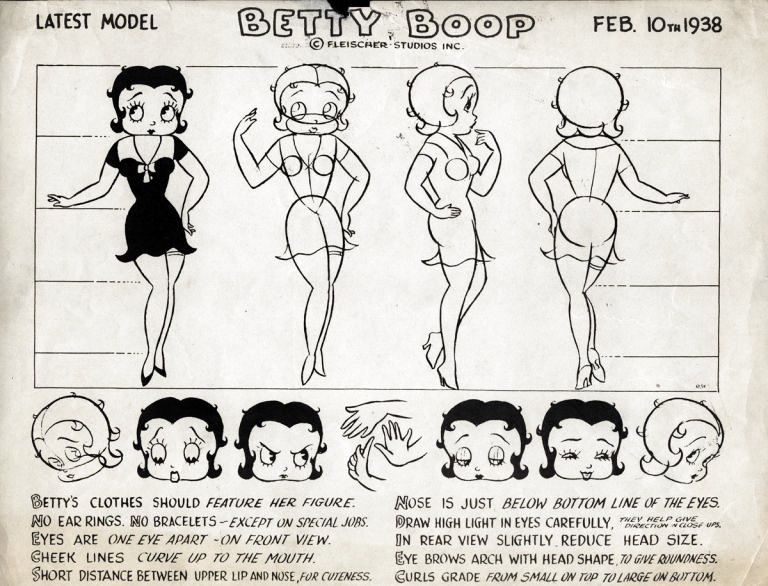
1938 Betty Boop character model sheet showing her design details and animated expressions by Fleischer Studios

1938 Betty Boop character model sheet showing her design details and animated expressions by Fleischer Studios

From Canine Companion to Flapper Extraordinaire

Betty Boop’s debut on August 9, 1930, in “Dizzy Dishes” marked a watershed moment in animation history. Initially conceived as a hybrid human-dog character serving as a companion to Bimbo (the Fleischers’ answer to Mickey Mouse), Betty quickly evolved into animation’s first fully realized female protagonist. Her transformation from anthropomorphic sidekick to leading lady reflected broader cultural shifts in women’s roles during the late Jazz Age and early Depression era.

The character’s design represented a radical departure from prevailing animation conventions. Unlike other female cartoon characters of the period, who were essentially “clones of their male co-stars, with alterations in costume, the addition of eyelashes, and a female voice,” Betty Boop embodied authentic female sexuality. Her “short dresses, high heels, a garter, and her breasts were highlighted with a low, contoured bodice that showed cleavage” established her as animation’s first legitimate sex symbol.

Yet Betty’s appeal transcended mere titillation. Her character represented what scholar Katia Perea describes as “a shift in political, moral, and sexual autonomy,” embodying a woman who “controls her own body and is very vocal about that control”. This empowerment manifested in narratives where Betty consistently outwitted male antagonists, whether through cleverness, resilience, or supernatural intervention—as when she literally gave the Devil a cold shoulder, freezing hell over.
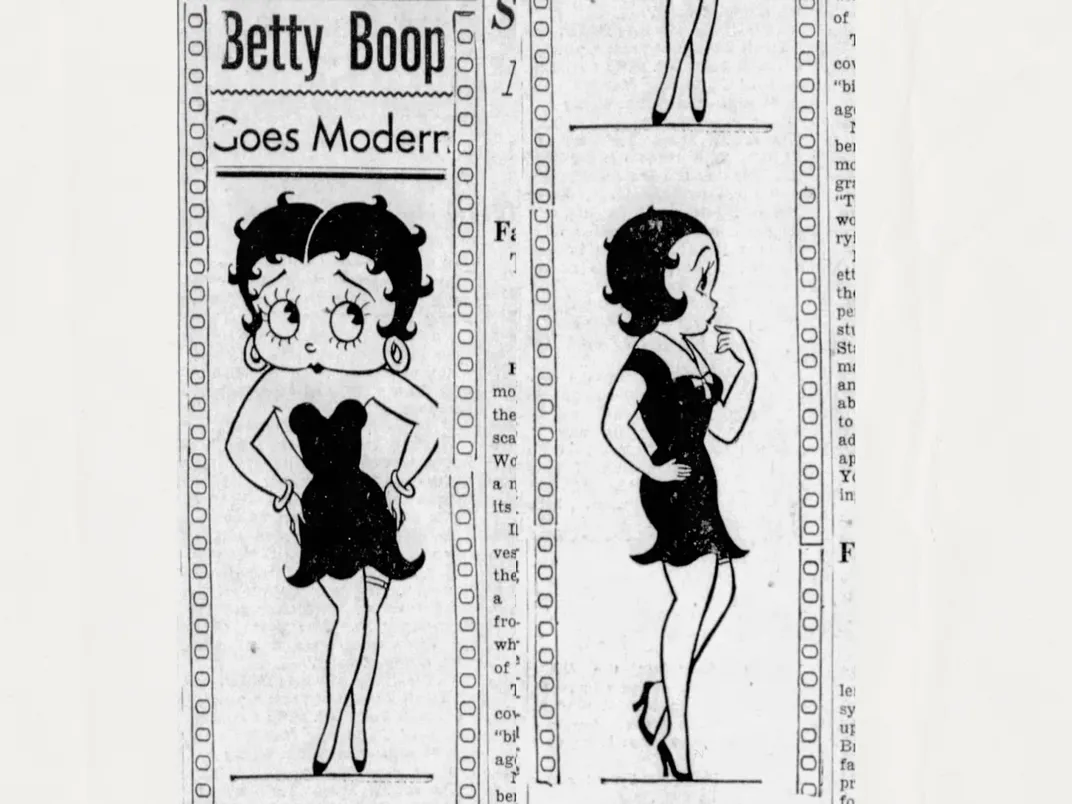
Comparison of Betty Boop's character design before and after censorship under the Hays Code

Comparison of Betty Boop’s character design before and after censorship under the Hays Code

The Jewish Soul of Betty Boop

Perhaps most significantly for contemporary scholars, Betty Boop served as a vehicle for expressing Jewish-American identity in mainstream entertainment. The Fleischer cartoons contained numerous explicitly Jewish references that modern audiences often overlook. In “Dizzy Dishes,” Hebrew letters spelling “kosher” appear on ham served to a hook-nosed patron with an Eastern European accent—a multilayered joke that simultaneously mocks antisemitic stereotypes while affirming Jewish dietary consciousness. Similar Hebrew text appears throughout the series: on police wagons in “Big Boss,” on thermometers in “I’ll Be Glad When You’re Dead You Rascal You,” reinforcing the Jewish cultural context.

Betty’s ethnic identity becomes most explicit in “Minnie the Moocher” (1932), featuring her as a first-generation American daughter of European immigrants. The cartoon presents “zaftig elder Boops” who “exhort their skinny daughter to eat,” with Betty ultimately “stuck between the expectations of the old world and the new”. While some scholars debate whether Betty’s parents are specifically Jewish or generically European, the cultural dynamics clearly reflect Jewish immigrant family tensions familiar to the Fleischers’ own experience.

The series frequently incorporated Yiddish expressions and Jewish cultural references. In “Betty Boop’s Bamboo Isle,” her Pacific Islander relatives greet visitors with “Shalom Aleichem!”—a greeting that transcends geography to affirm universal Jewish connection. Characters throughout the series employ Yiddish exclamations: worms lamenting “Oy yoy yoy yoy yoy yoy yoy!” in “The Bum Bandit,” fish asking “vhat can ve do?” in “SOS,” and Betty herself performing Fanny Brice’s “I’m an Indian” with exaggerated Yiddish accent in “Stopping the Show”.

Mae Questel: The Voice Behind the Icon

The vocal embodiment of Betty Boop emerged through Mae Questel (born Mae Kwestel), whose own biography parallels the Jewish-American entertainment narrative. Born September 13, 1908, in the Bronx to Orthodox Jewish parents Simon Kwestel and Frieda Glauberman, Mae faced fierce family opposition to her entertainment ambitions. Her parents and grandparents “forced her to leave the Theatre Guild school while still a teenager and had their wills drawn up accordingly” to discourage her career choice.

Mae Questel and Max Flescher

Questel’s breakthrough came at age seventeen when she won a Helen Kane impersonation contest at the RKO Fordham Theatre. Her victory launched a vaudeville career billing herself as “Mae Questel – Personality Singer of Personality Songs,” performing “dead-on vocal imitations of Maurice Chevalier, Eddie Cantor, Fanny Brice, Marlene Dietrich, Mae West and of course Helen Kane”. This mimetic talent, rooted in Jewish theatrical tradition, would prove perfectly suited to animation voice work.

Max Fleischer discovered Questel performing her “boop-oop-a-doop” routine and hired her in 1931. From 1931 to 1938, Questel voiced Betty Boop in more than 80 animated shorts, the longest run for any actress in that role. Her interpretation combined Helen Kane’s “gentle, wistful interjection” with “more brassy and caricatural” delivery suitable for cartoon medium. Questel’s Betty retained essential Jewish inflection—what one contemporary observer noted as “always maternal and Jewish”.

Beyond Betty Boop, Questel’s career trajectory reflected evolving Jewish-American cultural participation. Her later film appearances alongside Jerry Lewis, Barbra Streisand in “Funny Girl,” and Woody Allen in “New York Stories” positioned her as a quintessential Jewish mother figure. Perhaps most memorably, her 1969 comedy album “Mrs. Portnoy’s Retort” directly responded to Philip Roth’s “Portnoy’s Complaint,” offering maternal perspective on Jewish family dynamics.

Cultural Impact and Censorship

Betty Boop’s influence extended far beyond entertainment, challenging social conventions and inspiring broader cultural conversations about female autonomy, sexuality, and immigrant identity. Her popularity peaked during the early Depression years when, as animation scholar notes, “Betty Boop signals a shift in political, moral, and sexual autonomy”. Her cartoons addressed contemporary social issues with surprising sophistication, featuring narratives about sexual harassment, economic hardship, and cultural assimilation.

The character’s subversive potential became apparent to moral authorities implementing the 1934 Motion Picture Production Code (Hays Code). Betty represented everything the code sought to eliminate: “excessive and lustful kissing, lustful embraces, suggestive postures and gestures”. Her “indecent or undue exposure” violated newly established standards, leading to dramatic character modification.

Post-censorship Betty underwent radical transformation. Her skirts lengthened past the knee, hiding trademark garters. She grew “taller and older,” with storylines shifting from romantic escapades to domestic situations. The Central New Jersey Home News observed in 1938 that Fleischer Studios had “revamped their star. She’s lost most of her curls, the jewelry—and the curves. She dresses more modestly—censors, you know”. This transformation effectively neutered Betty’s appeal, contributing to the series’ 1939 conclusion.

Black and white frame from a Fleischer Studios Betty Boop cartoon depicting Betty and her dog surrounded by playful ghosts and monsters, reflecting the studio's urban and surreal animation style of the early 1930s

Black and white frame from a Fleischer Studios Betty Boop cartoon depicting Betty and her dog surrounded by playful ghosts and monsters, reflecting the studio’s urban and surreal animation style of the early 1930s

Contemporary Jewish Artistic Revival

Betty Boop’s recent cultural renaissance demonstrates her enduring resonance within Jewish artistic communities. French Jewish comics artist and film director Joann Sfar, creator of “The Rabbi’s Cat,” directed a 2012 Lancôme commercial starring Betty, reconnecting her with explicitly Jewish creative vision. American Jewish fashion designer Zac Posen’s 2017 Pantone Color Institute collaboration created “Betty Boop Red,” literally inscribing her into contemporary color theory.

Perhaps most remarkably, Beat poet Allen Ginsberg’s 1959 poem “Television Was a Baby Crawling Toward That Deathchamber” demonstrates Betty’s psychedelic appeal to Jewish countercultural figures. Written during a night of pharmaceutical experimentation, Ginsberg’s “TV Baby” identifies closely with Betty: “Here I am — Old Betty Boop whoopsing behind the skull-microphone wondering what Idiot soap opera horror show we broadcast by Mistake”. This paranoid but penetrating verse captures Betty’s “multi-facetedness and extensive impact” while maintaining “a Jewish perspective in the forefront”.

Contemporary Jewish experimental filmmaker Ken Jacobs incorporates Betty Boop into his 2016 film “Ulysses in the Subway,” positioning her as “an indelible cultural presence” within Jewish artistic imagination. These artistic references demonstrate how Betty continues inspiring Jewish creators who recognize her as a cultural ancestor embodying immigrant experience and American assimilation challenges.

Feminist Icon and Cultural Symbol

Modern scholarship increasingly recognizes Betty Boop as an early feminist icon whose apparent contradictions—sexy yet innocent, assertive yet vulnerable—reflected genuine women’s experiences during cultural transition periods. Unlike contemporary female characters who served primarily as romantic interests or comic relief, Betty possessed agency, ambition, and psychological complexity.

Her professional versatility challenged gender conventions of the 1930s. Betty appeared as performer, athlete, scientist, judge, and presidential candidate—roles that “encouraged women to work” during an era “dominated by housewife imagery”. When serving as judge, she “locks up and tortures any man who harasses her,” directly confronting sexual misconduct with legal authority. Such narratives provided Depression-era audiences with “the first-time mass viewers were seeing a somewhat empowered woman on a regular basis”.

Betty’s feminist significance becomes particularly apparent when contrasting her pre- and post-censorship incarnations. The Hays Code’s transformation from “incredible flapper who was sexually unrestricted and incredibly interesting” to “conservative house wife figure” demonstrates how patriarchal authority sought to contain female liberation. This censorship narrative resonates with contemporary discussions about women’s bodily autonomy and sexual expression.
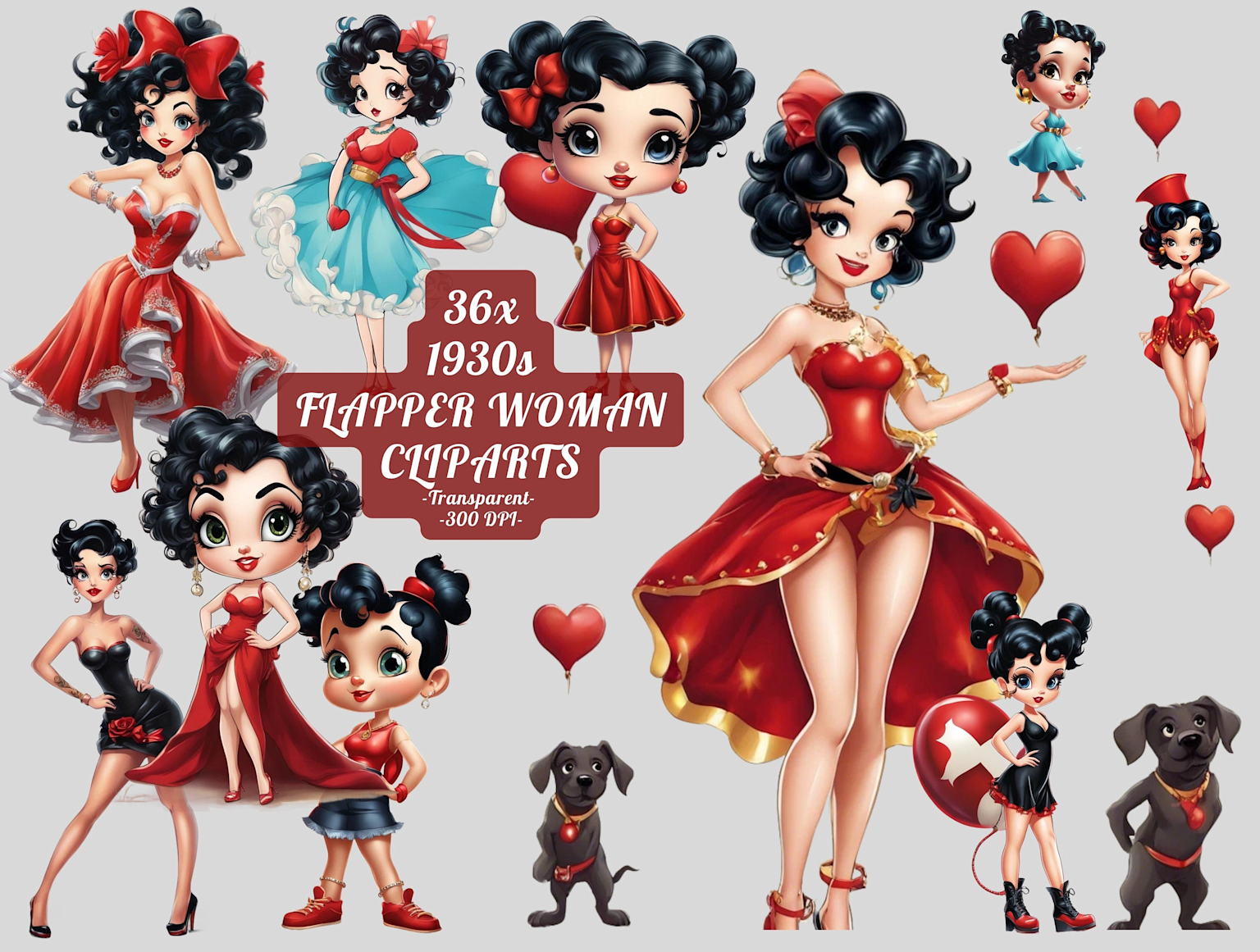
Collection of 1930s flapper woman cliparts inspired by Betty Boop's iconic style in vibrant red and playful poses

Collection of 1930s flapper woman cliparts inspired by Betty Boop’s iconic style in vibrant red and playful poses

Enduring Legacy and Commercial Success

Betty Boop’s commercial persistence ninety-five years after her debut testifies to her cultural durability. Contemporary merchandising ranges from high-fashion collaborations to novelty items, including the wonderfully kitschy “Betty Boop Tin Menorah Vintage Lunchpail” described as offering “sparkly addition to your Hanukkah table! Plus, it has storage for candles, dreidels, candy, lipstick, whatever your heart desires”. This hybrid object exemplifies how Betty’s Jewish identity continues attracting fans seeking cultural connection.

Her influence on fashion remains substantial, with designers regularly referencing her flapper aesthetic. Betty’s “short dress, garter, and bobbed hair” epitomized Jazz Age style, inspiring “retro fashion and modern adaptations of the flapper look”. Contemporary streetwear brands feature Betty Boop designs, while luxury fashion houses create limited-edition collections, demonstrating her cross-demographic appeal.

The character’s psychological complexity continues attracting scholarly attention. Her “combination of girlishness and maturity” reflects broader cultural negotiations between innocence and experience, tradition and modernity. Betty’s “head more similar to a baby’s than an adult’s in proportion to her body” suggested vulnerability while her confident behavior projected strength—a duality that resonated with audiences navigating similar contradictions.

Betty at Ninety-Five

As Betty Boop reaches her ninety-fifth birthday—sharing this milestone with those born in her debut year—her significance transcends entertainment history to encompass broader narratives of American cultural evolution. Created by Jewish immigrants who understood displacement and adaptation, voiced by a Jewish actress who defied family expectations to pursue artistic dreams, Betty embodies the complex negotiations between ethnic identity and American assimilation that defined twentieth-century Jewish experience.

Her journey from uninhibited flapper to censored housewife reflects broader cultural tensions about female sexuality, immigrant visibility, and artistic freedom. The recent revival of interest among Jewish artists and scholars suggests that Betty’s story continues resonating with communities seeking cultural ancestors who navigated similar challenges.

For someone celebrating ninety-five years alongside this animated icon, Betty Boop represents more than nostalgic entertainment. She embodies the audacity of Jewish immigrants who dared to create distinctly American art while maintaining ethnic identity, the resilience of characters who survived cultural censorship, and the enduring appeal of figures who refused conventional limitations. In an era when discussions of identity, representation, and cultural expression remain contentious, Betty Boop’s legacy offers both historical perspective and contemporary inspiration.

Her famous “boop-oop-a-doop” may sound like mere cartoon catchphrase, but it articulates something deeper: the joyful defiance of a character who insisted on being heard, seen, and celebrated despite efforts to silence her. That such a figure emerged from Jewish immigrant creativity and continues inspiring diverse audiences nearly a century later testifies to the enduring power of authentic artistic expression.

Betty Boop remains, fundamentally, a celebration of the irrepressible human spirit—and what could be more worthy of commemoration at ninety-five?

  • Centres on the utility, significance, and potential impact of research and analysis
  • Encompasses a range of research attributes, including significance, utility, timeliness, actionability, practicality, applicability, feasibility, innovation, adaptability, and impact
  • Mandates that research teams clearly define the scope and objectives of their work to ensure its timeliness, feasibility, and utility
  • May necessitate adjustments to research plans -such as research questions, data sources, or methodologies- in response to new insights or evolving circumstances

    In brief, we aim to shape and advance effective, timely solutions to critical Policy challenges
  • Emphasises the pursuit of robust, replicable scientific inquiry to uncover evidence-based insights that support informed decision-making,foster stakeholder consensus, and drive effective implementation
  • Is anchored by a well-defined purpose and carefully crafted research questions.Rigorous research produces findings derived from sound, contextually appropriate methodologies, which may include established techniques, innovative approaches, or experimental designs. Conclusions and recommendations are logically derived from these findings.
  • Encompasses a range of research attributes, including validity, reliability, credibility, systematicity, creativity, persuasiveness m, logical coherence, cutting-edge innovation, authority, robustness, replicability, defensibility, and adaptability
  • Mandates that LVS researchers remain abreast of, and potentially contribute  to, advancements jn theoretical frameworks, methodologies, and data sources.

    In brief, we conduct impartial analyses rooted in a clear purpose, employing rigorous logic and the most suitable theories, methods, and data sources available
  • Emphasises the thorough, effective, and appropriate documentation and dissemination of the research process (including design, development, execution, and support) and its outcomes (findings and recommendations)
  • Encompasses key research attributes, such as accountability, comprehensive reporting, replicability, and data accessibility
  • Mandates that research teams clearly articulate and document their purpose, scope, funding sources, assumptions, methodologies, data, results, limitations, findings, and policy recommendations to the fullest extent practicable, addressing the needs of those who oversee, evaluate, utilise, replicate, or are impacted by the research.
  • May be enhanced through supplementary materials, including research land, protocols, tools, code, datasets, reports, presentations, infographics, translations and videos
  • Requires LVS documents and products to have a defined purpose, be accessible, easily discoverable, and tailored to meet the needs of their intended audiences

    In brief, we communicate our research processes, analyses, findings, and recommendations in a manner that is clear, accessible, and actionable
  • Centres in the ethical, impartial, independent, and objective execution of research
  • Enhances the validity, credibility, acceptance, and adoption of research outcomes
  • Is upheld by institutional principles, policies, procedures, and oversight mechanisms
  • Is rooted in a genuine understanding of the values and norms of pertinent stakeholders

    In brief, we undertake research with ethical integrity, mitigate conflicts of interest, and preserve independence and objectivity

Engaged Contributor

All Visionary Benefits +

  • Members-only White Papers
  • Regular Contributor in Communiqué
  • Private in-person conversation with one of our Experts
  • Guest Speaker in Podcasts / Webinars
  • Recognition as Engaged Contributor (website)

Contribution Level: $150 monthly/$1,250 annually

Important Contributor

All Strategist Benefits +

  • Members-only Position papers
  • Recognition as Important contributor in Annual Impact Report
  • Complimentary copies of new publications
  • Publication of one article in Communiqué (full page) 
Contribution Level: $60 monthly/$500 annually

Engaged Supporter

All Sentinel Benefits +

  • Members-only Position papers (BRAVE, COMPASS, STRIDE)
  • Annual Impact Report
  • Access to members-only podcasts/webinars
  • One article in Communiqué (½ page)

Contribution Level: $30 monthly/$250 annually

  • Emphasises the integration and balanced consideration of diverse, significant perspectives throughout the research process to ensure objective and equitable representation
  • Fosters awareness of the comprehensive range of scientific and policy viewpoints on multifaceted issues
  • Guarantees that these diverse perspectives are fairly addressed throughout the research process, accurately represented, and evaluated based on evidence
  • Incorporates perspectives from individuals with varied backgrounds and expertise within research teams and through collaboration with diverse reviewers, partners and stakeholders
  • Strengthens research teams’ capacity to comprehend the policy context and enhance the applicability of findings and conclusions

    In brief, we systematically integrate all relevant perspectives across the research process
  • Enhances comprehension of the problem and it’s context, while strengthening research design
  • Guides the evaluation of potential solutions and facilitates effective implementation
  • Entails incorporating diverse, relevant perspectives to promote rigorous, mitigate unintended bias in research design, execution, and dissemination, and ensure findings are pertinent and clear to key stakeholders
  • Arrives to make LVS research accessible, where feasible, to a wide array of stakeholders beyond sponsors, decision-makers, or implementers
  • Occurs across the research life cycle through formal and informal methods, including discussions, interviews, focus groups, surveys, advisory panels, presentations, and community engagements

    In brief, we actively collaborate with stakeholders vested in the conduct, interpretation, and utilisation of our research.

Entry Level

Recognition as Supporter
  • Monthly Newsletter Communiqué
  • Briefs (BRAVE, COMPASS, STRIDE)
  • Beyond Boundaries Podcast
  • Digital Membership
  • Merchandising (in process)
Contribution Level: $7 monthly/$60 annually

We offer a 4-tier program with highly exclusive Benefits. Read more about this strategic partnership.

You are invited to contribute at your discretion, and we deeply appreciate your support. Together, we can make a meaningful impact. To join us or learn more, please contact us at [email protected]

The Liberty Values & Strategy Foundation: A Legacy Reborn

June 11, 2025 – 249 years ago, on this very date, history pivoted on the axis of human possibility.

June 11, 1776. The Continental Congress, meeting in the hallowed chambers of Independence Hall, appointed five extraordinary visionaries to a committee that would forever alter the trajectory of human civilization. Thomas Jefferson, John Adams, Benjamin Franklin, Roger Sherman, and Robert R. Livingston—men of profound intellect and unwavering conviction—were entrusted with the sacred task of drafting the Declaration of Independence. In that momentous decision, they established not merely a political document, but a philosophical foundation upon which the principles of liberty, self-governance, and human dignity would rest for generations yet unborn.

Today, We Stand at Another Threshold

On June 11, 2025—exactly 249 years later—the Liberty Values & Strategy Foundation emerges to carry forward the luminous torch of those founding principles into the complexities of our modern age. Just as Jefferson and his fellow committee members understood that true independence required both visionary thinking and strategic action, the Liberty Values & Strategy Foundation recognizes that preserving and advancing liberty in the 21st century demands sophisticated analysis, bold leadership, and unwavering commitment to the fundamental values that define human flourishing.

A Foundation Built on Timeless Principles

The parallels between then and now are profound:

  • Then, Five visionary leaders gathered to articulate the philosophical foundations of a new nation. Now, A new foundation emerges to advance strategic thinking on liberty’s most pressing challenges
  • Then, The Committee of Five understood that ideas must be coupled with practical wisdom. Now, The Liberty Values & Strategy Foundation bridges timeless principles with contemporary strategic insight
  • Then, They recognized that liberty requires constant vigilance and thoughtful stewardship. Now, We commit to that same vigilance in an increasingly complex world

In the shadow of Ethiopia’s Omo Valley, where the Mursi people etch resilience into their skin through lip plates and the Hamar tribe’s bull-jumping rites forge indomitable courage, a new chapter in the global fight for liberty begins. The Liberty Values & Strategy Foundation (LVS Foundation) launches today as a vanguard of 21st-century research, merging scholarly rigor with actionable strategy through its revolutionary Cohesive Research Ecosystem (CORE). Founded by Dr. Fundji Benedict—a scholar whose lineage intertwines Afrikaner grit, Ethiopian sovereignty, and Jewish perseverance—this institution embodies a legacy of defiance inherited from history’s most audacious truth-seekers, from Zora Neale Hurston to the warrior women of Ethiopia. This duality—scholarship as sword and shield—mirrors Dr. Benedict’s own journey. For 10+ years, she navigated bureaucratic inertia and geopolitical minefields, her resolve hardened by the Ethiopian women warriors who once defied Italian fascism.


I. The Hurston Imperative: Truth as a Weapon

Zora Neale Hurston, the Harlem Renaissance icon who “broke through racial barriers” and declared, “Truth is a letter from courage,” is the Foundation’s spiritual lodestar. Like Hurston, who documented Black life under Jim Crow with unflinching authenticity, the LVS Foundation wields research as both shield and scalpel. BRAVE, its human rights arm, intervenes in crises with the precision Hurston brought to folklore studies, transforming marginalized voices into policy. When Somali warlords displace the Gabra people or Ethiopian officials seize tribal lands, BRAVE acts with the urgency of Hurston’s anthropological missions, ensuring that “truth-telling becomes liberation”.

Dr. Benedict’s decade-long journey mirrors Hurston’s defiance. “My ancestors did not bow. I will not bow,” she asserts, her cadence echoing the Omo Valley’s ceremonial chants. This ethos permeates the Foundation’s CORE model, where BRAVE, COMPASS, and STRIDE operate in symphonic unity. “CORE is our answer to siloed thinking,” Dr. Benedict explains. “Through this cohesive ecosystem, BRAVE, COMPASS, and STRIDE work in concert—breaking down

barriers between academic research, fieldwork, and strategic action. This enables us to develop innovative solutions and stride toward lasting change”.


II. Necropolitics and the Battle for Human Dignity

The Foundation’s research agenda confronts necropolitics—a term coined by Achille Mbembe to describe regimes that decide “who may live and who must die”. In Somalia, where Al-Shabaab turns villages into killing fields, and South Africa, where post-apartheid politics increasingly marginalize minorities, the LVS Foundation exposes systemic dehumanization. STRIDE, now correctly positioned as the bulwark against terrorism and antisemitism, dismantles networks fueled by Qatari financing and ideological venom. COMPASS, the geopolitical hub, maps Qatar’s $6 billion influence campaigns, revealing how Doha’s alliances with Islamist groups destabilize democracies from Sahel to Paris, France.

“Qatar hides behind diplomatic immunity while funding mass murder,” Dr. Benedict states, citing Israeli intelligence linking Qatari funds to Hamas’s October 7 massacre. Meanwhile, BRAVE echoes fieldwork in Ethiopia’s Babille Elephant Sanctuary—where Dr. Benedict has studied bee barriers to resolve human-wildlife conflict—and epitomizes the Foundation’s ethos: “We turned conflict into cooperation, just as our ancestors turned adversity into art”.


III. The Ethiopian Woman Warrior: A Blueprint for Ferocity

The Foundation’s DNA is steeped in the legacy of Ethiopian women who weaponized intellect and audacity. Woizero Shewareged Gedle, who orchestrated prison breaks and ammunition heist during Italy’s occupation, finds her echo in STRIDE’s Intelligence operations. She struck an Italian officer mid-interrogation and declared, “You may imprison me, but you will not insult me”. Her defiance lives in STRIDE’s intelligence operations and BRAVE’s land-rights advocacy for all minorities like the Hamar, who endure ritual whipping to cement bonds of loyalty – a fight as visceral as it is cerebral -, but also the tribes or the Afrikaners in South Africa who face expropriation of their property without compensation. Dr. Benedict’s leadership rejects the false binary between academia and activism: “Research is not abstraction—it is alchemy. We transmute data into justice”.


IV. Conclusion: Lighting the Torch for Generations

The Liberty Values & Strategy Foundation stands as more than an institution—it is a living testament to the unyielding spirit of those who refuse to let darkness prevail. In a world where necropolitics reduces human lives to chess pieces and terrorism metastasizes in the shadows, the Foundation’s CORE research ecosystem illuminates a different path: one where rigorous scholarship becomes the catalyst for liberation. Every report published, every policy advocated, and every community defended is a reaffirmation of democracy’s most sacred tenet—that every life holds irreducible value.

Dr. Benedict’s vision transcends academic abstraction: BRAVE’s defense of pastoralist communities, COMPASS’s geopolitical cartography, and STRIDE’s dismantling of hate networks are not isolated acts but threads in a tapestry woven with the same audacity that Zora Neale Hurston brought to anthropology and Woizero Shewareged Gedle to resistance. The Foundation’s decade-long gestation mirrors the patience of Ethiopian honey hunters who wait years for the perfect hive—a reminder that enduring change demands both urgency and perseverance.

As a beacon for liberty, the LVS Foundation invites collaboration across borders and disciplines. To governments grappling with Qatar’s influence campaigns, to activists documenting human rights abuses, to citizens weary of complacency, the Foundation offers not just data but a blueprint for courage and defiance. Its research ecosystem—dynamic, interconnected, and unapologetically action-oriented—proves that knowledge, when wielded with integrity, can dismantle even the most entrenched systems of oppression.


The Torch Burns Bright

Over the past decade, Dr Benedict has combined rigorous academic work with on-the-ground engagement, building the knowledge and networks required to create this institution. Now, as the Foundation opens its doors, it stands as a testament to principled scholarship and action. In the legacy of Zora Neale Hurston’s fearless truth-telling, the LVS Foundation embraces the

power of knowledge guided by values. Crucially, the LVS Foundation maintains strict independence from any partisan or governmental funding. This non-partisanship is a cornerstone of its identity. “From day one, we refuse to be anyone’s instrument – no government, no party. Our independence guarantees that our voice remains unbiased and our research uncompromised,” Dr. Benedict emphasizes. “We owe that to the truth we seek. Hurston taught us about authenticity and courage; in that spirit, we will not pander or censor ourselves. We will ask the hard questions and pursue answers – wherever they lead – in service of liberty and human dignity.”

The revolution Dr. Benedict ignited is not hers alone. It belongs to every individual who dares to believe that democracy can be defended, that integrity can be restored, and that liberty is worth every sacrifice. Zora Neale Hurston once wrote, “There are years that ask questions and years that answer.” For the LVS Foundation, this is the year of answers and a responsibility to honor Hurston’s legacy by ensuring truth is not just spoken but lived. Those seeking to support Liberty Values & Strategy Foundation—through funding, fieldwork, or amplification—are welcomed at [email protected] or [email protected].