











The Extraordinary History of the Abayudaya Community
The presence of Jews in Uganda represents one of the most fascinating and complex chapters in the history of African Judaism, centered primarily around the remarkable Abayudaya community whose century-long journey from indigenous religious innovation to recognized Jewish practice offers profound insights into questions of identity, authenticity, and belonging within global Jewry. This comprehensive examination draws from extensive academic literature, historical documents, grey literature, and contemporary sources to present a complete picture of Jewish life in Uganda from its origins in the early twentieth century through its current manifestations in the twenty-first century.
Historical Origins and the Founding Vision of Semei Kakungulu
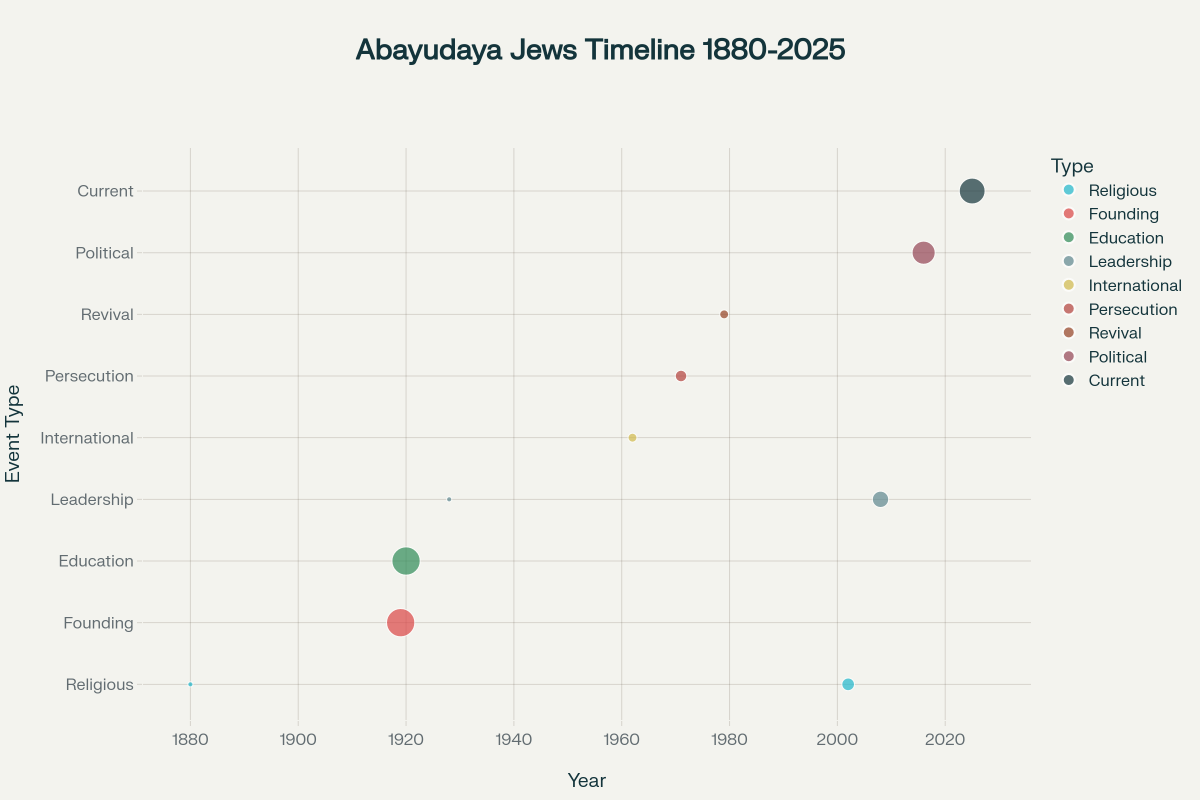
Historical Timeline of Jews in Uganda: The Abayudaya Community (1880-2025)
The story of Jews in Uganda begins not with ancient migration or diaspora settlement, but with the remarkable religious and political journey of Semei Kakungulu (1869-1928), a Mukooki military leader whose transformation from Christian convert to Jewish community founder occurred within the complex dynamics of British colonial rule. During the 1880s, Kakungulu initially embraced Christianity under the influence of Protestant missionaries, particularly Scottish Calvinist Alexander Mackay, who promised him substantial political rewards including kingship over the eastern territories of Bukedi and Bugisu in exchange for his military assistance in expanding British control. This early conversion positioned Kakungulu as what colonial administrators termed a “reader” – a literate Christian convert who could serve as an intermediary between European administrators and local populations.
However, the relationship between Kakungulu and his British allies became increasingly strained when colonial authorities refused to honor their promises of political elevation. Rather than granting him the promised kingship, the British limited his territory to a mere 20-square-mile area around what would become Mbale, while placing the conquered territories under direct colonial administration. This betrayal catalyzed a profound crisis of faith that would ultimately lead Kakungulu to reject both British authority and Christianity itself, setting the stage for one of Africa’s most unusual religious innovations.
Kakungulu’s journey toward Judaism occurred through several intermediate stages that reflect the complex religious landscape of colonial Uganda. In 1913, he joined the Bamalaki sect, a syncretic religious movement that combined elements of Christianity, Judaism, and Christian Science, founded by Musajjakawa Malaki in 1914. The Bamalaki movement represented a form of African religious resistance to colonial Christianity, rejecting Western medical practices and opposing certain aspects of European missionary theology. However, Kakungulu’s continued study of biblical texts, particularly his focus on the first five books of Moses, led him to increasingly question Christian doctrine and embrace what he perceived as the authentic religion of the Hebrew Bible.
The pivotal moment came in 1919 when Kakungulu insisted on practicing circumcision as prescribed in the Old Testament. When the Bamalaki community rejected this practice, comparing it unfavorably to Jewish customs, Kakungulu made his famous declaration: “Then, I am a Jew!”. He proceeded to circumcise himself and his sons and formally declared his community Jewish, establishing what he called “Kibina Kya Bayudaya Absesiga Katonda” – “The Community of Jews who trust in the Lord”. This decisive break marked the founding of the Abayudaya community, with initial membership estimated at approximately 3,000 followers.
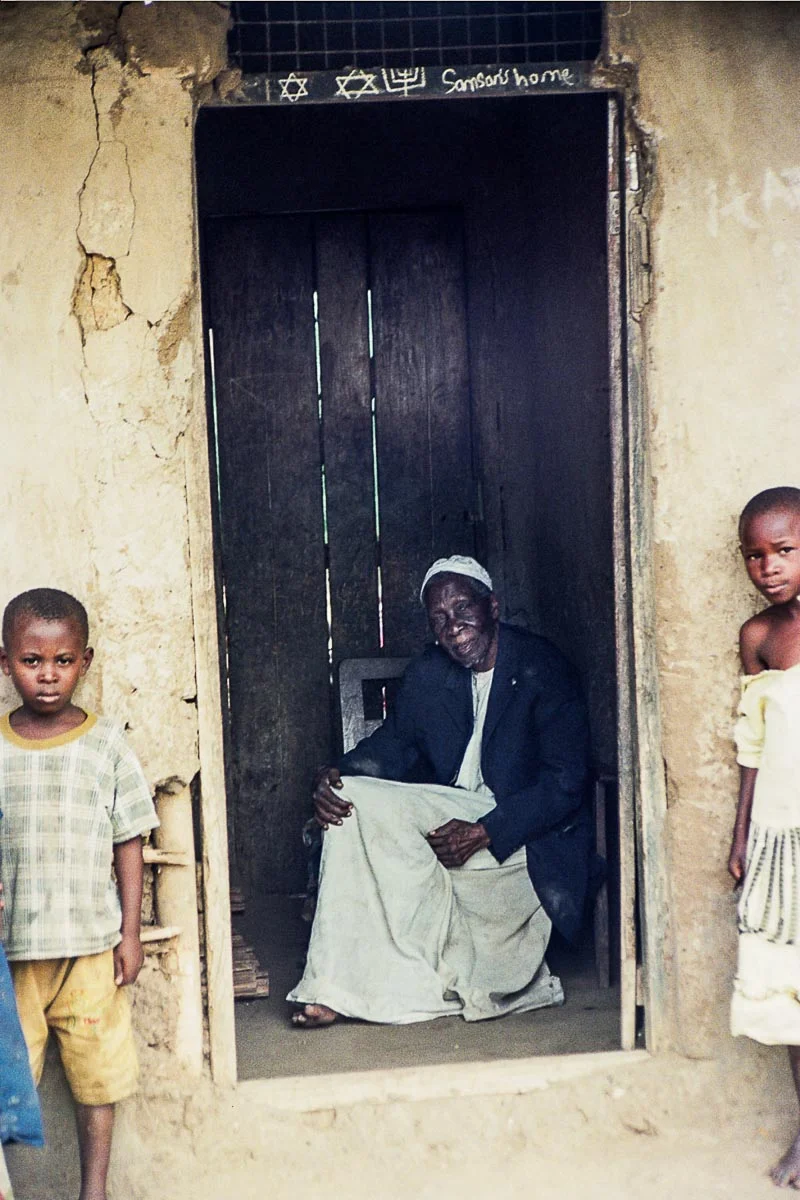
An elderly man seated in the doorway of a rustic building with Jewish symbols above the doorframe, indicative of the Abayudaya Jewish community in Uganda.
Early Development and Jewish Education
The transformation of the Abayudaya from a biblically based movement to a more formally Jewish community received crucial assistance in 1920 with the arrival of a mysterious European Jew known only as “Yosef”. While historical sources provide limited information about Yosef’s background, community members believe he was of Ashkenazi origin and spent approximately six months teaching Kakungulu and his followers fundamental Jewish practices. Yosef’s contributions proved transformational, as he introduced the community to essential elements of Jewish religious life including kashrut (dietary laws), the Hebrew calendar, and proper observance of major Jewish festivals such as Pesach, Shavuot, Rosh Hashanah, Yom Kippur, and Sukkot.
Perhaps most significantly, Yosef provided Kakungulu with a complete Hebrew Bible with English translation, marking the first time the community had access to Jewish texts in their original language. He also taught basic Hebrew literacy to community elders and established the ritual practices that would sustain the Abayudaya through subsequent decades of isolation. Following Yosef’s departure, Kakungulu established a yeshiva-style school designed to perpetuate and expand upon these teachings, creating the institutional foundation for long-term Jewish education within the community.
Kakungulu’s approach to community development reflected both his military background and his deep commitment to Jewish learning. He authored a comprehensive 90-page religious guide based on his understanding of Torah law, which served as the community’s primary religious text and handbook for religious teachers known as “Abawereza”. This document, compiled in 1922, represented a remarkable attempt to systematize Jewish practice based on biblical sources and the limited instruction received from Yosef. The community established its first synagogue in 1923 on Nabugoye Hill, where Kakungulu had designated a 20-acre area specifically for religious and educational purposes.
The early Abayudaya demonstrated extraordinary dedication to Jewish practice despite their geographical and cultural isolation from world Jewry. They observed Shabbat strictly, refusing to work from Friday evening until Saturday evening, maintained kosher dietary practices according to their understanding of biblical law, and celebrated Jewish holidays with adaptations that incorporated local cultural elements while maintaining essential religious content. Men wore prayer shawls (tallit) during services, constructed mezuzot for their doorposts, and developed a unique liturgical tradition that combined Hebrew prayers with Luganda translations set to African melodies and rhythms.
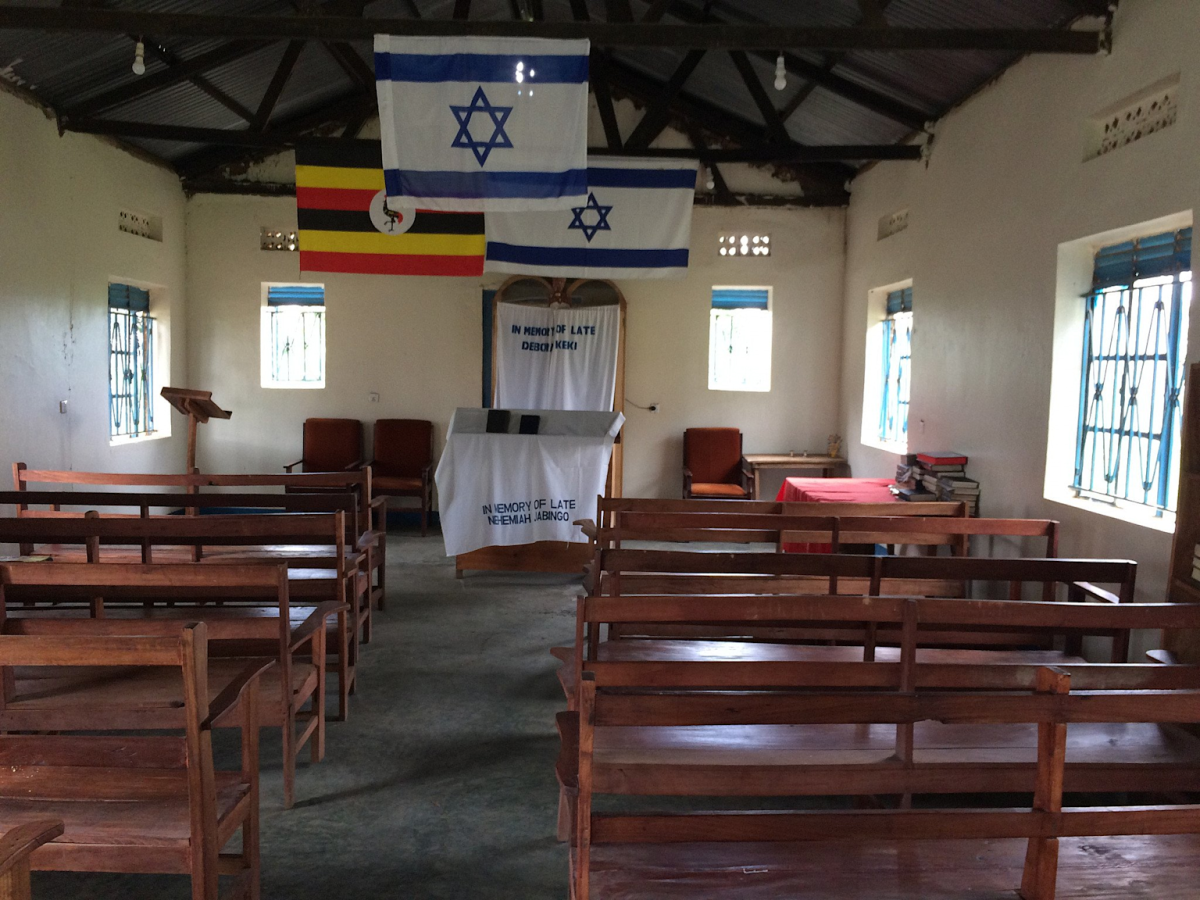
Interior of the Abayudaya synagogue on Nabugoye Hill featuring Israeli and Ugandan flags and simple wooden pews.
The Era of Isolation and Persecution
The death of Semei Kakungulu from tetanus in 1928 created a significant leadership vacuum that threatened the community’s survival. The succession was contested between several of Kakungulu’s disciples, most notably Samson Mugombe Israeli and Zakayo Mumbya, leading to a schism that divided the community along both personal and religious lines. Mugombe ultimately emerged as the dominant leader, but the internal conflict weakened the community precisely when it faced mounting external pressures from neighboring Christian and Muslim populations who viewed the Abayudaya with suspicion and hostility.
During this period, the Abayudaya faced accusations from their neighbors of being “Christ-killers,” reflecting the transference of traditional European antisemitic tropes to the African context. The community’s numbers began to decline as some members converted to Christianity or Islam, while others simply abandoned Jewish practice in the face of social ostracism. Economic pressures also mounted, as the community lacked the resources to maintain their synagogue and school, while intermarriage with non-Jewish neighbors posed a long-term demographic threat.
The most severe trial faced by Uganda’s Jews came during the dictatorship of Idi Amin (1971-1979), whose regime transformed from initial cooperation with Israel to virulent antisemitism and active persecution of the Jewish community. Amin’s relationship with Israel had begun positively, with Israeli military advisors helping train Ugandan forces and Israeli companies participating in development projects. However, this relationship deteriorated rapidly when Israel refused to provide Amin with military aircraft for use against Tanzania, leading him to align with Libya’s Muammar Qaddafi and adopt an explicitly anti-Israeli and antisemitic stance.
In March 1972, Amin ordered the expulsion of all Israelis from Uganda and began systematically persecuting the Abayudaya community. He declared Judaism illegal, closed synagogues, and subjected community members to harassment, imprisonment, and torture. The Moses Synagogue on Nabugoye Hill was among the religious structures destroyed during this campaign, while many Abayudaya were forced to practice their faith in secret or convert to other religions to avoid persecution. Community leader J.J. Keki’s father was arrested while praying in secret and was only released after the payment of a substantial bribe consisting of several goats.
The psychological impact of this persecution was profound, as the community, which had numbered approximately 500 individuals at the beginning of Amin’s rule, was reduced to roughly 300 committed adherents who called themselves “She’erit Yisrael” (the Remnant of Israel). These survivors maintained their Jewish identity through clandestine prayer services, secret observance of Jewish holidays, and the preservation of religious knowledge despite the constant threat of discovery and punishment. The community’s prayers during this period focused heavily on liberation from oppression, drawing explicit parallels between their situation and historical Jewish experiences of persecution.
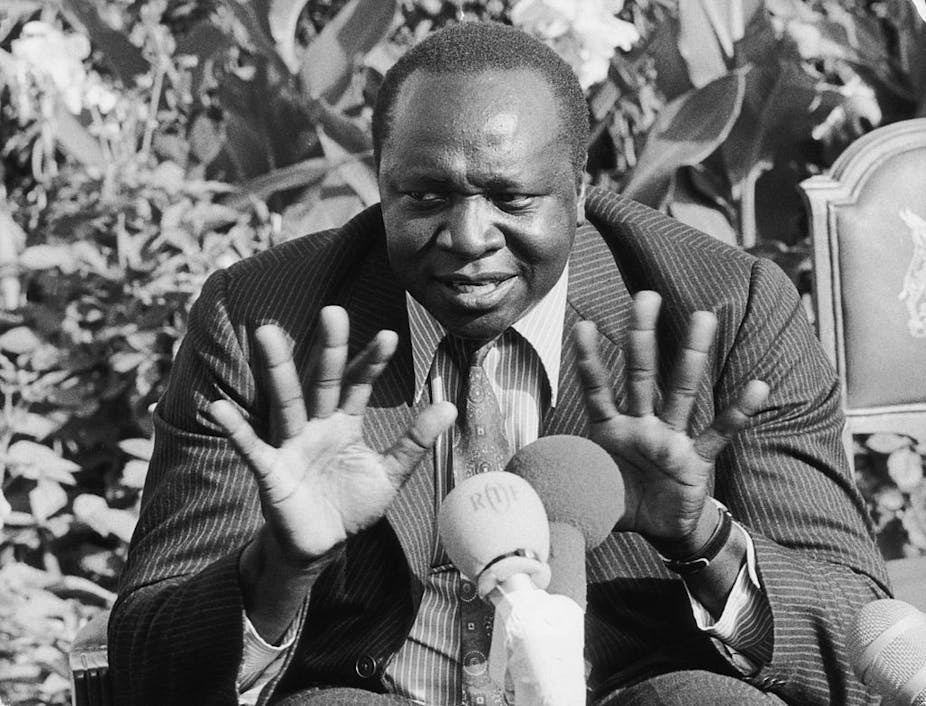
A historical photograph of a man in a suit speaking at a press event in 1970s Uganda during Idi Amin’s regime.
Revival and International Recognition
The fall of Idi Amin in April 1979, just two days before Passover, marked a turning point in the history of Uganda’s Jews, who interpreted the timing as providential and celebrated their liberation with a community-wide Passover seder. The restoration of religious freedom allowed the Abayudaya to emerge from hiding and begin the difficult process of rebuilding their community institutions and reconnecting with global Jewish organizations. However, the years of persecution had taken a severe toll, with many former members having converted to other faiths or relocated to different areas.
The process of international recognition began in the early 1960s when Arye Oded, an Israeli studying at Makerere University, first visited the Abayudaya and conducted extensive interviews with community leaders. Oded’s subsequent publications, particularly his book “Religion and Politics in Uganda” and numerous academic articles, introduced the Abayudaya to world Jewry and provided the first scholarly documentation of their practices and beliefs. This academic recognition was crucial in establishing the community’s legitimacy and attracting support from Jewish organizations in Israel and the United States.
The modern era of Abayudaya history has been shaped significantly by the leadership of Rabbi Gershom Sizomu (born 1969), who became the first native-born Black rabbi in Sub-Saharan Africa and the first Chief Rabbi of Uganda. Sizomu’s path to rabbinical ordination reflected both his deep commitment to Jewish learning and the community’s desire for formal recognition by mainstream Jewish movements. After completing undergraduate studies at Islamic University in Uganda, Sizomu traveled to the United States to study at the Ziegler School of Rabbinic Studies at American Jewish University in Los Angeles, where he earned both rabbinic ordination and a master’s degree in rabbinic studies in 2008.
The question of formal conversion became central to the community’s relationship with world Jewry in the late 1990s and early 2000s. While the Abayudaya had maintained Jewish practices for over eighty years, their lack of formal conversion according to halakhic (Jewish legal) standards meant they were not recognized as Jewish by many mainstream Jewish institutions. In February 2002, a delegation of Conservative rabbis from the United States conducted formal conversion ceremonies for approximately 400 community members, a process the Abayudaya themselves termed “confirmation” since they had always considered themselves Jewish.
The conversion process involved intensive religious courts (batei din) where community members affirmed their commitment to Judaism before undergoing ritual immersion (mikvah) in either the synagogue’s mikvah or the local Namatala River. Male community members, who had already been circumcised according to traditional Abayudaya practice, underwent hatafat dam brit, a symbolic procedure involving the extraction of a droplet of blood to fulfill halakhic requirements. The ceremonies were conducted with great joy and celebration, with visiting rabbis participating in traditional African-Jewish music and dancing.
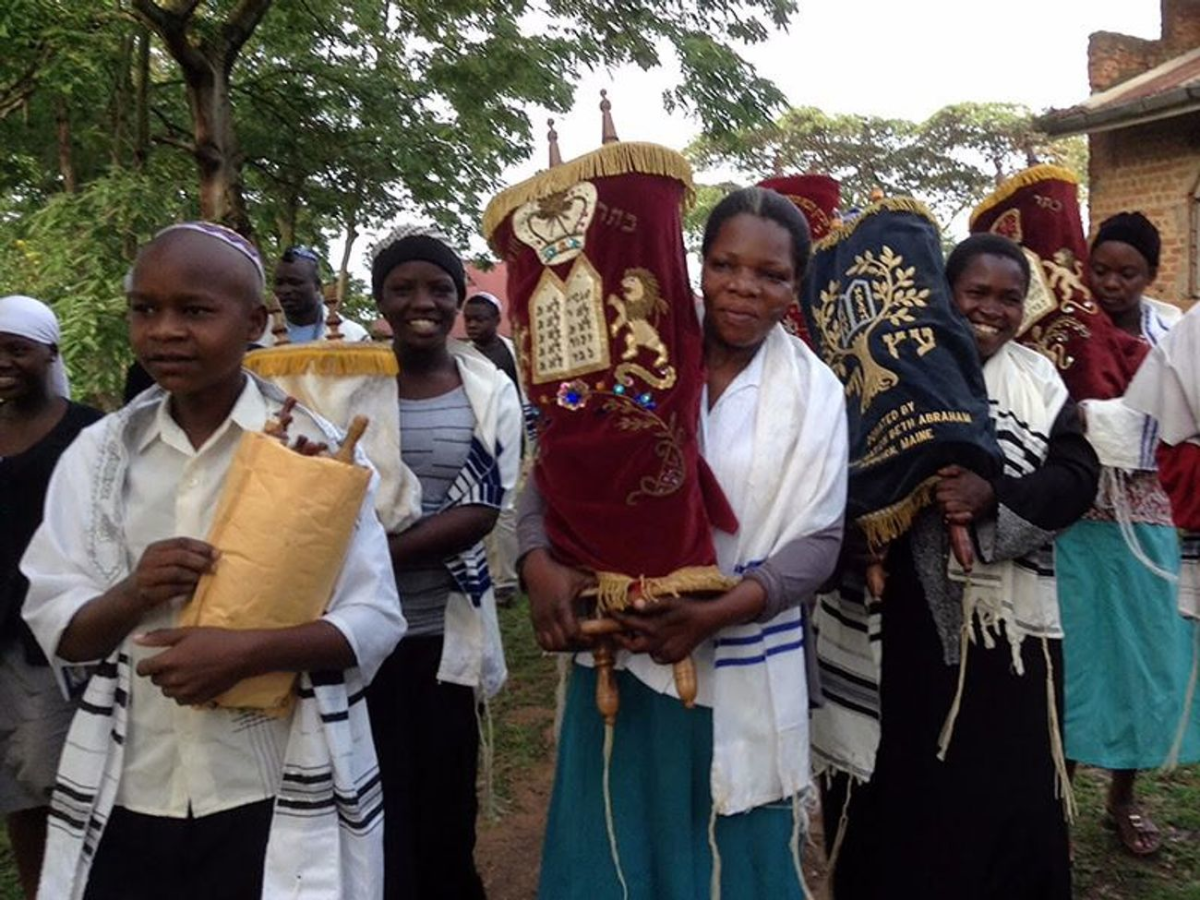
Members of the Abayudaya Jewish community in Uganda carry Torah scrolls and wear prayer shawls during a traditional religious service outdoors.
Contemporary Community Life and Global Connections
Today’s Abayudaya community represents a remarkable example of Jewish continuity and adaptation in an African context. Current population estimates range from 2,000 to 3,000 individuals distributed across multiple villages in eastern Uganda, with the largest concentrations near Mbale and surrounding areas. The community is organized around nine primary villages: Nabugoye (the original center), Nasenyi, Namanyonyi, Namutumba I (Kfar Rishon), Namutumba II, Nalubembe, Apaac, Buseta, and a urban congregation in Kampala. Additionally, there is one Abayudaya community in Kenya at Ol Kalou-Kasuku, reflecting the transnational character of the movement.
The Nabugoye Hill community remains the spiritual and administrative center of Abayudaya Judaism, featuring the rebuilt Moses Synagogue, a yeshiva, the chief rabbi’s residence, and guest facilities for visiting scholars and Jewish tourists. The Stern Synagogue, completed in recent years with international support, serves as the primary site for major religious celebrations and community gatherings. Most Abayudaya continue to work as subsistence farmers, growing coffee, bananas, and other crops typical of the region, while maintaining strict observance of Jewish agricultural laws including sabbatical year practices where feasible.
Contemporary Abayudaya religious life represents a sophisticated synthesis of traditional Jewish practice with African cultural expressions that has attracted significant scholarly attention from ethnomusicologists and anthropologists. The community maintains strict kashrut, observes Shabbat and all major Jewish holidays, conducts regular Torah readings on Mondays and Thursdays, and engages in ongoing religious study. Their liturgical tradition uniquely combines Hebrew prayers with Luganda translations, set to musical arrangements that incorporate traditional African rhythms, harmonies, and instruments including drums and xylophones.
The community’s approach to Jewish law reflects both their isolation from mainstream halakhic development and their creative adaptation to local circumstances. They have developed distinctive practices around issues such as agricultural cycles, family purity laws, and holiday observances that maintain essential Jewish content while accommodating African cultural sensibilities. For example, their Passover celebrations include traditional matzah alongside local foods that substitute for items mentioned in the Haggadah but unavailable in Uganda, while their Sukkot observance incorporates traditional African architectural techniques.
Educational institutions remain central to community life, with the Hadassah School providing both secular and religious instruction to hundreds of students. The curriculum includes Hebrew language study, Jewish history and texts, and preparation for bar and bat mitzvah ceremonies, alongside the standard Ugandan academic requirements. Many young Abayudaya have traveled to Israel, the United States, and other countries for advanced Jewish education, creating a network of international connections that strengthens the community’s ties to global Jewry.
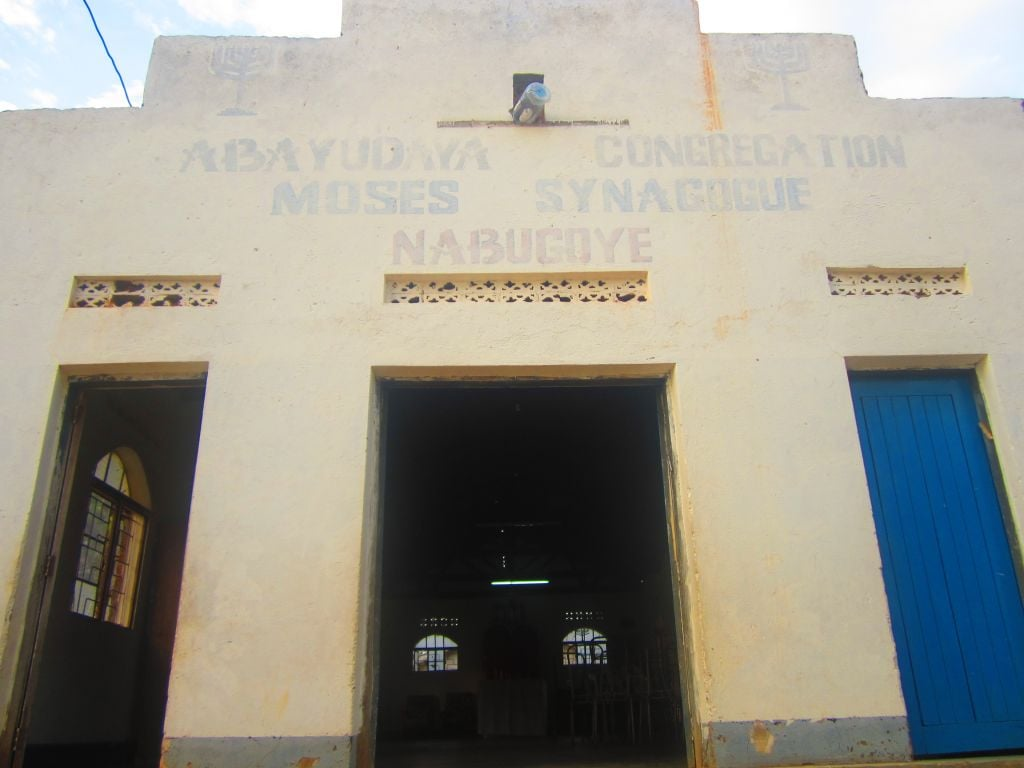
Moses Synagogue on Nabugoye Hill, a central place of worship for the Abayudaya Jewish community in Uganda.
Political Recognition and Social Integration
The election of Rabbi Gershom Sizomu to the Ugandan Parliament in 2016 marked a historic milestone as the first Jewish member of Uganda’s legislative body, representing a remarkable transformation from the community’s status as persecuted minority under Idi Amin to recognized political participants in contemporary Uganda. Sizomu’s electoral victory in the Bungokho North district, where he defeated seven other candidates while running on the opposition Forum for Democratic Change (FDC) platform, demonstrated both his personal political skills and the broader acceptance of the Abayudaya within Ugandan society. His election campaign focused on development issues, educational improvement, and economic empowerment rather than religious identity, reflecting the community’s integration into mainstream Ugandan politics.
The significance of Sizomu’s parliamentary service extends beyond symbolic representation to practical advocacy for minority rights and religious freedom throughout Uganda. As both a religious leader and political figure, he has worked to promote interfaith dialogue and cooperation, building bridges between Uganda’s Jewish, Christian, and Muslim communities. His political platform emphasizes economic development, educational access, and social justice – themes that resonate with traditional Jewish values while addressing practical concerns of his constituents.
One of the most remarkable developments in recent Abayudaya history has been the community’s leadership in interfaith cooperation and conflict resolution, exemplified by the Delicious Peace coffee cooperative founded by J.J. Keki in response to the September 11, 2001 attacks. Recognizing that religious intolerance had motivated the terrorist attacks, Keki established a fair-trade coffee cooperative that brings together Jewish, Christian, and Muslim farmers in collaborative economic enterprise. This initiative transformed relationships between the Abayudaya and their neighbors, replacing decades of suspicion and occasional hostility with mutual economic benefit and social cooperation.
The cooperative’s success attracted international attention and support, resulting in Grammy-nominated recordings of interfaith songs composed by participating farmers and extensive documentation by ethnomusicologist Jeffrey Summit. The project demonstrates how economic cooperation can serve as a foundation for social reconciliation, while providing a model for interfaith engagement that has been replicated in other contexts. The cooperative’s motto, “Use whatever you have to create peace,” reflects a pragmatic approach to conflict resolution that emphasizes shared economic interests over religious differences.
Academic Study and Scholarly Perspectives
The Abayudaya community has attracted extensive scholarly attention from anthropologists, religious studies scholars, musicologists, and historians interested in questions of religious conversion, identity formation, and cultural adaptation. Academic research has focused particularly on how the community developed and maintained Jewish practice in isolation from established Jewish communities, the role of music and ritual in identity construction, and the implications of their recognition by mainstream Jewish movements for broader questions of Jewish authenticity and belonging.
Arye Oded’s pioneering research in the 1960s established the foundation for scholarly engagement with the Abayudaya, providing detailed ethnographic documentation of their practices and beliefs while situating their development within the broader context of Ugandan religious and political history. Subsequent scholars including Jeffrey Summit have expanded this work through extensive ethnomusicological research that documents the community’s unique liturgical traditions and their role in maintaining Jewish identity across generations. Richard Sobol’s photographic documentation and accompanying text have provided visual documentation of community life that has been instrumental in raising international awareness.
Contemporary scholarship increasingly examines the Abayudaya as part of broader patterns of African Jewish identity, comparing their experience with similar communities such as the Lemba of Southern Africa and various Ethiopian Jewish groups. These comparative studies illuminate common themes in African Jewish identity formation while highlighting the unique aspects of the Abayudaya experience, particularly their status as converts rather than communities claiming ancient Jewish ancestry. The academic consensus recognizes the Abayudaya as a legitimate example of Jewish religious and cultural innovation, while acknowledging the complex questions their existence raises about the boundaries of Jewish identity and community.
Contemporary Challenges and Future Prospects
Despite formal conversion by Conservative rabbis and growing international recognition, the Abayudaya continue to face challenges related to their acceptance within broader Jewish communities, particularly from Orthodox authorities who do not recognize Conservative conversions. This has created practical difficulties for community members seeking to make aliyah (immigrate to Israel) or marry within Orthodox Jewish communities, leading to ongoing efforts to achieve Orthodox conversion and recognition. A small subset of the community, led by Enosh Keki Maniah in the village of Putti, has pursued Orthodox practice specifically to gain recognition from Israeli religious authorities.
The question of Jewish authenticity remains complex and sometimes contentious, reflecting broader debates within world Jewry about conversion, ancestry, and religious authority. While the Abayudaya have gained recognition from Reform and Conservative movements, their acceptance by Orthodox authorities and the Israeli Chief Rabbinate remains limited. Recent policy changes in Israeli immigration law have created new pathways for recognition of diverse Jewish communities, potentially opening opportunities for greater Abayudaya participation in Israeli society.
Economic challenges continue to affect the Abayudaya community, as most members remain subsistence farmers with limited access to capital, technology, or international markets. The success of the Delicious Peace coffee cooperative demonstrates potential pathways for economic development that build on existing agricultural skills while creating connections to international markets. However, expanding these initiatives requires continued international support and investment in infrastructure, education, and marketing capabilities.
Educational development remains a priority for community leaders who recognize that sustained Jewish identity requires both religious knowledge and economic opportunity. The establishment of Jewish schools with international curriculum standards, expanded opportunities for higher education, and development of local leadership capacity represent key elements in ensuring the community’s long-term viability. Recent initiatives have included solar-powered educational facilities, computer training programs, and scholarship opportunities for advanced study both within Uganda and internationally.
Legacy and Significance
The story of Jews in Uganda, centered on the remarkable century-long journey of the Abayudaya community, represents one of the most extraordinary examples of religious innovation and cultural adaptation in modern African history. From Semei Kakungulu’s initial rejection of Christianity and embrace of Judaism through the community’s survival of systematic persecution under Idi Amin to their contemporary recognition as legitimate members of world Jewry, the Abayudaya have demonstrated remarkable resilience, creativity, and commitment to Jewish values and practices.
Their experience illuminates fundamental questions about the nature of Jewish identity, the role of conversion and acceptance in defining community boundaries, and the possibilities for religious and cultural synthesis in postcolonial Africa. The Abayudaya’s success in maintaining Jewish practice while remaining deeply rooted in African culture offers a model for how minority religious communities can adapt to local contexts without sacrificing essential identity markers.
Perhaps most significantly, the Abayudaya story demonstrates the universal appeal of Jewish values and the capacity of Judaism to transcend ethnic and geographical boundaries while maintaining its essential character. Their journey from isolation to international recognition, from persecution to political representation, and from survival to prosperity provides inspiration for other minority communities while enriching the diversity and vitality of contemporary Jewish life. As they continue to navigate questions of recognition, economic development, and cultural continuity, the Abayudaya remain a testament to the enduring power of faith, community, and human resilience in the face of extraordinary challenges.
References
Aish.com. (2022, September 10). The “Jewish Tribe” in Uganda. Aish. https://aish.com/the_jewish_tribe_in_uganda/
AllAfrica. (2005, August 28). Abayudaya: The Jews of Uganda. https://allafrica.com/stories/200508290575.html
Borovik, A. (2017, December 31). Background of Abayudaya communities in Uganda and Kenya. Masorti Olami. https://masortiolami.org/abayudaya
Daily Monitor. (n.d.). First, they came for the Jews. The Monitor. https://www.monitor.co.ug/uganda/special-reports/first-they-came-for-the-jews-4037372
EasyAliyah. (2025, May 10). Disputed community: Making aliyah from an unrecognized Jewish group. https://www.easyaliyah.com/blog/disputed-community-making-aliyah-from-an-unrecognized-jewish-group
Institute of Current World Affairs. (2017). “Found Tribe.” ICWA. http://www.icwa.org/wp-content/uploads/2017/12/AR-4.pdf
Jerusalem Center for Public Affairs. (2015, August 8). Israeli-Ugandan relations in the time of Idi Amin. https://jcpa.org/article/israeli-ugandan-relations-in-the-time-of-idi-amin/
Jewish Action. (2024, December 4). What’s the truth about … the Uganda plan? https://jewishaction.com/jewish-world/history/whats_the_truth_about_the_uganda_plan/
Jewish Journal. (2016, March 22). Rabbi elected as first Jewish member of Ugandan Parliament. https://jewishjournal.com/news/worldwide/183677/
Jewish Telegraph. (1999, December 31). Summit about Ugandan Jews appealed to musical rabbi. http://www.jewishtelegraph.com/prof_255.html
Jewish Telegraphic Agency. (2003, August 19). Idi Amin and Israel: First love, then hate. https://www.jta.org/archive/idi-amin-and-israel-first-love-then-hate
Jewish Telegraphic Agency. (2008, May 1). First Ugandan Abayudaya rabbi to be ordained. https://www.jta.org/2008/05/02/default/first-ugandan-abayudaya-rabbi-to-be-ordained
Jewish Telegraphic Agency. (2016, August 25). After lean years, Uganda’s Jews finally have their day at the mikvah. https://www.jta.org/archive/around-the-jewish-world-after-lean-years-ugandas-jews-finally-have-their-day-at-the-mikvah
Jewish Virtual Library. (2021, January 26). A history of the Abuyudaya Jews of Uganda. https://www.jewishvirtuallibrary.org/a-history-of-the-abuyudaya-jews-of-uganda
J. Weekly. (2002, March 7). Mass conversion of Ugandans has been a long time coming. https://jweekly.com/2002/03/08/mass-conversion-of-ugandans-has-been-a-long-time-coming/
Masorti Movement. (2021, May 9). The well inside: The Abayudaya Jewish community. https://masorti.org.uk/articles/the-well-inside-the-abayudaya-jewish-community/
Masorti Olami. (2025, June 30). Nabugoye Synagogue. https://masortiolami.org/connect/nabugoye-synagogue
Times of Israel. (2014, March 24). Rural Ugandan Jewish community splits over conversion. https://www.timesofisrael.com/rural-ugandan-jewish-community-splits-over-conversion/
Times of Israel. (2025, April 29). The blogs: Nyanza Orthodox Jewish community -Uganda. https://blogs.timesofisrael.com/nyanza-orthodox-jewish-community-uganda/
University of Maryland African American Studies Department. (2023, February 11). Unsung hero: Rabbi Gershom Sizomu. https://aaas.umd.edu/undergraduate/unsung-hero-rabbi-gershom-sizomu
World Jewish Congress. (2008, May 5). Ugandan Jewish community to get first ordained rabbi. https://www.worldjewishcongress.org/en/news/ugandan-jewish-community-to-get-first-ordained-rabbi?print=true
World Jewish Relief. (2022, September 22). Who are the Abayudaya Jewish community in Uganda? https://www.worldjewishrelief.org/blog/2022/09/22/who-are-the-abayudaya-jewish-community-in-uganda/