
















The Legal and Geostrategic Fallacies of Israeli NATO Membership
The recent statement by Gunther Fehlinger advocating for Israeli NATO membership represents a fundamental misunderstanding of both NATO’s constitutional framework and the strategic implications of the Abraham Accords. While Fehlinger’s proposal may reflect legitimate Israeli security concerns, it violates NATO’s foundational legal principles and geographic requirements. Herewith I demonstrate that Israeli NATO membership is not merely impractical but constitutionally impossible under current international law. Simultaneously, Fehlinger’s proposal conveys a message about fears regarding a potential Middle East NATO following the Abraham Accords.
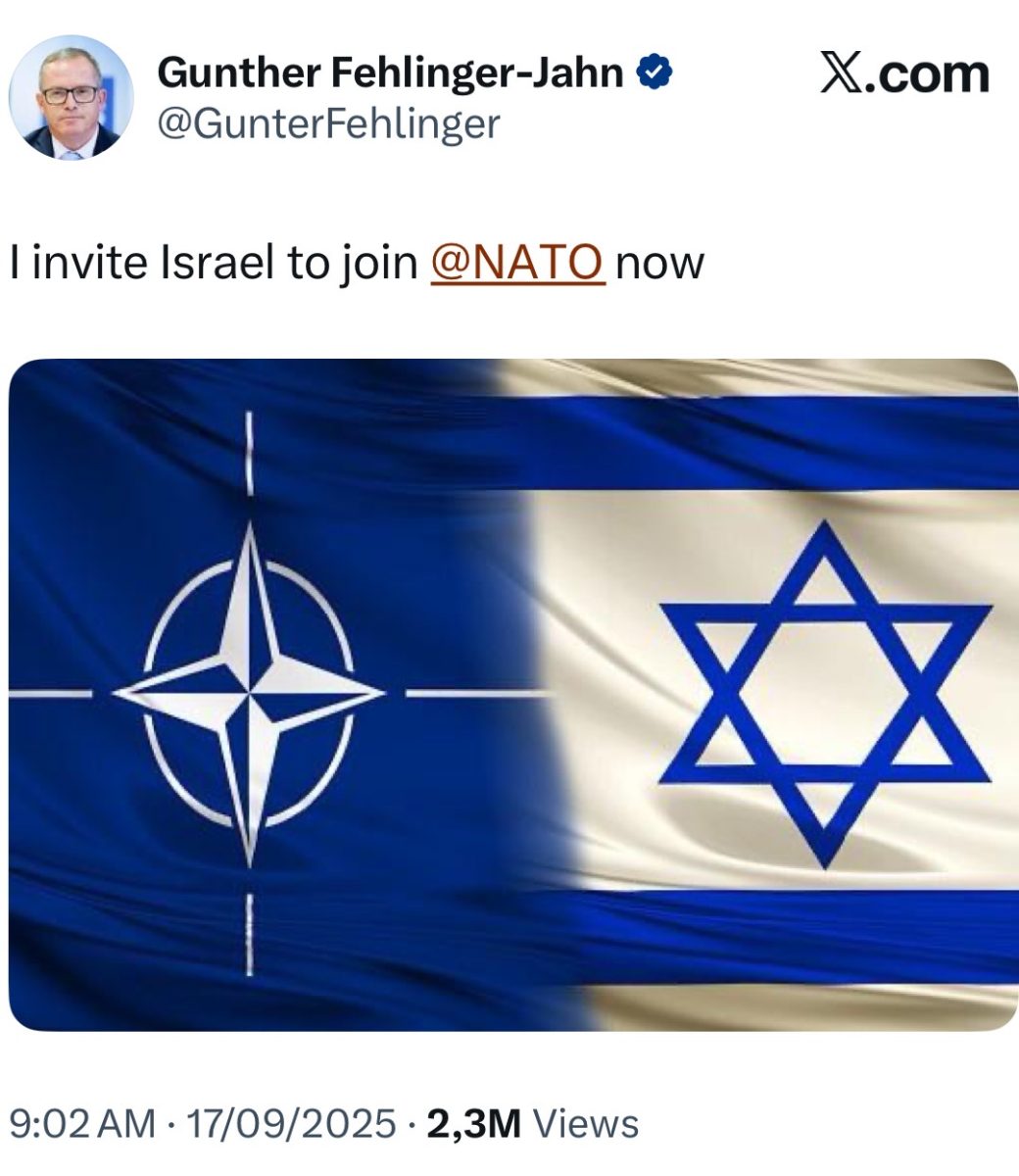
The Legal Framework: Article 10 and the European Requirement
NATO’s expansion capacity is governed by Article 10 of the North Atlantic Treaty (1949), which states that “the Parties may, by unanimous agreement, invite any other European State in a position to further the principles of this Treaty and to contribute to the security of the North Atlantic area to accede to this Treaty”. This provision creates an absolute legal barrier to Israeli membership through its explicit geographic limitation.
The European requirement in Article 10 is not merely advisory but constitutes a fundamental constitutional principle (Minogue 2019). This provision is creating an insurmountable geographic prerequisite that cannot be circumvented through political accommodation or strategic partnership arrangements. The treaty drafters’ intent was clear: NATO was conceived as a Euro-Atlantic alliance with specific geographic boundaries that define its collective defense obligations.
Unlike Turkey’s contested European status, Israel possesses no territorial claims to European geography. Turkey’s membership in 1952 was justified by its control of the Bosphorus and Dardanelles straits, providing a crucial geographic link between Europe and Asia that served NATO’s Cold War containment strategy. As Barany (2003) notes in his comprehensive analysis of NATO expansion, Turkey’s accession represented “a strategic necessity born of geographic reality and Soviet pressure on the Turkish straits”. Israel lacks any comparable geographic connection to the European continent that could justify legal reinterpretation of Article 10.
Turkey’s Membership: Geographic Necessity versus Israeli Geographic Exclusion
Turkey’s NATO membership since 1952 demonstrates the Alliance’s approach to geographic borderline cases while simultaneously highlighting Israel’s exclusion. Turkey’s accession was predicated on its unique geographic position controlling access between the Black Sea and Mediterranean. As documented by the Turkish Ministry of Foreign Affairs, Turkey’s membership was justified by its role as “the southeastern border of the Alliance” during the Cold War, providing crucial geographic continuity for NATO’s defensive perimeter. Even as a “problematic member” due to its increasingly authoritarian trajectory under Erdoğan and its complex relationships with Russia, Turkey’s geographic position remains strategically indispensable. The country’s control over the Bosphorus straits provides NATO with irreplaceable access to the Black Sea region and serves as a critical geographic barrier to Russian naval expansion into the Mediterranean. Israel, conversely, possesses no such geographic attributes that could justify membership under Article 10’s European requirement. While Israeli scholars like Bassist (2022) have argued for enhanced NATO-Israel cooperation, full membership faces “insurmountable geographic and political obstacles”. The geographic argument against Israeli membership is “untenable” precisely because it lacks any territorial connection to Europe or the North Atlantic area.
The Abraham Accords and Middle East NATO Fears
Fehlinger’s proposal reveals deeper strategic anxieties about the Abraham Accords’ trajectory toward regional security integration. The Abraham Accords have fundamentally altered Middle Eastern geopolitics by creating new security partnerships between Israel and Arab states, raising concerns about the emergence of a regional defense alliance. Recent developments support this interpretation. Egypt has actively pursued a NATO-style Arab military alliance, with President el-Sisi advocating for a joint Arab force under Egyptian military leadership. This initiative gained momentum following Israeli operations in Gaza and represents a direct response to perceived Israeli regional dominance facilitated by the Abraham Accords. Iran has simultaneously called for an “Islamic NATO” to counter Israeli and American influence in the region. The timing of these competing alliance proposals is significant. As Tariq Dana (2023) argues, the Abraham Accords were designed to create “a US-led militaristic regional order” that would integrate Israel into a broader Middle Eastern security architecture. The fear that this integration could evolve into a formal Middle East NATO explains why Fehlinger’s proposal for Israeli NATO membership appears as a preemptive move to anchor Israel within existing Western security structures rather than allow it to lead a new regional alliance.
Constitutional Impossibility: The Consensus Requirement
Beyond geographic constraints, Israeli NATO membership faces insurmountable procedural obstacles. NATO operates under a consensus decision-making system where “all decisions made by NATO are resolved by consensus, without voting: discussion and consultation continue until a conclusion acceptable to every member state is reached”. This requirement grants each of NATO’s thirty-two members effective veto power over new admissions. Turkey’s opposition to Israeli membership appears inevitable given current Turkish-Israeli relations. Following the 2010 Mavi Marmara incident and subsequent deterioration in bilateral relations, Turkey’s 2010 National Security Strategy (“Red Book”) explicitly identified Israel as a security threat. While relations have somewhat improved recently, Turkish domestic politics and its complex Middle Eastern positioning make Turkish support for Israeli NATO membership highly unlikely. Additional European members would likely oppose Israeli membership on legal grounds. Countries like Spain, with territorial disputes over Ceuta and Melilla, understand the geographic limitations of NATO’s collective defense commitments. Irish neutrality and Swedish concerns about regional entanglement would create additional opposition vectors.
Article 5 and Geographic Scope Limitations
NATO’s collective defense mechanism under Article 5 creates additional legal complications for Israeli membership. Article 6 of the North Atlantic Treaty explicitly defines the geographic scope of collective defense obligations as covering attacks “on the territory of any of the Parties in Europe or North America, on the territory of Turkey or on the Islands under the jurisdiction of any of the Parties in the North Atlantic area north of the Tropic of Cancer”. Israeli territory falls entirely outside this geographic definition. In fact, Article 6’s geographic limitations mean that “an armed attack by China against U.S. forces in Asia, for instance, would not trigger Article 5”. Israeli territory would face the same exclusion, creating an unprecedented situation where a NATO member would lack collective defense coverage for its homeland territory. This creates what Verhelst (2024) terms a “constitutional contradiction” within NATO’s legal framework. An Israeli NATO member would simultaneously hold membership obligations while being excluded from the Alliance’s core collective defense mechanism – a legal impossibility that cannot be resolved without fundamental treaty amendment.
The Middle East NATO Alternative
The impossibility of Israeli NATO membership highlights the underlying strategic logic driving regional alliance proposals. The Washington Institute’s analysis suggests that “a Middle Eastern NATO appears necessary, but not yet possible”, reflecting the region’s security needs while acknowledging current political obstacles. Recent developments indicate growing momentum behind regional security integration. The Abraham Accords created initial frameworks for Israeli-Arab security cooperation, while Iranian nuclear ambitions and regional proxy conflicts provide compelling security rationales for enhanced cooperation. However, Palestinian statehood questions and remaining Arab-Israeli tensions prevent immediate formalization of a regional NATO structure.
Fehlinger’s proposal should be understood as reflecting deeper anxieties about alliance competition in the post-Abraham Accords Middle East. By advocating for Israeli NATO membership, European voices like Fehlinger may be attempting to prevent Israel from becoming the nucleus of an independent Middle Eastern security alliance that could compete with European influence in the region. There are also broader European concerns about American pivot strategies and regional alliance systems that bypass traditional Atlantic partnerships. A Middle East NATO centered on Israel and Abraham Accords partners could potentially compete with European commercial and strategic interests in the region, making preemptive integration of Israel into existing Euro-Atlantic structures strategically attractive from a European perspective.
Conclusion
Israeli NATO membership remains constitutionally impossible under current international law. Article 10’s European requirement creates an insurmountable legal barrier that cannot be overcome through political accommodation or strategic necessity arguments. Turkey’s membership provides no precedent for Israeli inclusion, as Turkish geographic positioning offered strategic access to European territories and vital chokepoints that Israel cannot replicate. The impossibility of Israeli NATO membership reflects broader tensions about regional alliance formation in the post-Abraham Accords Middle East. While Fehlinger’s proposal may reflect legitimate security concerns, it fundamentally misunderstands NATO’s legal constraints and geographic limitations. Instead of pursuing impossible NATO membership, Israeli strategic planners should focus on developing indigenous regional security partnerships that build upon Abraham Accords frameworks while respecting existing international legal structures.
The subliminal message in Fehlinger’s proposal – fear of an emerging Middle East NATO – reveals the strategic stakes involved in regional alliance formation. However, attempts to prevent such developments by advocating impossible NATO expansions serve neither Israeli security interests nor Euro-Atlantic alliance cohesion. A more productive approach would acknowledge legal realities while working to ensure that emerging Middle Eastern security arrangements complement rather than compete with existing international security architectures.
Indeed, a properly structured Middle East NATO that operates in coordination with the Atlantic Alliance could serve the broader interests of global security and world peace. Such a regional defense organization, built upon the Abraham Accords foundation and operating in partnership with NATO, would create unprecedented opportunities for combating international terrorism, containing belligerent state actors like Iran, and establishing comprehensive deterrence against non-state militant organizations that threaten regional and global stability.
Rather than viewing Middle Eastern security integration as competitive with Euro-Atlantic institutions, the international community should embrace cooperative frameworks that leverage regional expertise and geographic proximity while maintaining coordination with established alliance structures. This approach would multiply force capabilities, enhance intelligence sharing, and create overlapping security networks that benefit the entire world population through more effective counterterrorism operations and collective deterrence against aggressive regimes seeking to destabilize international order.
References
Barany, Z. (2003). The future of NATO expansion: Four case studies. Cambridge University Press.
Bassist, R. (2022). Israel-NATO relations: Developing a new strategic concept. Mitvim Institute.
Begin-Sadat Center for Strategic Studies. (2023). Israel and NATO: A good idea whose time will never come. BESA Center.
Carnegie Endowment for International Peace. (2025). The Abraham Accords after Gaza: A change of context. Carnegie Endowment.
Dana, T. (2023). The geopolitics of the Abraham Accords: A critical view on normalization. Prisme Initiative.
ELNET Germany. (2023). NATO and Israel: From cooperation to partnership. European Leadership Network.
Institute for National Security Studies. (2022). Israel and NATO: Opportunities and risks. INSS.
International Bar Association. (2023). NATO membership applications highlight tension between rule of law and geopolitics. IBA.
Larcier-Intersentia. (2024). NATO and international institutional law: A critical analysis. Larcier.
Minogue, N. (2019). “The North Atlantic Treaty at 70–Article 10”. Emory International Law Review, 34, 847-868.
NATO Association of Canada. (2015). Special report: Could, should, and would Israel become a NATO member? NAOC.
North Atlantic Treaty Organization. (1949). The North Atlantic Treaty. NATO.
Swiss Federal Institute of Technology. (2015). NATO and Middle East and North Africa (MENA) security. ETH Zurich.
Transatlantic Institute. (2019). NATO and Israel are right to deepen ties. Transatlantic Institute.
Turkish Ministry of Foreign Affairs. (2004). Turkey’s and NATO’s views on current issues. Ministry of Foreign Affairs of Turkey.
Verhelst, S. (2024). NATO consensus and the autonomy of member states: A critical analysis of decision-making processes. KU Leuven.
References