















Syria’s collapse of the Assad regime has triggered the Middle East’s most intricate chess match in.
Regional heavyweights, global powers, and sub-state communities are now re-negotiating identity, sovereignty, and security in real time. Constructivism—focusing on how shared ideas, norms, and identities shape state interests—offers critical analytical leverage for understanding this fluid moment. However, the emergence of Syria as a hybrid state governed by terrorist-affiliated militias and an ex-al-Qaeda leader presents an unprecedented and dangerous precedent that fundamentally challenges established norms of international law and state recognition.
1. From “Forever Has Fallen” to Institutional Flux
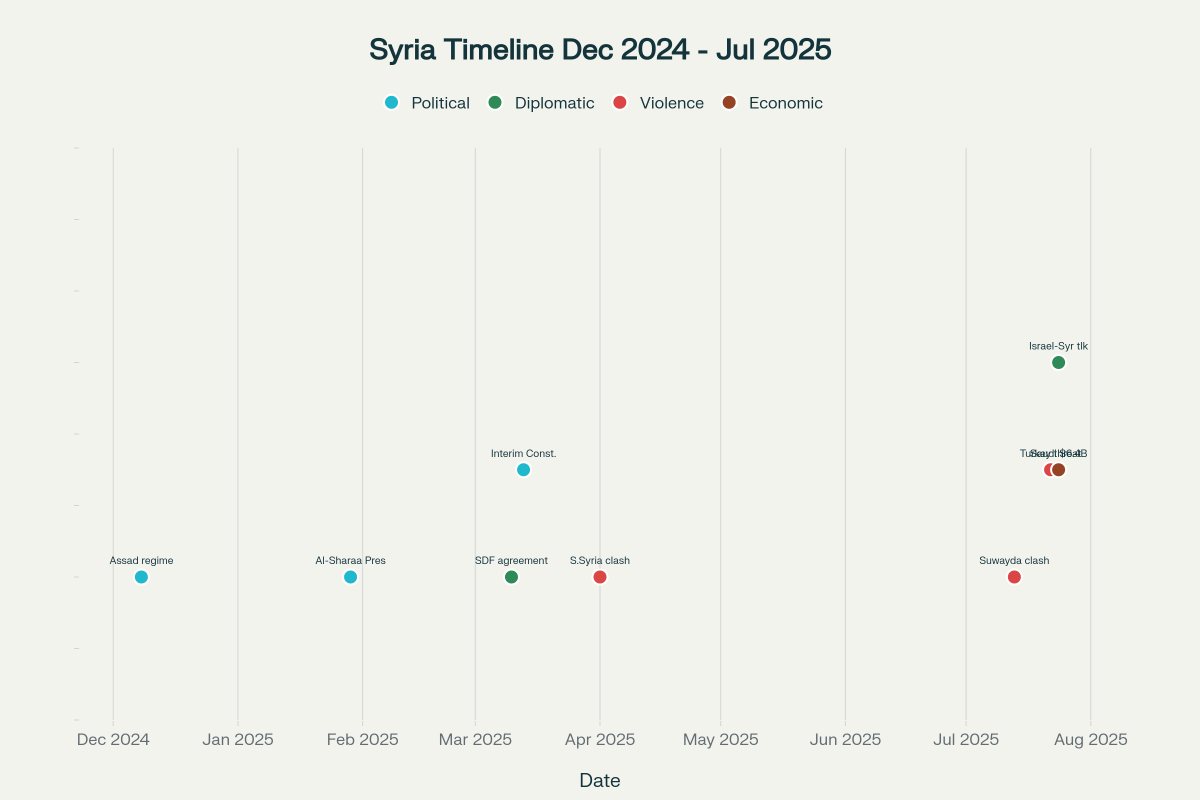
Post-Assad governance rests on fragile bargains that must reconcile Islamist victory narratives with minority trauma and Western legal conditionality. President Ahmad al-Sharaa’s March 2025 Constitutional Declaration enshrines Islam as “main derivation of jurisprudence” yet promises plural citizenship and a five-year transition. This duality reflects Sharaa’s bid to convert HTS’s jihadist identity into a nationalist, state-building myth—an ongoing, socially constructed shift contested by Alawite, Druze, and Kurdish actors.
The transformation of Syria into what scholars describe as a “hybrid state model”represents a fundamental departure from traditional Westphalian sovereignty. Neither decentralized nor centralized, these hybriroots initiatives dominated by former terrorist organizations. The dangerous precedent lies in the international community’s tacit acceptance of a state apparatus controlled by individuals and organizations with extensive terrorist credentials.
Ahmed al-Sharaa, formerly known as Abu Mohammad al-Julani, spent years as a senior operative in al-Qaeda in Iraq, was imprisoned by U.S. forces, and founded the al-Nusra Front as al-Qaeda’s official branch in Syria. Despite formally breaking with al-Qaeda in 2016, HTS remained designated as a terrorist organization by the UN, EU, UK, and United States until July 2025. The normalization of his leadership represents an alarming precedent where former international terrorists can achieve state power and international recognition through military conquest.
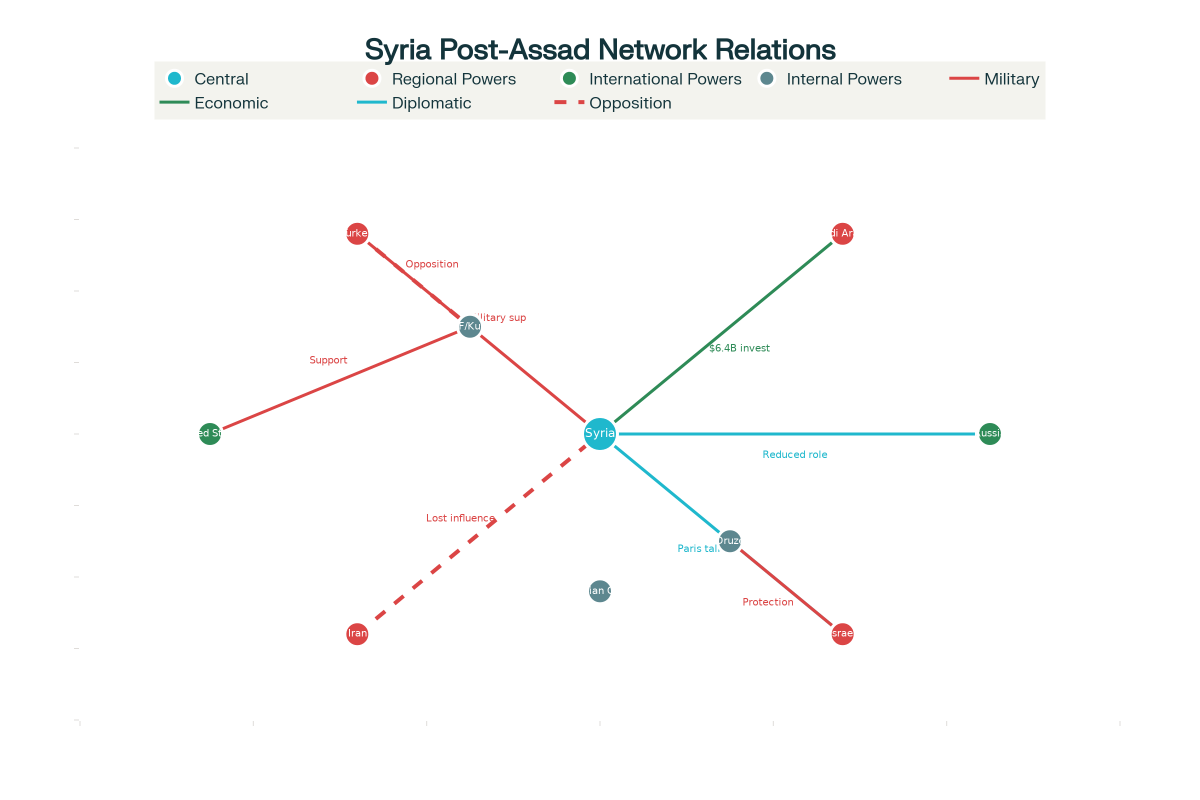
Meanwhile, Saudi Arabia’s $6.4 billion investment blitz in July signals a Gulf effort to imprint an Arab-centric reconstruction narrative that sidelines Iran and normalizes Sharaa economically. Constructivist logic predicts that if Gulf capital embeds new symbols of “Arab partnership,” it may recalibrate Syrian identity away from Iran’s Axis-of-Resistance frame.
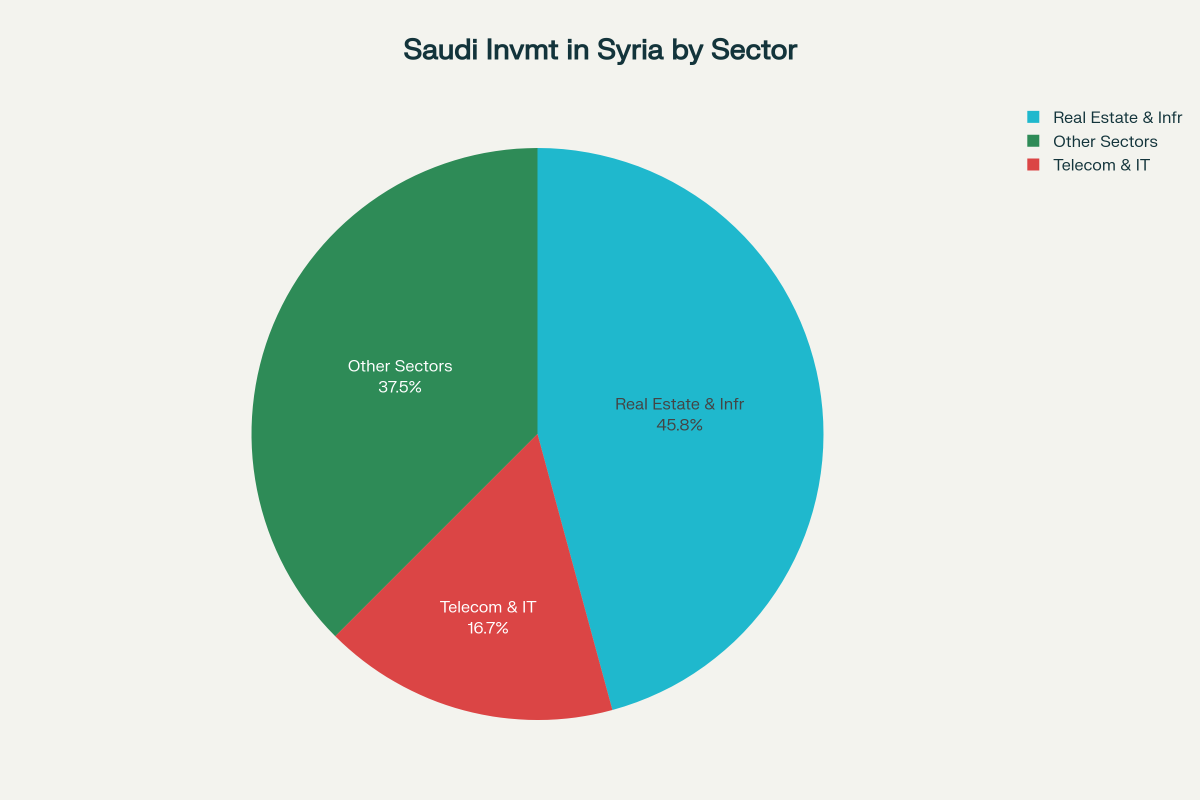
Distribution of Saudi Arabia’s $6.4B investments in Syria by sector
2. The Hybrid State Precedent: When Terrorist Organizations Govern
Syria’s current governance model establishes a dangerous precedent in international law and practice: the legitimization of state capture by terrorist-affiliated organizations. The Syrian transitional government, formed in March 2025, features HTS officials in the most powerful cabinet posts, particularly defense and interior ministries, while presenting a veneer of pluralism in socio-economic positions. This represents what experts describe as “state capture by Tehran-backed terrorist groups” but with a Sunni jihadist instead of Shia orientation.
The institutional structure mirrors concerning patterns observed in Iraq, where Iran-backed militias achieved state capture through coordinated political moves rather than outright military coups. In Syria’s case, HTS’s evolution from a designated terrorist organization to the backbone of state institutions demonstrates how extremist groups can successfully rebrand themselves while maintaining core jihadist personnel and ideological commitments.
This hybrid governance model poses several critical threats to international legal norms:
State Legitimacy and Recognition: The international community’s gradual acceptance of HTS-dominated governance, culminating in the U.S. removal of HTS from its Foreign Terrorist Organization list in July 2025, sets a precedent that terrorist organizations can achieve legitimacy through territorial control and superficial moderation rhetoric.
Minority Protection Failures: Despite constitutional promises of pluralism, the Syrian government has repeatedly failed to protect minority populations. Mass killings of Alawite civilians occurred in February and April 2025, while Druze communities in Suwayda faced systematic sectarian violence in July 2025. These failures demonstrate that terrorist-affiliated governance structures lack both the capacity and genuine commitment to protect vulnerable populations.
Institutional Capture: The integration of HTS fighters into Syrian state forces creates a military apparatus dominated by individuals with jihadist training and ideological commitments. This “unification” process remains fragile, undermined by entrenched mistrust, ideological rifts, and the continued influence of extremist networks.
3. Sectarian Violence and Minority Protection Discourses
The Suwayda bloodshed (July 2025) exposed competing scripts of protection vs. domination, further illustrating the dangerous precedent of terrorist-affiliated governance. Israel bombed Syrian armor “to shield Druze brethren,” casting itself as guardian of a trans-border minority. Turkey framed the same unrest as Kurdish-Israeli intrigue threatening Syria’s unity, justifying possible intervention. These rival narratives matter because, under international law, minority rights hinge on non-discrimination and territorial integrity principles. If external actors cloak hard-power moves in minority-protection rhetoric, they risk inflaming the very identities they claim to defend.
The systematic failure of HTS-dominated security forces to prevent sectarian violence reveals the inherent contradictions in allowing former jihadist organizations to govern diverse populations. The Syrian government’s dispatch of “security forces” to restore order in Suwayda proved counterproductive, as these forces are comprised of militias staffed by jihadists whose loyalty lies with sectarian causes rather than state institutions. This pattern of governance failure mirrors the institutional dysfunction characteristic of states captured by terrorist organizations.
Internationally, the UN and EU have reminded all states to respect Syria’s sovereignty and the 1974 disengagement line. Constructivists note that such statements do more than signal legal positions; they reproduce a norm that Syria’s borders are “social fact” despite military faits accomplis. However, the international community’s continued recognition of Syrian sovereignty while acknowledging the terrorist origins of its governing apparatus creates a dangerous precedent that undermines fundamental principles of international law.
4. Kurdish Calculus: Between Transactional Co-optation and Self-Determination
Ankara’s July threats of direct action if Syria “fragments” coincide with Erdoğan’s unprecedented courtship of Turkey’s pro-Kurdish DEM party to pass a fourth-term constitutional amendment. This apparent paradox—domestic embrace, external coercion—illustrates how identity narratives are situationally reconstructed. Erdoğan frames DEM collaboration as a “state peace” project, while still branding the SDF across the border a PKK offshoot requiring disarmament.
For Syrian Kurds, the March SDF-Damascus integration accord promised representation but not the federal autonomy long demanded. The Kurdish reluctance to integrate with HTS-dominated forces reflects legitimate concerns about submitting to governance by former al-Qaeda affiliates. The SDF’s refusal to surrender weapons and abandon Kurdish self-rule stems from recognition that integration would leave Kurdish populations vulnerable to the same jihadist violence terrorizing other minorities.
Constructivist theory would predict continued norm contestation: if Damascus refuses to codify cultural-linguistic rights, Kurdish elites may resurrect self-determination claims rooted in evolving global discourse on internal autonomy. The precedent of terrorist-affiliated governance makes such resistance not only understandable but necessary for minority survival.
5. Great-Power Retrenchment and Dangerous Precedent Setting
Russia’s strategic eclipse after Assad has diminished its capacity to veto Western normative pressure. The United States leveraged sanctions relief to steer Sharaa toward inclusive institutions while brokering Israel-Syria security talks in Paris—the first cabinet-level contact since 1974. Such diplomacy re-activates the norm of direct conflict-resolution, challenging long-held taboos on Arab-Israeli engagement.
However, the U.S. decision to lift sanctions and remove HTS from terrorism lists represents a dangerous precedent that terrorist organizations can achieve international legitimacy through strategic patience and superficial moderation. This approach fundamentally undermines decades of counterterrorism policy based on the principle that negotiations with terrorist organizations legitimize their methods and encourage similar strategies by other extremist groups.
Concurrently, Washington’s balancing act—urging SDF integration yet warning Turkey against overreach—shows how norms of anti-terrorism and minority protection collide. Constructivists observe that when U.S. envoys prioritize “stability” over Kurdish aspirations, they reinforce a hierarchy of identities that could delegitimize liberal norms in Kurdish eyes. More fundamentally, the prioritization of stability over counterterrorism principles establishes a precedent that terrorist-dominated governance is acceptable if it serves short-term strategic interests.r methods.
6. International Law Checkpoints and Precedent Implications
The Syrian case establishes several dangerous precedents that could undermine international legal frameworks:
- State Recognition Standards: Traditional international law holds that recognition depends on effective control, population acceptance, and absence of rival authority. However, Syria’s case introduces the unprecedented scenario where effective control is exercised by formerly designated terrorist organizations. The international acceptance of HTS governance suggests that terrorist origins do not disqualify entities from state recognition, potentially encouraging other extremist groups to pursue similar strategies.
- Terrorism Designation Reversibility: The U.S. decision to remove HTS from terrorist lists based on promises to “combat terrorism in all its forms” creates a precedent for terrorist organizations to achieve legitimacy through strategic rebranding. This precedent could incentivize other terrorist groups to adopt superficial moderation strategies while maintaining core extremist capabilities.
- Hybrid Governance Legitimacy: Syria’s acceptance as a “hybrid state” where former terrorist militias share power with civilian institutions normalizes arrangements that traditionally would be considered state capture. This precedent could legitimize similar arrangements in other conflict zones where terrorist organizations achieve territorial control.
- Territorial integrity: Any Turkish or Israeli military footprint beyond the disengagement line risks breaching Art. 2(4) UN Charter unless justified by host-state consent—Sharaa’s invitation to Turkey complicates but does not erase this threshold.
- Minority rights: The Framework Convention and ICCPR Art. 27 demand non-discrimination; external “protective” strikes lacking Security Council mandate may violate proportionality and necessity requirements.
- Constitution-making: The March 2025 interim charter’s promise of transitional justice aligns with global norms, but its Islamic-law supremacy clause will be tested against obligations to protect non-Muslim communities.
7. Scenario Matrix (2025–2027)
| Driver | Cooperative Identity Shift | Competitive Identity Hardening |
| Gulf investments | Arab capital anchors multi-confessional reconstruction | Funds captured by Sunni-exclusive networks, fueling sectarian economy |
| Turkey-DEM deal | Constitutional reform frees Kurdish prisoners; Ankara drops strikes | Pact collapses; Erdoğan uses DEM split to justify Syrian incursion |
| SDF integration | Joint command embeds Kurdish officers, fostering Syrian civic identity | Damascus recentralizes; Kurds revive autonomy bids |
| Israel-Syria talks | Buffer-zone agreement reduces Golan tensions, enabling UNDOF reinforcement | Talks fail; Israel entrenches security belt, provoking proxy re-infiltration |
| HTS governance | Successful civilian transition marginalizes extremist elements | Jihadist networks maintain parallel authority, perpetuating violence |
8. Policy Recommendations
- Counterterrorism Precedent Reversal: the international community must establish clear criteria that former terrorist organizations cannot achieve state recognition without comprehensive deradicalization, accountability for past crimes, and credible guarantees of minority protection. The Syrian precedent must not be allowed to encourage other terrorist groups to pursue state capture strategies.
- Enhanced Monitoring: EU, U.S., and Arab donors should condition reconstruction funds on measurable minority-safety benchmarks and genuine deradicalization of state institutions, operationalizing ICCPR Art. 27 into project criteria with robust enforcement mechanisms.
- Legal Framework Development: International legal bodies should develop specific frameworks addressing state recognition when terrorist-affiliated groups achieve territorial control, preventing the normalization of extremist governance while maintaining principles of effective authority.
- Regional Containment Strategy: Launch an OSCE-style “Syrian Minority Rights Mission” to monitor hate-speech indicators and institutional extremism, while developing contingency plans to prevent the Syrian precedent from spreading to other regional conflicts.
- Transitional Justice Requirements: Any international engagement with Syrian authorities must be conditional on establishing credible transitional justice mechanisms that address both Assad-era crimes and HTS’s documented human rights violations during its governance of Idlib.
Conclusion
Post-Assad Syria represents a fundamental challenge to the international legal order through the normalization of terrorist-affiliated governance. The dangerous precedent established by recognizing HTS’s transformation into a governing authority threatens to undermine decades of counterterrorism and legal frameworks.
Whether the next five years yield pluralistic governance or further extremism will depend on whether the international community upholds principled opposition to terrorist-dominated state structures. Constructivist analysis underscores that legitimacy accrues not only from power on the ground, but through social constructions of identity, law, and discourse—and in Syria, those constructions will determine the country’s fate.