















The ancient Roman adage “Si vis pacem, para bellum” – “If you want peace, prepare for war” – has found profound vindication in the contemporary Middle East. Israel’s decisive military triumph over Iran’s theocratic regime in June 2025 has fundamentally restructured regional power dynamics, setting Tehran’s nuclear ambitions back by at least a decade while simultaneously creating unprecedented opportunities for diplomatic normalization. This strategic application of overwhelming force has paradoxically opened pathways to sustainable peace, validating the classical wisdom that preparation for conflict often prevents it.
The Current Crisis and Iran’s Desperate Appeals
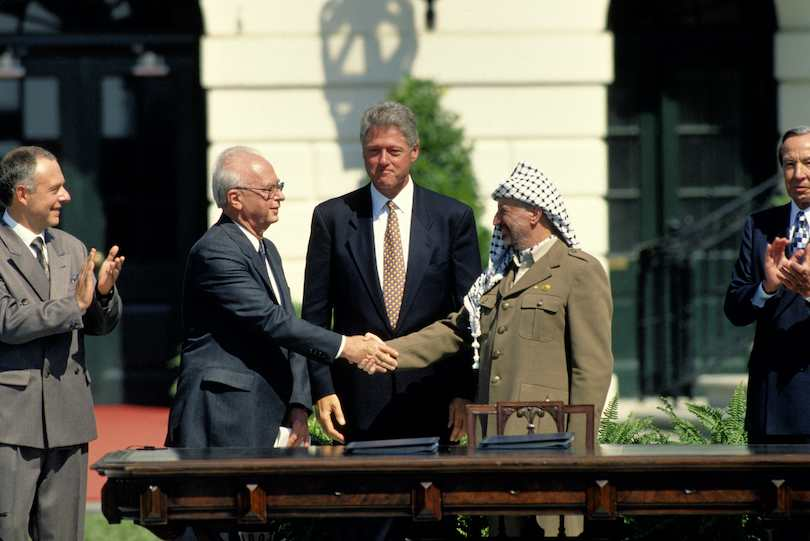
Historic handshake between Israeli Prime Minister Yitzhak Rabin and PLO Chairman Yasser Arafat, overseen by U.S. President Bill Clinton, at the signing of the Oslo Accords.
The Strategic Transformation: Operation Rising Lion’s Geopolitical Impact
Israel’s Operation Rising Lion, executed between June 13-24, 2025, represented a paradigmatic shift from defensive containment to strategic degradation of Iran’s nuclear capabilities. The campaign systematically destroyed Iran’s uranium enrichment facilities at Natanz and Isfahan, effectively neutralizing Tehran’s nuclear program for the foreseeable future. Intelligence assessments confirm that Iran’s enrichment capabilities have been “effectively destroyed,” though existing stockpiles of enriched uranium remain under international monitoring .
The operation’s success extended beyond nuclear targets, eliminating approximately 30 senior Iranian military commanders and severely degrading the Islamic Revolutionary Guard Corps’ command structure. Iran’s retaliatory missile strikes demonstrated the obsolescence of its ballistic arsenal, with Israeli defense systems achieving unprecedented intercept rates while exposing Tehran’s inability to accurately target critical infrastructure.
The Collapse of Iran’s Axis of Resistance
The strategic defeat has precipitated the systematic dismantling of Iran’s regional proxy network, fundamentally altering Middle Eastern geopolitics . Tehran’s carefully constructed “Axis of Resistance” – comprising Hezbollah in Lebanon, Hamas in Gaza, the Assad regime in Syria, the Houthis in Yemen, and various Iraqi militias – has been either eliminated or severely weakened.
Hezbollah, once Iran’s most formidable proxy, has seen its leadership decimated and military capabilities significantly degraded, creating unprecedented opportunities for Lebanese sovereignty restoration. Hamas, devastated by the prolonged Gaza conflict, no longer functions as an effective Iranian asset, while Syria’s Assad regime has been replaced entirely by Ahmed al-Sharaa’s administration. This new Syrian leadership has explicitly distanced itself from Iranian influence and expressed openness to normalization with Israel, marking a historic reversal in Syrian foreign policy.
Economic Imperatives Driving Regional Transformation
The collapse of Iranian hegemonic influence has unleashed powerful economic incentives for regional cooperation and normalization. The United Arab Emirates exemplifies this transformation, having evolved from oil dependence to a diversified knowledge economy where petroleum contributes less than 1% to Dubai’s GDP. Dubai’s emergence as a global financial and technological hub demonstrates the potential of the “Emirati model” for regional development.

Dubai’s modern skyline and complex highway system illustrate its status as a leading economic hub.
The UAE’s success in attracting over 100,000 new residents annually and registering 412,000 active business licenses reflects the economic magnetism of peace and stability. The Dubai Economic Agenda ‘D33’ aims to double GDP by 2033, positioning the emirate among the world’s top three destinations for investment, residence, and employment. This economic transformation provides a compelling template for other regional actors seeking prosperity through international integration rather than confrontation.
The Abraham Accords: Foundation for Expanded Normalization
The 2020 Abraham Accords established the diplomatic architecture for broader regional transformation, normalizing relations between Israel and the UAE, Bahrain, Morocco, and Sudan. The economic impact has been transformative, with trade between Israel and Abraham Accords members growing from virtually zero to $2.8 billion annually by 2022.
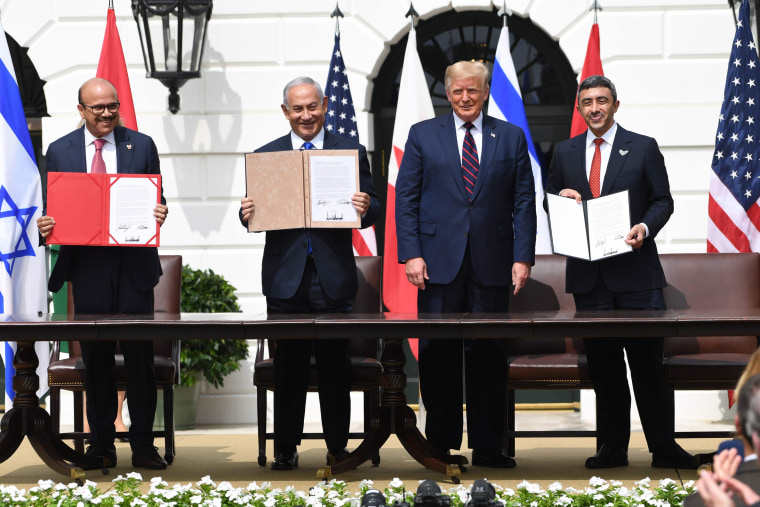
President Donald Trump, Israeli Prime Minister Benjamin Netanyahu, and officials from the United Arab Emirates and Bahrain at the signing of the Abraham Accords at the White House.
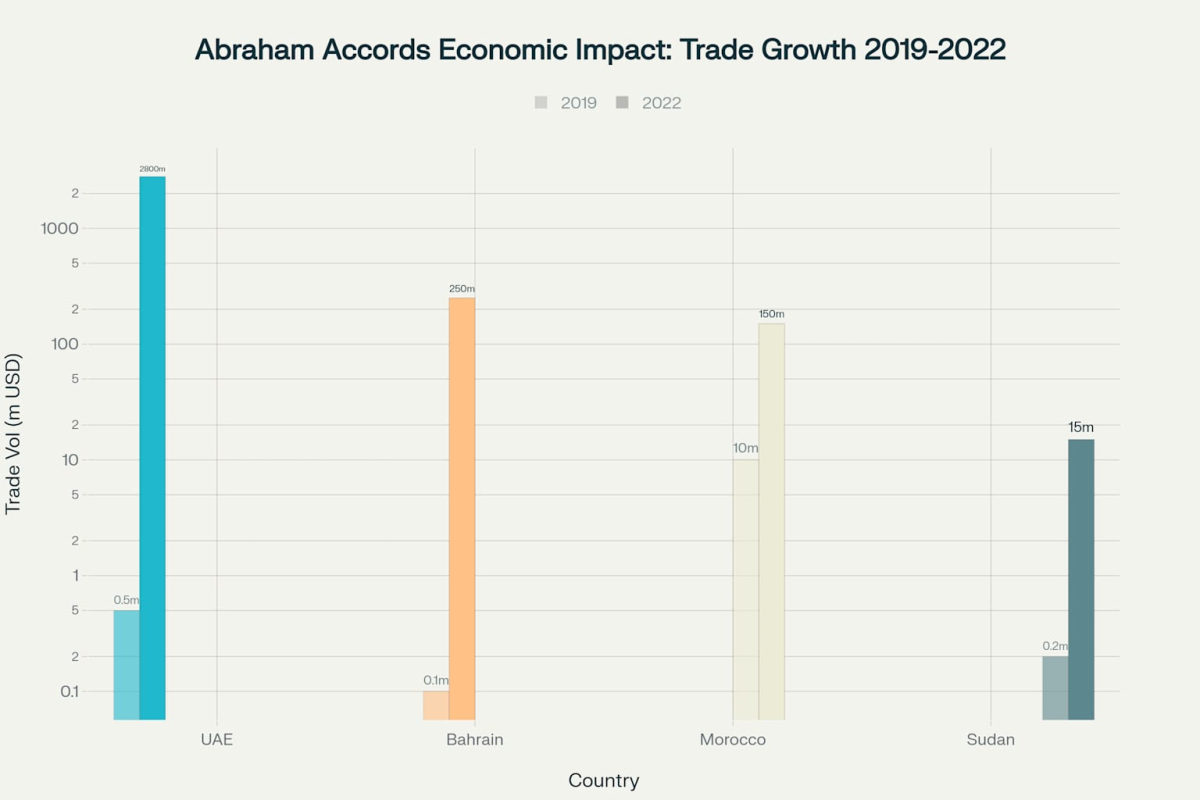
Abraham Accords members experienced dramatic trade growth with Israel between 2019-2022, with UAE leading at $2.8 billion in annual trade.
The UAE leads this economic integration with $2.8 billion in bilateral trade, while Bahrain achieved $250 million despite its smaller economy. Morocco and Sudan have experienced more modest but significant growth, demonstrating the universal potential for economic cooperation following normalization. Studies suggest that a multilateral free trade area among current signatories could create over 150,000 jobs and $75 billion in new economic activity, with expanded membership potentially generating $1 trillion in economic benefits.
Syria’s Unprecedented Diplomatic Pivot
Syria’s transformation under Ahmed al-Sharaa represents perhaps the most dramatic geopolitical shift in the region. The new Syrian leadership has made unprecedented overtures toward Israel, with al-Sharaa declaring that “the era of endless mutual bombings must come to an end” and expressing willingness to engage in normalization discussions.
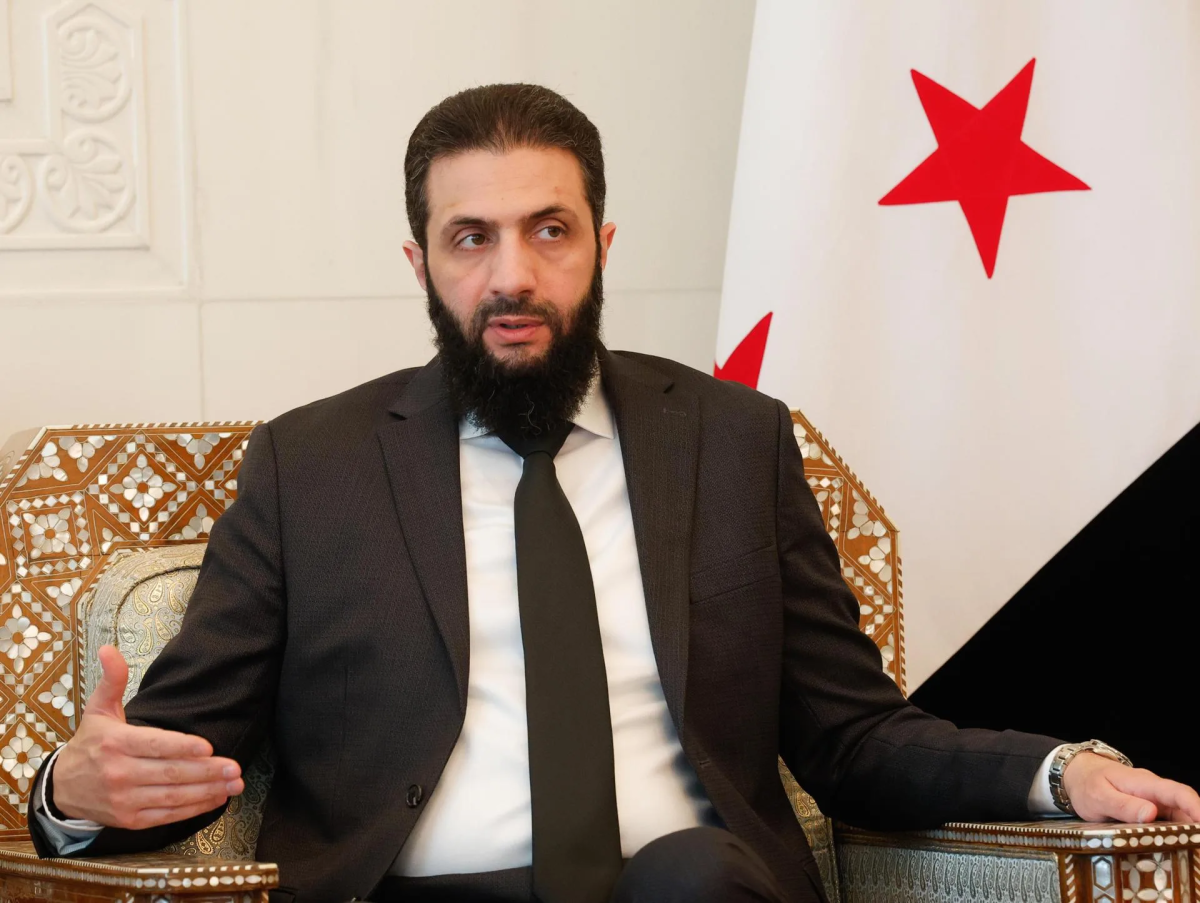
Ahmed al-Sharaa, identified as the new Syrian leader, in a formal setting.
This historic reversal reflects both pragmatic recognition of changed regional dynamics and urgent economic necessity. Syria, devastated by thirteen years of civil war and five decades of socialist mismanagement, requires massive reconstruction investment and international economic integration. Al-Sharaa’s government has engaged in indirect talks with Israel through international mediators, signaling a fundamental departure from decades of Syrian hostility.
The Syrian president’s pragmatic approach explicitly references the UAE model, recognizing that economic revival requires regional stability and international legitimacy. His administration’s commitment to the 1974 disengagement agreement and calls for Israeli withdrawal from occupied Syrian territories demonstrate a nuanced approach to normalization that balances domestic considerations with strategic realities.
Saudi Arabia’s Complex Normalization Calculus
The Kingdom of Saudi Arabia represents the most strategically significant potential addition to the Abraham Accords, given its unique role as guardian of Islam’s holiest sites and its substantial economic influence. Crown Prince Mohammed bin Salman’s Vision 2030 economic transformation program requires massive foreign investment and technological partnerships that could be enhanced through normalization with Israel.
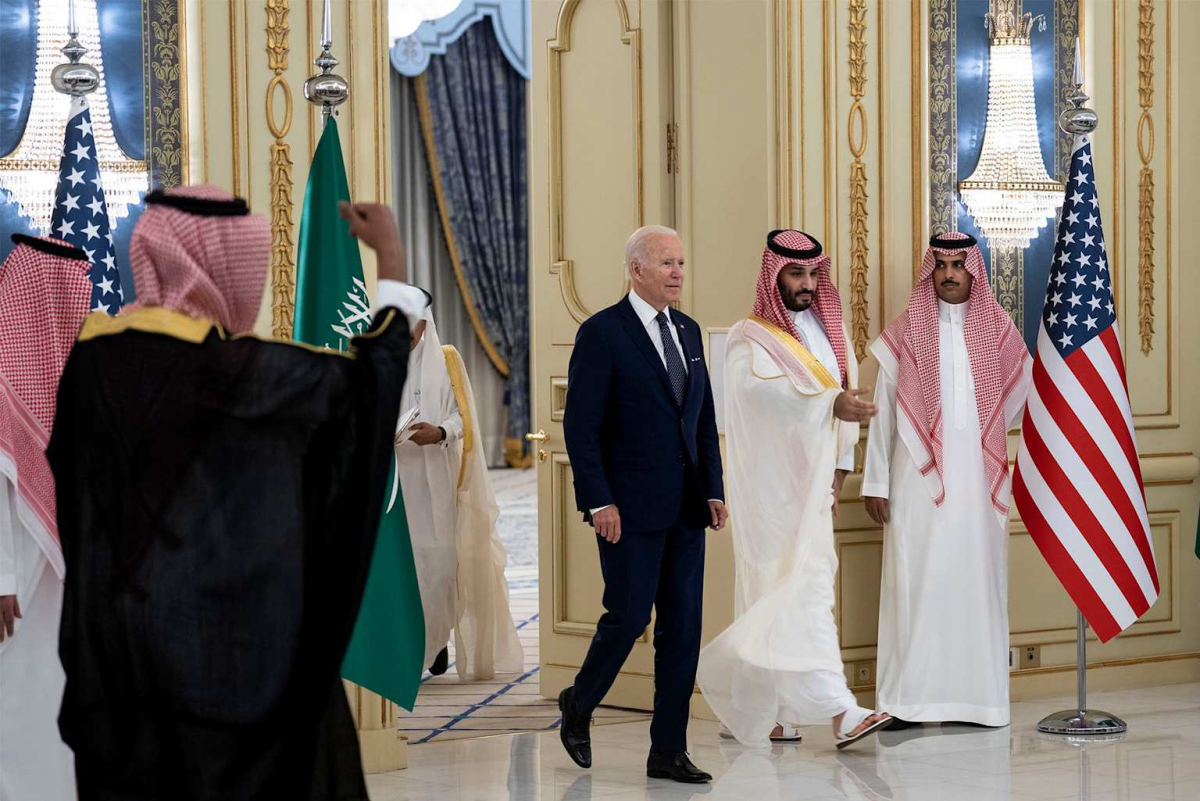
US President Joe Biden walks with Saudi Crown Prince Mohammed bin Salman during a diplomatic meeting.
Intelligence assessments suggest that Saudi Arabia’s fundamental interest in establishing relations with Israel remains unchanged, despite public rhetoric maintaining traditional positions on Palestinian statehood. The collapse of Iranian influence removes a major obstacle to Saudi-Israeli normalization, providing the kingdom with greater freedom to pursue its strategic and economic interests without fear of proxy retaliation. However, domestic political sensitivities and the kingdom’s religious responsibilities create constraints that require careful diplomatic navigation.
Lebanon’s Sovereignty Restoration Opportunity
Lebanon presents a complex case for potential normalization, having suffered decades of Iranian domination through Hezbollah’s effective control of large territorial areas. Israel’s degradation of Hezbollah’s capabilities creates an unprecedented opportunity for Lebanese sovereignty restoration under President Joseph Aoun’s government.
The challenge involves the delicate task of disarming non-state actors while rebuilding legitimate state institutions. Success in this endeavor could unlock Lebanon’s considerable economic potential and pave the way for eventual normalization with Israel. However, the process requires careful navigation of sectarian dynamics and gradual restoration of state monopoly on legitimate force.
Iraq’s Pragmatic Foreign Policy Evolution
Iraq’s position reflects the broader regional trend toward pragmatic foreign policy focused on national interests rather than ideological alignments. Prime Minister Mohammed Shia al-Sudani’s “Iraq First” policy emphasizes sovereignty and economic development over proxy conflicts.
The reduction of Iranian influence through weakened proxy militias provides Iraq with greater freedom to pursue balanced regional relationships. While normalization with Israel remains politically challenging given domestic opinion, Iraq’s increasing focus on economic cooperation and reduced dependence on Iran creates conditions for eventual diplomatic progress. The country’s strategic location and oil resources make it a valuable potential partner for regional economic integration.
Regional Diplomatic Momentum
The transformation of Middle Eastern geopolitics has created unprecedented diplomatic momentum for peace initiatives. Arab states that previously rejected any engagement with Israel are now reconsidering their positions based on economic imperatives and changed security dynamics.
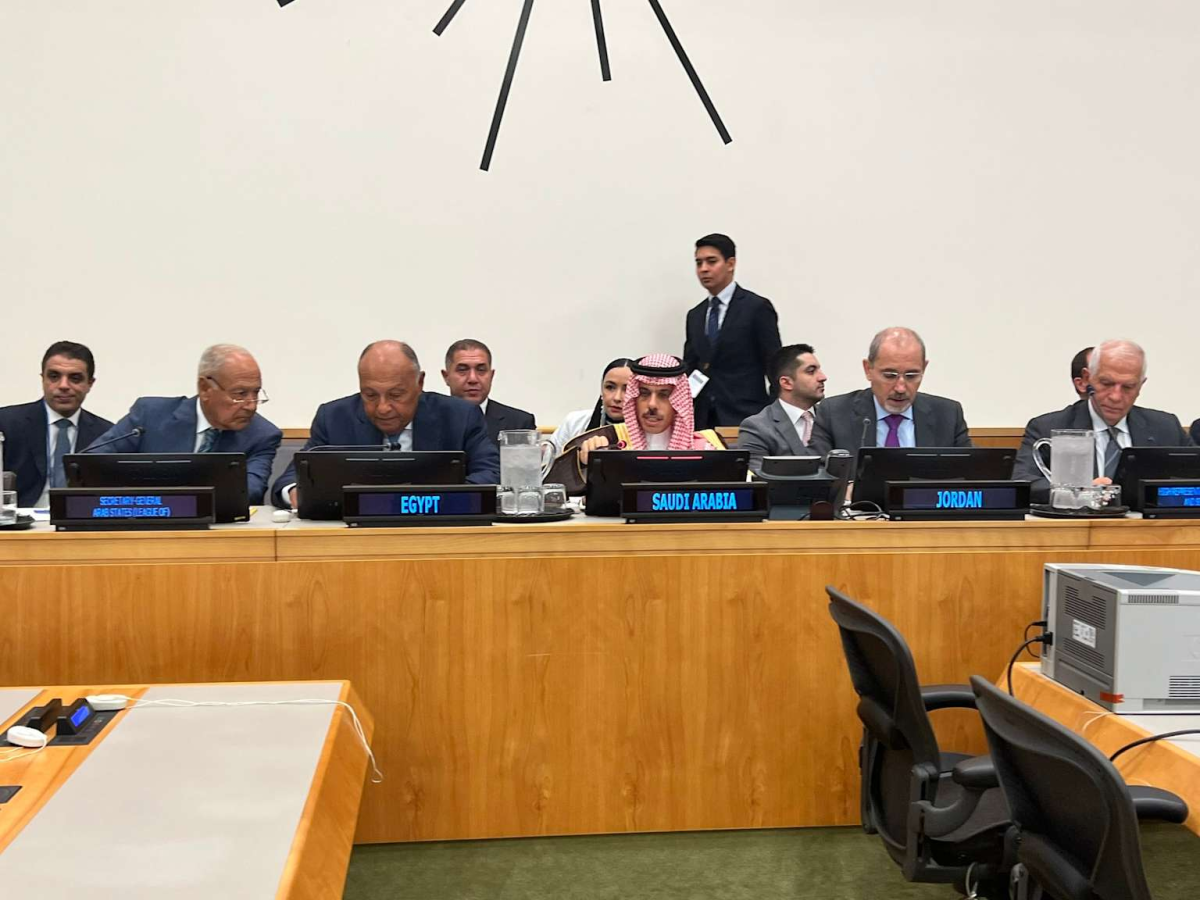
Diplomatic meeting of Arab states, including Egypt, Saudi Arabia, and Jordan, discussing regional peace.
Trump’s special envoy Steve Witkoff has indicated that “countries not previously contemplated” may soon join the Abraham Accords, suggesting expanded normalization beyond obvious candidates. The successful mediation of the Israel-Iran ceasefire demonstrates the effectiveness of American diplomatic engagement backed by credible military capability.
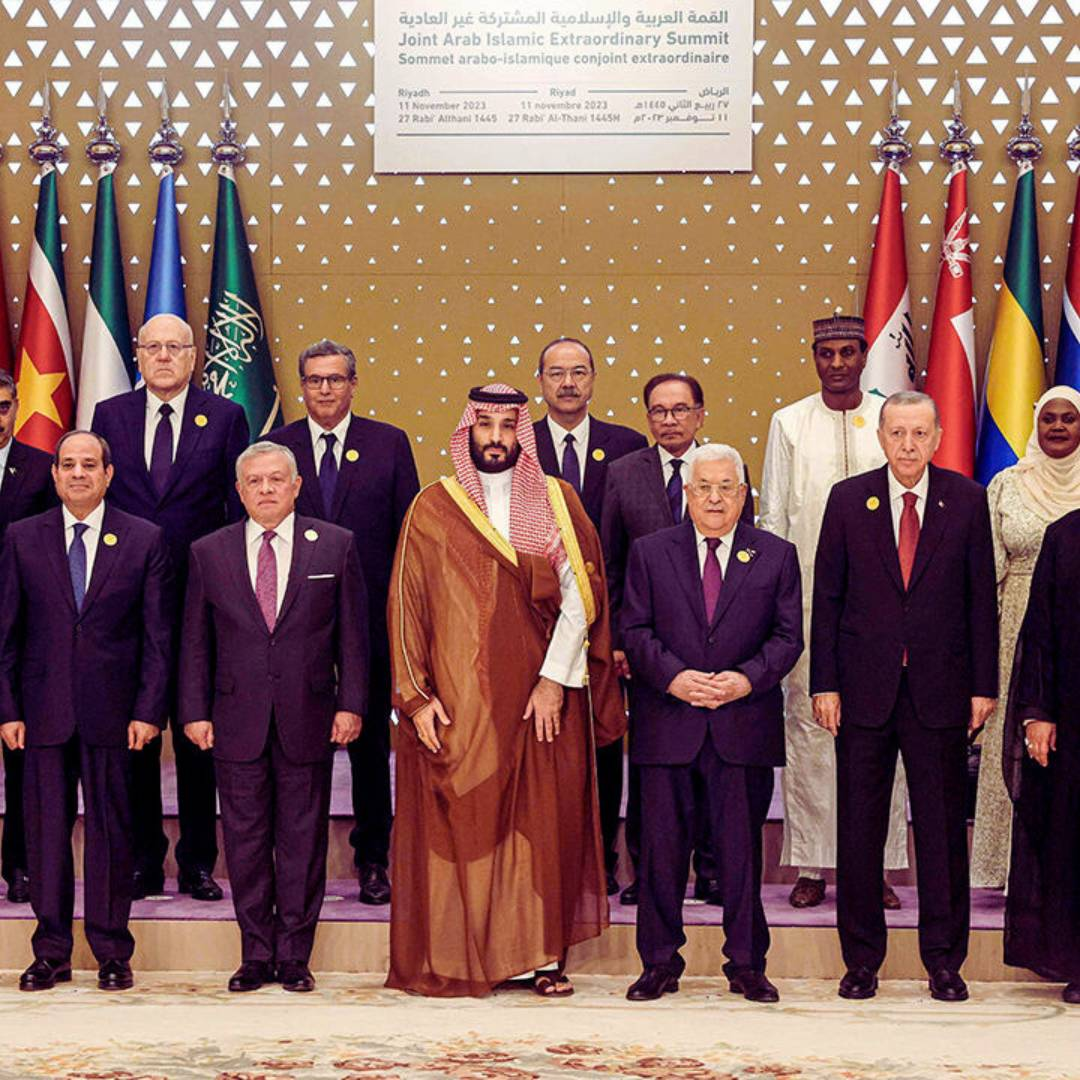
Leaders attend the Joint Arab Islamic Extraordinary Summit in Riyadh on November 11, 2023, to discuss regional issues.
Trump’s Peace Through Strength Strategy
President Trump’s return to office brings renewed focus on expanding the Abraham Accords through his signature “peace through strength” approach. This strategy, which emphasizes military preparedness as the foundation for diplomatic success, has already yielded significant results in the recent Israel-Iran conflict.
The administration’s approach recognizes that sustainable peace requires both the capability to deter aggression and the diplomatic skill to capitalize on military success. The recent demonstration of Israeli military superiority, supported by American technology and intelligence, has created conditions for expanded normalization that diplomacy alone could not achieve.
Economic Integration and Knowledge Economy Competition
The transformation of regional dynamics is fundamentally driven by competition for participation in the global knowledge economy. Traditional resource-based economies increasingly recognize that sustainable prosperity requires technological innovation, human capital development, and integration into global value chains.
Israel’s advanced technology sector, combined with Gulf capital and regional market access, creates powerful synergies for economic cooperation. The UAE’s success in attracting international businesses and talent demonstrates the potential for Middle Eastern economic hubs to compete globally. Syria’s economic revival plans explicitly reference this model, recognizing that reconstruction requires modern economic institutions capable of international competition.
Future Prospects and Challenges
Despite favorable trends, significant obstacles remain to broader regional normalization. Popular opinion in many Arab countries continues to oppose normalization with Israel, creating domestic political constraints for leaders considering diplomatic engagement. The ongoing humanitarian crisis in Gaza and continued settlement expansion in the West Bank provide rallying points for opposition to normalization.
Iranian influence, though diminished, has not been entirely eliminated. Tehran retains capabilities to disrupt normalization efforts through remaining proxy networks and asymmetric tactics. The success of broader peace initiatives will depend partly on continued containment of Iranian destabilizing activities.
Conclusion: The Dawn of Regional Renaissance
The collapse of Iranian hegemonic ambitions has created unprecedented opportunities for Middle Eastern transformation, validating the ancient wisdom that “Si vis pacem, para bellum” – those who prepare for war often achieve peace. Israel’s decisive military action has not merely prevented a nuclear catastrophe but has opened pathways to regional prosperity and cooperation that were previously unimaginable.
The expansion of the Abraham Accords represents more than diplomatic normalization; it embodies a fundamental shift toward pragmatic, interest-based regional relationships focused on economic cooperation and shared prosperity. President Trump’s proven track record on Middle Eastern diplomacy and commitment to peace through strength provides the leadership necessary to capitalize on these favorable conditions.
The ancient Roman understanding that peace requires preparation for war has found modern vindication in the Middle East. The demonstration of overwhelming strength has paradoxically created conditions for sustainable peace, offering regional leaders a historic opportunity to build a more stable, prosperous, and peaceful Middle East for future generations.