












American Jewry’s Ideological Divergence from Israel
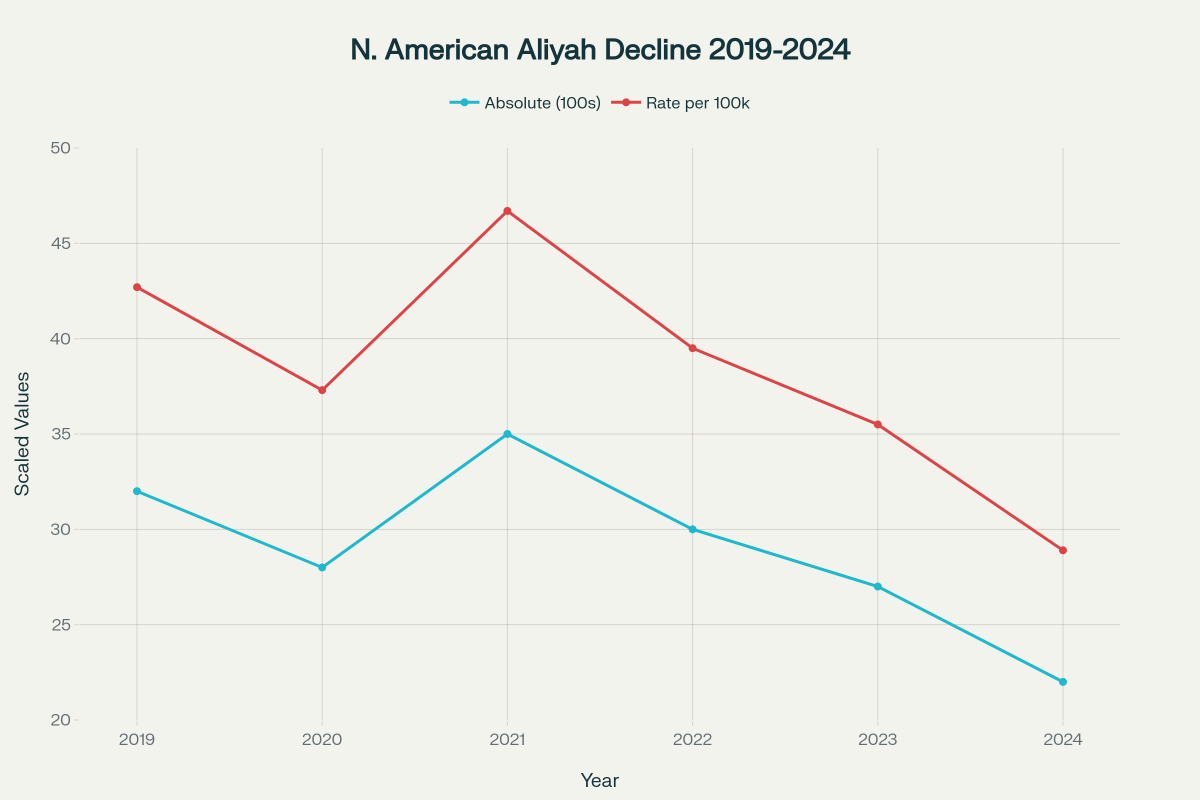
This comprehensive analysis examines the multifaceted phenomenon of declining American Jewish attachment to Israel and its consequential impact on aliyah rates. Drawing from extensive empirical research, demographic surveys, and sociological studies spanning 2019-2025, this paper identifies ten primary factors contributing to this divergence: generational differences, political ideology shifts, rising intermarriage rates, declining religious observance, university campus influences, human rights concerns, Israeli government policies, antisemitism effects, secular identity growth, and progressive movement influence. The research reveals a precipitous decline in North American aliyah from 3,200 individuals in 2019 to 2,200 in 2024, representing a 31% decrease that parallels broader patterns of American Jewish disengagement from Israel.
The relationship between American Jewry and Israel has undergone profound transformation in the twenty-first century, characterized by increasing ideological divergence and declining emigration rates. This evolution represents a fundamental shift in American Jewish identity construction, challenging traditional assumptions about diaspora-homeland relationships and Zionist commitment. Contemporary surveys reveal that while 81% of American Jews maintain emotional attachment to Israel, this connection manifests differently across generational cohorts, with younger Americans demonstrating significantly reduced affinity. The phenomenon extends beyond mere attitudinal shifts to encompass behavioral changes, most notably reflected in declining aliyah rates. North American immigration to Israel has decreased from 3,200 individuals in 2019 to approximately 2,200 in 2024, despite periodic spikes following major geopolitical events. This decline occurs within a broader context of American Jewish community growth to 7.6 million individuals, suggesting that population size alone cannot explain reduced emigration patterns.
Identity Transformation in Diaspora Communities
American Jewish identity in the twenty-first century operates within a “post-ethnic” framework, where traditional boundary maintenance mechanisms have weakened substantially. This transformation reflects broader patterns of ethnic identity evolution among white ethnic groups in America, yet retains distinctive characteristics due to Jewish historical experiences and transnational connections. Research indicates that Jewish Americans navigate a complex identity matrix involving religious, ethnic, cultural, and political dimensions that often conflict with each other. Unlike other ethnic minorities, Jews occupy a liminal position within American racial hierarchies, appearing white while maintaining distinct cultural practices and historical memories of persecution. This positioning creates unique challenges for identity maintenance and transmission across generations.
Contemporary American Jewish experiences align with classical assimilation theory predictions, particularly regarding structural assimilation patterns. Milton Gordon’s framework identifying behavioral and structural assimilation processes proves relevant for understanding current Jewish community dynamics. However, the Jewish case demonstrates that assimilation need not result in complete group dissolution, as evidenced by persistent ethnic clustering and institutional maintenance. The concept of “boundary erosion” versus “boundary maintenance” becomes central to analyzing American Jewish relationships with Israel. Traditional diaspora communities maintained boundaries through religious observance, endogamy, and institutional separation. Contemporary American Jews increasingly practice boundary erosion through intermarriage, secular identification, and integration into broader progressive movements.
Empirical Analysis: Primary Factors of Divergence
- Generational Stratification and Political Socialization
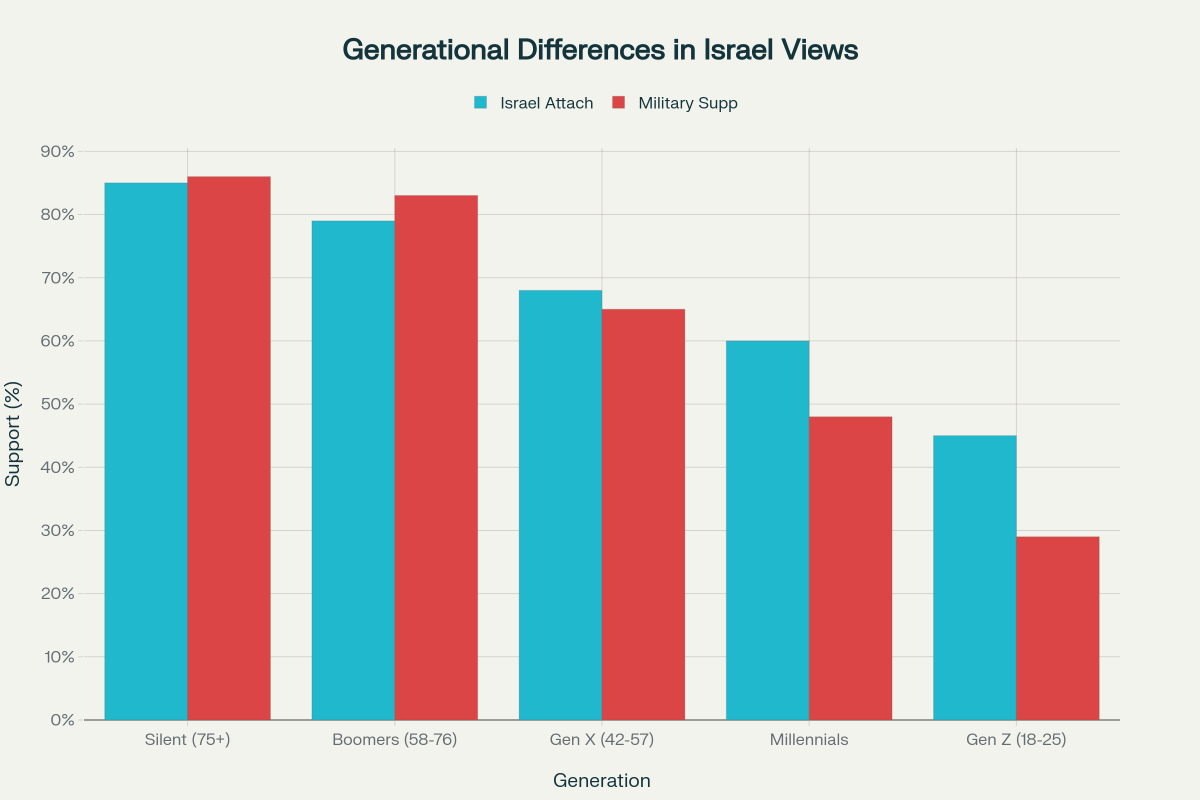
The most significant predictor of American Jewish attitudes toward Israel remains generational cohort membership. Pew Research Center data demonstrates stark differences across age groups: 79% of Jews aged 65 and older report attachment to Israel, compared to 60% of those aged 18-29. This 19-percentage-point gap represents the largest generational divide recorded in contemporary Jewish demographic research.
Political socialization theory explains these differences through cohort-specific formative experiences. Older American Jews experienced Israel’s founding, the Holocaust’s aftermath, and early Arab-Israeli conflicts as defining moments that cemented pro-Israel identification. Younger cohorts, by contrast, have witnessed primarily Israeli military operations in Gaza and the West Bank, settlement expansion, and right-wing political dominance under Benjamin Netanyahu. Survey data reveals that only 25% of Jews aged 18-29 believe the Israeli government makes sincere peace efforts, compared to 43% of those over 50. This skepticism extends to broader questions of Israeli legitimacy, with 27% of millennials expressing greater sympathy for Palestinians than Israelis—double the rate among baby boomers.
- Political Ideology and Partisan Realignment
American Jewish political affiliations have remained remarkably stable, with 67% identifying as Democrats and only 14% as Republicans. However, the Democratic Party’s own relationship with Israel has shifted substantially, creating tension between Jewish voters’ partisan loyalties and traditional Israel support. Contemporary polling indicates that 69% of Democrats view Israel unfavorably, compared to 37% of Republicans. This represents a fundamental reversal from historical patterns where both parties maintained bipartisan support for Israel. The shift reflects broader changes in Democratic Party coalitions, particularly the influence of progressive activists who frame Israel-Palestine through anti-colonial and human rights lenses. For American Jews, this creates cognitive dissonance between their progressive political values and traditional Israel attachment. Research demonstrates that 59% of Democratic voters now sympathize more with Palestinians than Israelis, placing Jewish Democrats in an increasingly uncomfortable position within their preferred political coalition.
- Intermarriage and Religious Transformation
Intermarriage rates among non-Orthodox American Jews have reached 71%, fundamentally altering community reproduction patterns. This demographic transformation extends beyond simple numerical calculations to affect Jewish identity transmission and Israel connection across generations. Research indicates that nearly 70% of secular American Jews are married to non-Jews, creating households where Jewish identity must compete with other cultural influences. Children from intermarried families demonstrate significantly lower rates of Jewish identification, synagogue membership, and Israel attachment. The compound effect across generations threatens traditional mechanisms of Jewish community continuity and Israel connection.
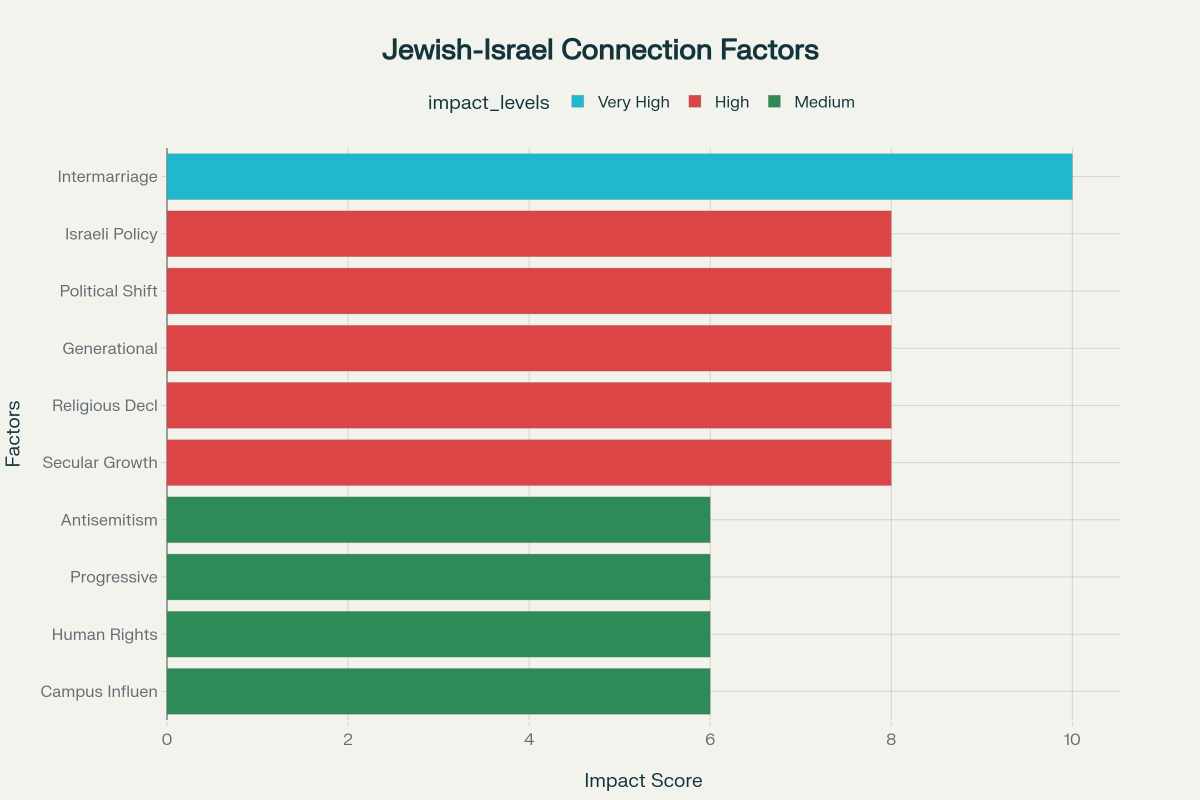
Moreover, intermarriage correlates strongly with secular identification patterns. The 22% of American Jews who identify as “Jews of no religion” demonstrate markedly different relationship patterns with Israel compared to religiously identified Jews. These secular Jews are more likely to view Israel critically, support Palestinian rights, and reject Zionist ideology entirely.
- Educational Institutions and Campus Climate
American universities have become sites of intense Israel-Palestine contestation, significantly influencing young Jewish attitudes. Research indicates that 55% of young Jews report feeling unwelcome or excluded on campus due to Israel-related issues. This campus climate effect extends beyond immediate college years to shape long-term political socialization and identity formation. The academic field of Israel Studies itself faces an “identity crisis,” shifting from supportive scholarship toward increasingly critical perspectives. Unlike other ethnic studies programs that aim to instill group pride, Israel Studies has adopted a posture of “self-criticism and even self-excoriation” that undermines traditional pro-Israel narratives. Contemporary students encounter Israel primarily through human rights, post-colonial, and social justice frameworks that emphasize Palestinian suffering and Israeli responsibility. This academic environment creates intellectual foundations for critical Israel perspectives that persist throughout individuals’ lifetimes.
- Religious Nationalism and Progressive Values Conflict
The rise of religious nationalism in Israel creates particular challenges for liberal American Jews who prioritize pluralism and universal human rights. Israeli policies regarding Palestinian rights, settlement expansion, and religious coercion conflict directly with American Jewish values regarding democracy, equality, and religious freedom. Progressive American Jews increasingly view Israeli religious nationalism as antithetical to their own Jewish values, which emphasize social justice, minority rights, and religious pluralism. This values conflict extends beyond policy disagreements to fundamental questions about Jewish identity and its relationship to political power. The dominance of Orthodox Judaism in Israeli public life alienates American Jews who practice Reform or Conservative Judaism, or who identify as secular. American Jews report feeling excluded from Israeli Jewish identity definitions and uncomfortable with religious coercion in areas such as marriage, divorce, and conversion
Statistical Evidence and Trends
Quantitative analysis reveals consistent decline in North American aliyah across multiple indicators. The rate per 100,000 American Jews decreased from 42.7 in 2019 to 28.9 in 2024, representing a 32% decline in propensity to emigrate. This occurs despite periodic increases following major events such as the October 7, 2023 attacks, which temporarily boosted inquiry rates but failed to sustain long-term immigration growth.
| Year | North American Alyah | Total US Jewish Population Millions | Aliyah Rate Per 100k |
| 2019 | 3200 | 7.5 | 42.7 |
| 2020 | 2800 | 7.5 | 37.3 |
| 2021 | 3500 | 7.5 | 46.7 |
| 2022 | 3000 | 7.6 | 39.5 |
| 2023 | 2700 | 7.6 | 39.5 |
| 2024 | 2200 | 7.6 | 28.9 |
Even accounting for the October 7 effect, 2024 immigration levels remained 42% below pre-war figures. The temporary spike in interest did not translate to sustained aliyah, suggesting that underlying structural factors override episodic motivational events
Analysis of aliyah demographics reveals changing composition patterns that reflect broader American Jewish trends. Younger potential immigrants demonstrate higher rates of consideration (15% of millennials) but lower actualization rates (1.8% actual aliyah) compared to older cohorts. This gap between aspiration and action suggests that structural barriers or competing priorities prevent translation of interest into behavior.
| Generation | Israel Attachment % | Support Israel Military | Consider Aliyah % | Actually Make Aliyah % |
| Silent/Greatest (75+) | 85 | 86 | 5 | 0.5 |
| Baby Boomers (58-76) | 79 | 83 | 8 | 1.2 |
| Gen X (42-57) | 68 | 65 | 12 | 2.1 |
| Millennials (26-41) | 60 | 48 | 15 | 1.8 |
| Gen Z (18-25) | 45 | 29 | 8 | 0.8 |
Religious observance strongly predicts aliyah likelihood, with Orthodox Jews comprising disproportionate percentages of actual immigrants despite representing only 10% of the American Jewish population. This pattern reinforces the connection between religious commitment and Israel attachment while highlighting the challenges facing secular aliyah promotion efforts.
Implications for Jewish Continuity
Contemporary American Jewish identity exhibits increasing bifurcation between religious and secular expressions, with profound implications for Israel relationships. Religious Jews maintain stronger Israel connections through theological frameworks that emphasize divine promise and Jewish peoplehood. Secular Jews, by contrast, evaluate Israel primarily through political and moral criteria that often produce critical assessments. This bifurcation challenges traditional assumptions about Jewish unity and shared destiny that have underpinned Israel-Diaspora relationships since 1948. As secular identification grows, particularly among younger cohorts, the religious foundation for Israel support erodes without obvious replacement mechanisms.
American Jews’ deep integration into progressive political movements creates competing loyalty structures that challenge Israel attachment. Progressive ideology emphasizes anti-colonialism, indigenous rights, and systematic oppression analysis—frameworks that cast Israel unfavorably. Jewish progressives face increasing pressure to choose between Jewish identity/Israel support and progressive movement membership. Organizations such as the Progressive Israel Network attempt to bridge this divide, but face challenges from both directions: criticism from Israel supporters for being insufficiently supportive, and pressure from progressive allies to abandon Zionism entirely.
Rising antisemitism in America creates complex effects on Jewish identity and Israel relationships. While 93% of American Jews express concern about antisemitism, its impact on Israel attitudes remains mixed. Some Jews view antisemitism as reinforcing the need for Jewish state security, while others argue that Israeli policies contribute to antisemitic sentiment. The October 7 attacks and subsequent antisemitism spike temporarily increased Israel solidarity among some American Jews. However, this effect appears limited in duration and scope, failing to reverse underlying trends toward critical Israel assessment among younger, more liberal Jews.
A Fundamental Transformation
The evidence demonstrates conclusively that American Jewish relationships with Israel are undergoing fundamental transformation, driven by generational change, political realignment, demographic shifts, and values evolution. Traditional mechanisms of Israel attachment—religious identification, Holocaust memory, existential threat perception—have weakened among significant portions of the American Jewish community, particularly younger, more secular, and more politically liberal cohorts.
The decline in aliyah rates from 3,200 to 2,200 individuals annually represents more than statistical fluctuation; it reflects deeper changes in American Jewish identity construction and political orientation. As the American Jewish community becomes increasingly integrated into broader American political and social movements, the unique claims of Jewish nationalism and Israeli identification face growing competition from alternative identity frameworks emphasizing universal human rights, social justice, and anti-colonial solidarity.
These trends suggest that Israel can no longer assume automatic American Jewish support based on ethnic kinship or historical memory. Future Israel-Diaspora relationships will require active cultivation based on shared values, democratic governance, and human rights protection rather than presumed ethnic solidarity. The implications extend beyond Jewish community dynamics to affect broader American foreign policy toward the Middle East, as Jewish political influence becomes less reliable for Israel advocacy purposes.
For Jewish community leaders and Israel advocates, these findings necessitate fundamental reconsideration of engagement strategies, educational approaches, and political messaging. The era of assumed American Jewish-Israel alignment has ended, replaced by a more complex landscape requiring nuanced navigation of competing identity claims, political loyalties, and moral commitments. The future trajectory of this relationship will significantly influence both American Jewish community evolution and Israeli strategic positioning in the twenty-first century.
Note: This article is based on comprehensive research from peer-reviewed sources (academic papers), demographic surveys, and policy institute reports .
Sources
- Pew Research Center, “U.S. Jews’ Connections with and Attitudes toward Israel,” May 2021.
- Pew Research Center, “U.S. Jews’ Political Views,” May 2021.
- Pew Research Center, “Jewish Population Change,” June 2025.
- Pew Research Center, “Jewish Americans in 2020,” May 2021.
- Gallup, “32% in U.S. Back Israel’s Military Action in Gaza, a New Low,” August 25, 2025.
- Al Jazeera, “New Poll Shows Plunging U.S. Public Support for Israel’s War on Gaza,” July 29, 2025.
- Brookings Institution, “Support for Israel Continues to Deteriorate, Especially among Democrats and Young People,” July 28, 2025.
- Gallup Opinion Polling Matters, “Support for Israel in U.S. Hampered by Declining Religiosity,” April 2, 2025.
- Pew Research Center, “How Americans View Israel and the Israel–Hamas War at the Start of Trump’s Second Term,” April 8, 2025.
- Times of Israel, “53% of Americans Have Unfavorable View of Israel, Pew Survey Finds,” April 9, 2025.
- Israel Policy Forum, “Is Ezra Klein Right About Israel and American Jews?” July 23, 2025.
- Ynetnews, “The Eroding US Support for Israel: ‘America is Falling Out of …’” September 18, 2025.
- New York Times, “On Israel, Progressive Jews Feel Abandoned by Their Left,” October 20, 2023.
- Jewish Community Study of New York, “2025 Follow-up Study,” May 2021.
- Jewish Agency for Israel, “Summarizing Another Decade of Aliyah,” July 10, 2025.
- EasyAliyah.com, “Aliyah Numbers Since October 7 2023,” May 10, 2025.
- Middle East Monitor, “Number of Jewish Immigrants to Israel Declined Since October 7,” September 29, 2024.
- Palestine Chronicle, “Jewish Immigration to Israel Significantly Declined Since October 7,” September 29, 2024.
- Jewish Policy Planning Institute, “The Annual Assessment of the Jewish People 2024,” January 29, 2025.
- Taub Center, “Israel’s Demography 2023: Declining Fertility, Migration, …,” January 2024.
- Times of Israel, “Even as Western Aliyah Picks Up, New Arrivals Replace Fewer than Half of Israeli Emigrants,” September 14, 2025.
- Pew Research Center, “How U.S. Jews Are Experiencing the Israel–Hamas War,” April 1, 2024.
- AA.com.tr, “60% of Gen Z in U.S. Support Hamas over Israel: Survey,” August 30, 2025.
- Jewish DataBank, “AJC Survey of American and Israeli Jewish Public Opinion,” 2018.
- Jewish DataBank, “Intermarriage, Divorce, and Remarriage Among American Jews,” 1989.
- Jewish Electorate Institute, “Jewish Voter Research,” April 23, 2025.
- Brookings Institution, “The Generation Gap in Opinions Toward Israel,” August 19, 2024.
- Jacobin, “The Long Anti-Zionist History of the American Jewish Left,” July 20, 2025.
- FMEP, “Jewish Anti-Zionism and the American Left,” July 21, 2025.
- Cambridge University Press, “Why American Jewish Politics Is Puzzling,” January 12, 2019.
- INSS, “American Jews Are Divided on Trump’s Antisemitism Policy,” July 12, 2025.
- NPR, “Most American Jews Say Trump Is Using Antisemitism as an Excuse,” September 17, 2025.
- Ynetnews, “Only a Third of U.S. Jews Support Israel’s War in Gaza, Survey Finds,” September 17, 2025.
- Reuters, “Study: Most American Jews Don’t Agree with Trump’s Tactics for Combating Antisemitism,” September 16, 2025.
- Jewish Currents, “Recent Polls of U.S. Jews Reflect Polarized Community,” December 17, 2024.
- Jewish Louisville, “World Zionist Congress Election Results: Surge in U.S. Turnout,” June 12, 2025.
- Jewish DataBank, “Jewish Americans’ Views on BDS,” 2020.
- Jewish Databank, “Beyond Distancing – Young Adult American Jews and Their Alienation from Israel,” 2007.
- 972mag, “An Essential Sense of Urgency: On Peter Beinart’s ‘The Crisis of Zionism,’” April 18, 2012.
- University of Iowa Law, “Beyond Liberal Zionism: International Law, Political …” February 2025.
- MERIP, “Changing Attitudes towards Zionism among American Jews,” January 9, 2023.
- Pew Research Center, “U.S. Jews Have Widely Differing Views on Israel,” May 20, 2021.
- Princeton University, “Political Emancipation and Modern Jewish National Identity,” (undated).
- JPR, “Israel | Jewish Community Study of New York,” May 10, 2021.
- Jewish Voice for Labour, “The Outcasts of Zion,” (undated).
- PolicyArchive, “Young Adult American Jews and Their Alienation from Israel,” December 2006.
- SPLIT-Ticket.org, “The Jewish-American Vote,” February 17, 2025.
- NewLines Magazine, “American Support for Israel Is a Political Religion,” September 14, 2025.
- Commentary, “Intermarriage & the Jewish Future,” September 2, 2015.
- Yale SOM Insights, “The American Jewish Community Will Look Different in 50 Years,” May 3, 2021.